Pezeshkian at the UNGA: defiance on offer, the negotiating surface unchanged
Iran's president used his UN General Assembly address to reject Trump's framing of Iran as a terrorist state and to insist that sanctions and threats will not bring Tehran to heel. The speech offered talks while drawing a red line at capitulation; what the text did not say matters as much as what it did.
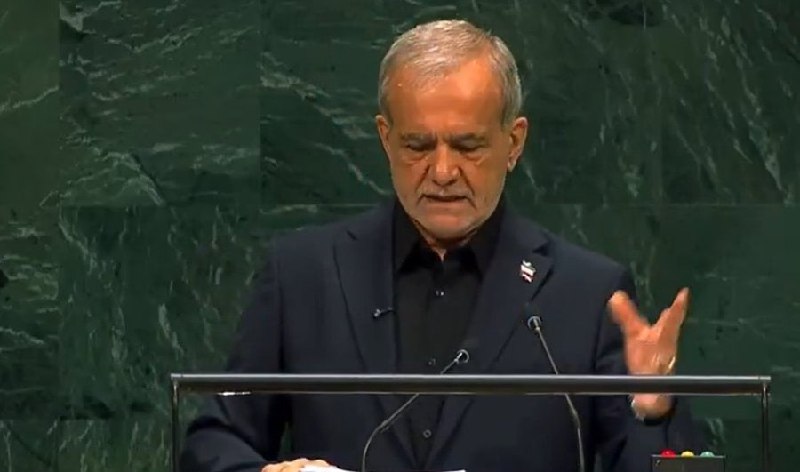
At 14:14 UTC on 23 September 2026, a Telegram post from Clash Report carried the opening lines of Iranian President Masoud Pezeshkian's address to the United Nations General Assembly: "Yesterday, Trump described us as terrorists. We have been the victims of terrorism. I come from an Iran in which our esteemed Supreme Leader was assassinated without…", followed by the line, "A school was bombed, and children who were the flowers of this land died. They were innocent and had committed no crimes" (https://t.me/ClashReport/97948). The text that follows in the available source items runs roughly twenty minutes, until about 14:36 UTC, when Pezeshkian's appeal to the chamber closes with the line that several Iran-watcher channels carried as the speech's headline: "Iran extends her hand towards the world. We invite the world, we call the world, not out of weakness, but out of a deep belief in our own power and steadfastness" (https://t.me/ClashReport/97963).
Between those bookends, Pezeshkian delivered a posture statement, not a negotiation. He rejected Trump's verbal escalation, rejected the legitimacy of the sanctions regime that travels with it, and drew a red line at the word "capitulation." Monexus reads the speech as calibrated to satisfy a domestic Iranian audience that has watched the regime absorb a year of pressure, while leaving enough rhetorical room for European and Gulf interlocutors to keep diplomatic channels technically alive.
What the address actually said
The substantive content of the speech, as relayed by Telegram channels covering it in real time, runs along three tracks, each aimed at a different audience.
The first track was for Washington. Pezeshkian framed maximum pressure as a tactical error: "US president should know that threats against our nation only make us more united, stronger, and more determined in our resistance" (https://t.me/FotrosResistancee/23937). In the same register, he accused the United States of being "the creators of instability" in a passage that placed Washington on the wrong side of the chamber's stated preference for multilateral principle (https://t.me/wfwitness/112656).
The second track was for the General Assembly itself. Pezeshkian's peroration argued that the international order should resist a return to great-power coercion: "We must not allow the 21st century to become an era of returning to the politics of force and the rule of the powerful. We must not build a world in which military [power]…" (https://t.me/FotrosResistancee/23936). The pitch is the one Iran's reformist camp has run since the Rouhani era: a defensive posture, dressed in the vocabulary of multilateral principle, that the chamber can endorse without binding Tehran to anything concrete.
The third track was the Israeli-Palestinian file, where the language was sharpest. Pezeshkian said "Israel targets any neighborhood in any city in any province, commits assassinations like a true terrorist," and cited a figure of "over 80,000 innocent civilians" killed since the start of the Gaza war (https://t.me/ClashReport/97952). On Gaza itself, he argued that "Gaza, despite relentless killing and widespread devastation, has strengthened the people's faith in resistance and resistance cannot be destroyed" (https://t.me/wfwitness/112662). The 80,000 figure sits at the high end of estimates circulating in non-Western media; the available source items do not show it cross-checked against wire-service counts, and readers should weigh the number as the Iranian framing of a contested statistic rather than as a verified total.
What the address offered, and what it refused
The speech is a managed opening, not a position paper. Pezeshkian's invitation is unambiguous: "We seek cooperation in order to have security" (https://t.me/wfwitness/112660), a formulation that telegraphs willingness to talk without naming a counterpart or a venue. The historical caveat travels with the invitation. "For the past two centuries, Iran has not attacked any country or any territory, but we've always defended ourselves steadfastly," he said, before pivoting to a complaint that Iran was now being accused of a posture it does not hold (https://t.me/ClashReport/97954).
The refusal is in the same paragraph as the offer. The line that anchored the day's coverage on Telegram's Iran-watcher channels was the one Insider Paper ran as its lead: that Trump "must know" Iran "will never 'bend at the knee'" (https://t.me/insiderpaper/44761). On war itself, Pezeshkian's framing was deliberately broad: "If a human being is driven from his or her land, they will resist. If their homes are subjected to bombings and aggression and attacks, they will resist," a passage that doubles as a justification of Iran's regional posture without naming any specific armed actor (https://t.me/wfwitness/112664).
Monexus assessment: the pairing of invitation and refusal is the speech's structural signature. It keeps the diplomatic channel formally alive while foreclosing the specific concession the United States has spent the year demanding. The speech is not, on its face, a pivot toward talks; it is a refusal to be blamed for the absence of talks.
What the speech did not say
Diplomatic readers parse these texts for the gaps. Three omissions in Pezeshkian's text, as relayed in the available source items, are worth flagging.
First, the available text contains no direct reference to the nuclear file. The Telegram posts covering the address do not record Pezeshkian addressing the JCPOA, the IAEA inspection question, or the sanctions snapback mechanism that European governments have been discussing in the background. Monexus assessment: this silence does not settle the nuclear-file question; it leaves Tehran's position unmade on the floor of the chamber.
Second, the speech contains no concession on missile range or on regional armed coordination. Pezeshkian defended resistance as a category; he did not address the specific demands that European and US interlocutors are widely understood to have tabled in prior rounds. The available source items do not specify what those demands are.
Third, the speech does not engage with the hostage file. No American, European, or dual-national detainee is named in the relayed text, and the framing of terrorism-as-victimhood closes the rhetorical space in which a confidence-building gesture on detainees would normally sit. Whether this silence reflects a tactical choice by the Iranian delegation or a selective relay by the channels that covered the address, the available source items do not specify.
The structural frame, in plain prose
The speech sits inside a wider realignment of the post-2015 sanctions architecture. The Joint Comprehensive Plan of Action, signed in 2015 and effectively abandoned by the United States in 2018, has been the technical anchor for European-Iranian engagement ever since; the available source items do not record Pezeshkian addressing it. Monexus assessment: the omission is not accidental. A speech that defended the JCPOA would invite a debate Tehran has spent a year refusing to have; a speech that attacked it would foreclose the European channel. Pezeshkian's choice to keep the JCPOA off the floor is the diplomatic equivalent of the speech's invitation-and-refusal structure: enough silence to keep everyone in the room, enough defiance to keep the domestic base onside.
The wider pattern is a familiar one. Iran at the UNGA routinely pairs a multilateral-rights pitch with a refusal to negotiate under duress; the United States, under successive administrations, has routinely demanded that Iran negotiate under exactly that duress. The two postures are mutually reinforcing. Neither side appears, on the available evidence, to have moved in this address.
Caveats and what to watch
Every quotation above is drawn from Telegram channels reporting on Pezeshkian's address in real time. The available source items do not specify whether the Iranian mission distributed a verified English text, and the wording should be treated as best-available relay rather than as a checked transcript.
Two things to watch in the days that follow. First, whether European governments, in their own UNGA interventions, treat Pezeshkian's silence on the JCPOA as a negotiating opening or as a confirmation that the multilateral channel is closed for the autumn. Second, whether the 80,000 Gaza figure cited in the speech is picked up by wire services, or whether it stays inside the Iran-aligned channel ecosystem in which it originated. The answer to each will tell readers whether Pezeshkian's speech moved the diplomatic surface, or only restated where it had already settled.
How Monexus framed this versus the wire: Western wires lead on the Trump-Pezeshkian clash and on the regional reactions; this piece foregrounded the speech's invitation-and-refusal structure, treated the omissions as the analytically interesting material, and flagged the 80,000 Gaza casualty figure as Iranian-framed rather than as established consensus.
Wire provenance
This editorial synthesis draws on the following public wire/social posts:
- https://t.me/ClashReport/97948
- https://t.me/FotrosResistancee/23937
- https://t.me/FotrosResistancee/23936
- https://t.me/ClashReport/97963
- https://t.me/wfwitness/112660
- https://t.me/ClashReport/97954
- https://t.me/wfwitness/112656
- https://t.me/ClashReport/97952
- https://t.me/wfwitness/112662
- https://t.me/wfwitness/112664
- https://t.me/insiderpaper/44761
- https://t.me/ClashReport/97948
- https://t.me/FotrosResistancee/23937
- https://t.me/FotrosResistancee/23936
- https://t.me/ClashReport/97963
- https://t.me/wfwitness/112660
- https://t.me/ClashReport/97954
- https://t.me/wfwitness/112656
- https://t.me/ClashReport/97952
- https://t.me/wfwitness/112662
- https://t.me/wfwitness/112664
- https://t.me/insiderpaper/44761