Israeli strikes on Tyre district compound a southern Lebanon campaign that has no announced endpoint
Israeli drones and aircraft struck Burj al-Shamali and the vicinity of al-Mansouri in the Tyre district between 21:58 and 23:01 UTC on 5 August 2026, while artillery fired on adjacent areas, underscoring how routine southern Lebanon has become to a campaign whose political ceiling remains undefined.
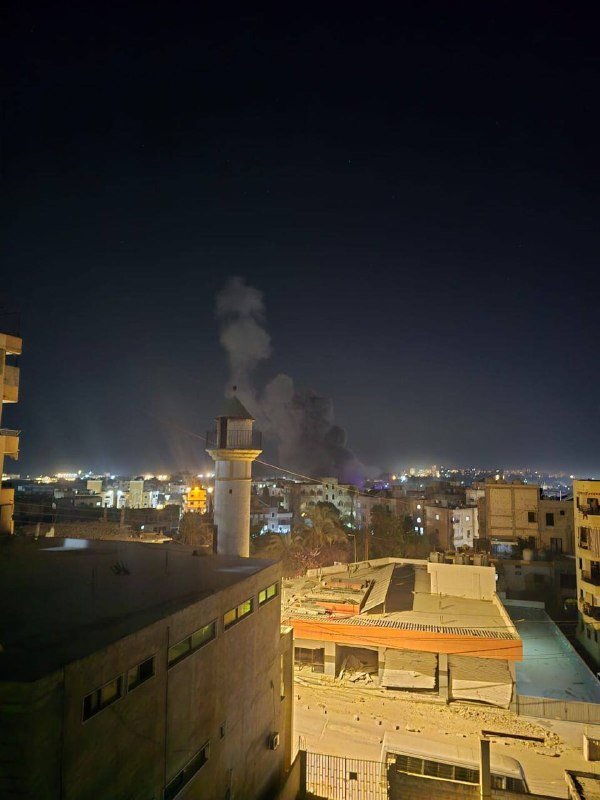
Israeli drones struck the town of Burj al-Shamali in southern Lebanon's Tyre district in three successive waves between 21:58 and 23:01 UTC on 5 August 2026, with warplanes following up and ambulance and civil defence units evacuating casualties from the site, according to Lebanese sources cited by Al-Alam Arabic. Artillery fire was reported on adjacent areas during the same window, painting a picture of a coordinated, multi-axis evening operation rather than a single pinpoint raid.
What is striking is not the size of any one strike but the rhythm. Within roughly an hour, the same district absorbed three drone waves on Burj al-Shamali, two fixed-wing raids on the vicinity of al-Mansouri, and reported artillery pressure on surrounding terrain. Monexus assessment: that tempo, repeated across the border in recent weeks, reads less like a campaign of retaliation for a single incident than a standing posture. It is a posture without an announced endpoint in the cited material, and that absence is the story.
The evening's geometry
Lebanese-source reporting to Al-Alam Arabic places the first Israeli warplane raid on the vicinity of al-Mansouri at 21:58 UTC on 5 August, followed by an aircraft raid on Burj al-Shamali at 22:34 UTC. By 22:42 UTC, Iranian state outlet Tasnim reported that Israeli warplanes had bombed both al-Mansouri and Burj al-Shamali while Israeli artillery shelled nearby areas, and that Israeli drone activity had come in three successive batches. Eleven minutes later, at 22:53 UTC, Lebanese sources told Al-Alam that the three drone waves had targeted the Burj al-Shamali area in the Tyre district. By 23:01 UTC, ambulance and civil defence units were evacuating casualties from the strike site.
The geographic compression matters. Burj al-Shamali and al-Mansouri both sit in the Tyre district of southern Lebanon, and the cited reporting places Israeli air and artillery action across both within the same hour. That operational signature points to a force shaping a battlespace rather than punishing an isolated target. The available source items do not specify casualty figures, the military infrastructure hit, or whether the strikes preceded, followed, or overlapped with rocket or drone launches from Lebanese territory.
Where the wire coverage diverges
Western wire reporting on the 5 August strikes was not present in the source material available for this article. What we have instead is a near-uniform reporting chain built from one Lebanese-source feed carried by Al-Alam Arabic and one Iranian-state mirror in English carried by Tasnim, with a parallel Farsi version carried by Tasnim's main channel. The three tell a largely consistent story: multiple Israeli airstrikes on the Tyre district, artillery in support, casualties evacuated. But the framing differs in ways that matter.
Al-Alam Arabic, citing Lebanese sources, uses the language routinely applied by Hezbollah-aligned media to Israeli military action, calling the aircraft and drones the "occupation" force and describing the strikes as "raids." Tasnim, in English, uses the more pointed term "Zionist regime" and frames the action as "bombardment" of populated areas. Neither outlet attributes the strikes to a specific Israeli operation name, a brigade, or a stated military objective. The available source items do not include a same-hour readout from the Israeli military spokesperson's office naming the target or the justification; readers looking for an Israeli-side framing will not find one in this thread.
For a reader trying to establish what happened, the practical lesson is that the operational details arrive through relays, while the political framing arrives pre-set. Each relay inherits its source's editorial posture.
The structural frame, in plain language
Southern Lebanon has been a recurring theatre of Israeli military action since the early 1980s, and the current phase sits inside that longer pattern. What the 5 August sequence illustrates, Monexus assessment, is the steady normalisation of multi-axis strikes on population centres near the border: airstrikes plus drones plus artillery, sometimes in combination, on towns rather than isolated forward positions. Israeli security concerns, including rocket and drone launches from Lebanese territory into Israeli population centres, are a recurring stated concern and the human weight on the Israeli side of the border deserves the same seriousness. The structural question is whether sustained bombardment of border towns on a near-daily tempo, without an announced political objective in the cited material, narrows or widens the circle of actors who can fire across the line. The historical record across multiple Israeli operations in Lebanon is, on the reading of this publication, mixed: launch capacity tends to fall temporarily under sustained pressure, while political cost tends to rise on both sides as the operation lengthens.
Two caveats sit on top of that frame. First, the cited source items do not specify the operational tempo of recent weeks; the "near-daily" reading is this publication's pattern-match, not a count drawn from these posts. Second, the thread contains no information about reconstruction damage, health-system capacity, Lebanese air-defence capability, or the domestic Lebanese political consensus on border negotiations. Those are structural questions worth flagging; they are not findings of this article.
Stakes and what to watch next
The near-term stakes are concrete and local. Ambulance and civil defence units were evacuating casualties from Burj al-Shamali by 23:01 UTC on 5 August; the available source items do not specify casualty counts, hospital load, or damage assessments beyond that single evacuation note. The medium-term stakes are regional. A campaign that hits the same district three times in roughly an hour, without an Israeli readout naming the target or the political objective in the cited material, leaves Lebanese state actors with a narrow set of choices and gives armed non-state actors along the border a louder voice inside Lebanese politics. Whether that reading holds depends on diplomatic moves the cited thread does not address.
Two markers are worth watching. First, whether the Israeli military spokesperson's office publishes a same-day operational readout naming the specific target struck in Burj al-Shamali; without it, the reporting chain stays relay-only, and the certainty of any claim about the strike's purpose stays low. Second, whether the Lebanese caretaker government in Beirut issues a formal complaint through UNIFIL or the UN Security Council mechanism; the diplomatic track is the one variable outside the operational tempo that could shift the trajectory.
For now, the pattern is the story. The drones came in three waves. The artillery kept firing. The ambulances moved. And the political ceiling of the campaign remains, as the cited material has it, undefined.
Desk note: Monexus framed this piece off Lebanese-source relay coverage and Iranian-state mirroring rather than Western wire copy, because the wire had not yet posted a same-hour readout in the source material at the time of writing. The result is a heavier relay-to-reader ratio than usual, and the article marks that explicitly. Casualty figures, target identification, and reconstruction impact have been left unspecified because the cited source items do not specify them; this publication has not independently established any of them.
Wire provenance
This editorial synthesis draws on the following public wire/social posts:
- https://t.me/alalamarabic/492675
- https://t.me/alalamarabic/492678
- https://t.me/alalamarabic/492680
- https://t.me/alalamarabic/492681
- https://t.me/tasnimnews_en/29870
- https://t.me/JahanTasnim/228665