A Damascus verdict, an empty dock, and the bill for a dictator who left
A Damascus court has sentenced Bashar al-Assad to death in absentia for killings and torture during Syria's civil war. The trial is also a test of who gets to write the country's new script.
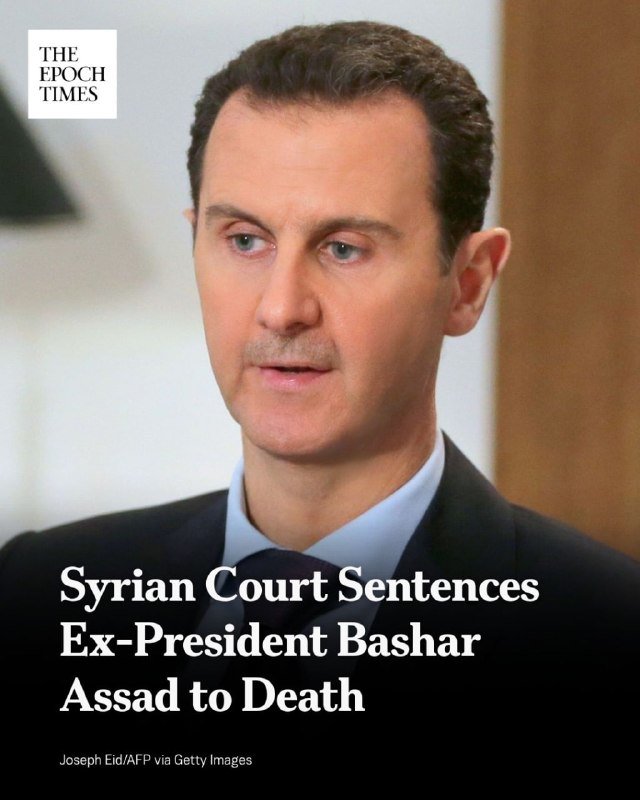
At 09:42 UTC on 11 August 2026, the BBC moved a single, blunt line across its front: ousted Syrian ruler Bashar al-Assad has been sentenced to death in absentia, convicted of war crimes and crimes against humanity committed during the country's civil war. Reuters put the wire out three minutes later, by 09:45 UTC. By 09:59 UTC, the Damascus courthouse story was already bouncing across Telegram channels. By 11:29 UTC, Middle East Eye was naming the charge sheet: premeditated murder, including of children, torture, and incitement to murder. The former president was not in the building. He has not been in Syria since late 2024, when a lightning rebel offensive drove him out.
The verdict lands at a moment when the new Syrian authorities are trying to answer a question with no clean precedent: what does accountability look like when the man on trial is sitting in Moscow, the court is sitting in Damascus, and the courtroom cameras belong to a transitional government still consolidating its own writ? Monexus reads the judgment less as a legal milestone than as a political instrument, deliberately wielded.
The charge sheet, and what's missing
Reporting from the BBC, Reuters and Middle East Eye converges on a narrow list: murders carried out with premeditation, including killings of children; torture; incitement to murder. The Jerusalem Post's Telegram wire adds the framing the court itself appears to have chosen: crimes against humanity. The BBC's coverage specifies war crimes alongside that category. None of the wire copy reviewed by Monexus lists a casualty figure, a named chemical-weapons incident, or a specific massacre by date. The available source items do not specify any such detail.
The proceedings opened inside a Syrian judicial system that was, until roughly twenty months ago, the judicial system of the defendant. The court is now staffed and directed by a transitional administration that inherited a broken institution and is using it, quickly and visibly, to draw a line between the regime that fell and the state it hopes to build. Verdict-by-verdict, the new authorities are populating a public ledger of who did what. The Assad judgment is the loudest line on that ledger so far.
Why in absentia matters
A trial the defendant does not attend is not really a trial in the adversarial sense. There is no cross-examination of the man whose decisions are at issue. There is no defence counsel testing the chain of command, the forensic evidence, the identities of the order-givers and order-followers. What there is, instead, is a one-sided record built largely from Syrian state documents that survived the regime, survivor testimony already on file, and the public infrastructure of the transitional state. Disclose TV's wire makes the absentia frame explicit.
Monexus assessment: the procedure is closer to a truth commission that issues sentences than to a common-law prosecution. That is not a criticism. It is a description. In transitional-justice practice, in absentia convictions often function as the legal counterpart to a memorial: they ratify, in the language of a court, what the society has already decided it remembers. They also make any future return by the defendant politically combustible, which is part of the point.
The Russian overhang
Assad is in Russia. The available source items do not specify any Russian statement on the verdict; that is a gap Monexus has not independently filled.
The structural read is straightforward. A death sentence issued in absentia against a head of state sheltering in a permanent Security Council member is, for now, a piece of theatre about who speaks for Syria and on whose authority. It binds the transitional government to its own narrative of rupture. It does not bind the Russian government to anything.
Who the verdict is really for
Inside Syria, the audience is not the courthouse. It is the survivor networks of Saydnaya, the families of the disappeared, the diaspora lawyers who spent a decade collecting evidence in foreign jurisdictions, and the returning refugees who need a signal that the new state is willing to use the word "crime" about its predecessor. For that audience, the charge of murder of children is not an abstraction; it is a thing people can name.
The verdict is also for a regional audience watching how post-2024 Syria will be governed. Lebanon, Jordan, Iraq and the wider Gulf are recalibrating relationships with Damascus after years of treating the country as a pariah. A visible, documented conviction of the man they all dealt with makes that recalibration easier to defend at home. So does the absence of any vengeful theatre around the sentence itself: the punishment is on paper, not on a scaffold.
What remains contested
The sources reviewed do not specify whether the court named co-accused, whether lower-level officials are being tried alongside the former president, or whether the proceedings include a reparations or victim-witness component beyond testimony. The wire coverage does not specify which Syrian judicial chamber heard the case, how the judges were appointed under the transitional framework, or whether defence counsel were appointed for the absent defendant in any meaningful sense. Those omissions will matter the moment international observers, donor governments, or Syrian civil society ask whether the new judiciary can do again tomorrow what it did today.
The deeper uncertainty is jurisdictional. A verdict in absentia produces no prisoner unless someone is willing to hand one over. It produces no closure for victims who still want a face across a courtroom. What it produces, on this evidence, is a date and a name attached to the worst of the country's recent past. That is something. It is not everything.
Desk note: Monexus framed the verdict as a transitional-justice act with political functions, not as a standalone criminal prosecution. The wire ledes emphasised the death sentence itself; the analytical interest here is the in absentia structure, the Russian overhang, and the audience inside Syria who is not in the courtroom.
Wire provenance
This editorial synthesis draws on the following public wire/social posts:
- https://www.bbc.co.uk/news/articles/ce34dkpnyg7o?at_medium=RSS&at_campaign=rss
- http://reut.rs/4z8E4aC
- https://middleeasteye.pulse.ly/gp0z1vdsr6
- https://t.me/The_Jerusalem_Post/16978
- https://t.me/disclosetv/21698