Abbas goes to tape, not to New York: the visa denial is now the speech
For a second year, Washington refused Mahmoud Abbas a visa to address the UN in person. The Palestinian president answered with a taped speech accusing Israel of a 'genocidal war' and warning that Israeli policy now threatens Palestinian 'life and existence'.
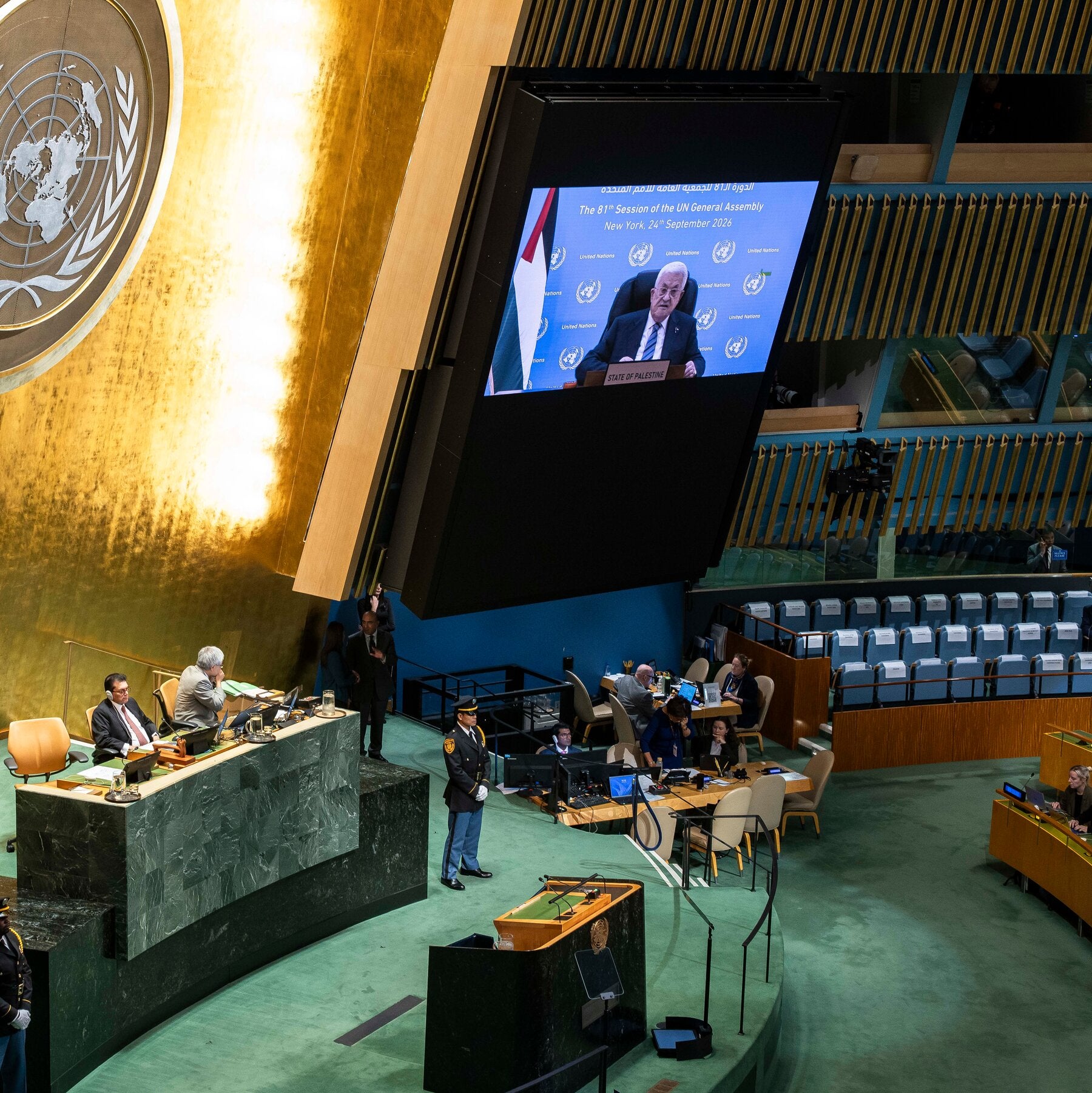
Mahmoud Abbas did not walk into the UN General Assembly hall on 24 September 2026. He sat in his office in Ramallah and let a tape do the talking, the second year running that Washington refused him and other senior Palestinian officials entry to the United States for the annual leaders' gathering (France 24, 24 Sep 2026). The format forced the optics: a Palestinian president delivering the most important foreign-policy address of his year to an empty lectern in New York, while the room listened to a recording.
The content was sharper than the setting. Abbas accused Israel of prosecuting "a genocidal war" against Palestinians and argued that Israeli policies no longer merely undermined a two-state solution but now threatened "the very life and existence" of his people (The New York Times, 24 Sep 2026; France 24, 24 Sep 2026). He renewed his call for international recognition of a Palestinian state, framed as a democratic entity living "side by side" with Israel, and urged UN member states to back self-determination for the Palestinian people (Deutsche Welle, 24 Sep 2026). It was a familiar Abbas pitch, delivered in the language of a man who no longer expects the audience to act.
The visa is the story
Strip the speech and the headline is the visa. The US decision to deny entry to Abbas and the wider Palestinian delegation is now a recurring fact of UN diplomacy, not an aberration, and it shapes what is and is not possible in the chamber. A president who cannot fly to New York cannot lobby foreign ministers in the corridors, cannot face a press gaggle on the steps, cannot trade a handshake for a paragraph in a wire report the next morning. The taped address collapses the engagement to its barest form: a video, a translation, a statement read out by a representative in his absence (France 24, 24 Sep 2026).
That is the asymmetry the framing of this week's coverage tends to obscure. Western coverage has tended to treat the visa denial as a procedural detail, an asterisk at the bottom of the story. Abbas's own address treated it as the headline: the prohibition on "our physical participation in the UN General Assembly" was item one in his enumerated list of grievances (English Abuali channel on Telegram, 24 Sep 2026). Whether or not one accepts his characterisation of Israeli policy, the procedural fact is uncontentious: the Palestinian Authority's head of state has now been barred from travelling to the body's signature event two years running.
What Abbas actually said
The substantive payload of the speech ran on two tracks. First, the diagnosis: Israeli settlement expansion, military operations in Gaza, and restrictions on Palestinian life in the occupied West Bank have, in Abbas's telling, moved past undermining a two-state solution and into a phase that puts Palestinian existence itself at risk (France 24, 24 Sep 2026; The New York Times, 24 Sep 2026). The phrase "life and existence" echoes language historically reserved for existential threats to a state. Abbas deployed it deliberately, and reporters flagged it in their lead paragraphs (France 24 takeaways segment, 24 Sep 2026).
Second, the ask: recognition. Abbas called on UN member states to support a sovereign, democratic Palestinian state coexisting with Israel, and pressed for the Palestinian Authority to be allowed to fulfil the responsibilities of statehood rather than be managed as a permanent sub-contractor of the occupation (Deutsche Welle, 24 Sep 2026). He did not lay out a negotiation roadmap. He did not name a counterpart on the Israeli side. The omission is the tell: a speech built for a recognition track, not a talks track.
The framing problem
The wire coverage across Western outlets converges on Abbas's strongest phrase and treats his argument as a routine rhetorical escalation. That is partly fair: Palestinian leaders have used existential language about the two-state project for years. But the framing flattens a structural shift. The visa denial has converted the General Assembly from a forum where Abbas can speak and be questioned into a forum where he speaks and disappears. Coverage that treats the speech as one more annual cycle misses what the format itself signals: a Palestinian leadership increasingly addressed at a distance, and increasingly willing to speak in the register of a people under threat rather than a government negotiating its future (Monexus assessment; The New York Times, 24 Sep 2026; France 24, 24 Sep 2026).
The counter-read, also worth weighing: the visa policy is defended in Washington as consistent with US law and security review, and previous Palestinian leaders have used UN platforms in ways that did not advance negotiations. From that vantage, the taped address is the predictable output of a system working as designed. The two reads do not cancel each other out; they describe a system in which the Palestinian leadership has lost the UN stage as a venue for direct engagement with the diplomats who actually matter.
What to watch
The next signal is procedural. UN member states will move on a series of resolutions and recognition pledges during the high-level week, and the count of new recognitions of a Palestinian state will be the metric that determines whether Abbas's call landed. The structural test is harder: whether any of the Quartet-adjacent Western governments shift from abstention to support, or whether the recognition track continues to accumulate votes outside North America and the EU. Abbas has now placed "life and existence" on the record, in a tape that will live in the UN archive long after this General Assembly week is over. The video was the substitute for a handshake. The question is whether anyone in the room treats it as a substitute for a policy.
Desk note: Monexus treats the visa denial as the lead, not the asterisk; we read Abbas's "life and existence" framing as a deliberate escalation of language rather than routine rhetoric, and we note that the sources do not specify any Israeli or US rebuttal to the specific speech delivered on 24 September 2026.
Wire provenance
This editorial synthesis draws on the following public wire/social posts:
- https://www.nytimes.com/2026/09/24/world/middleeast/abbas-general-assembly-palestinians.html
- https://www.france24.com/en/americas/20260924-israel-policies-threaten-life-existence-palestinian-says-abbas-un
- https://www.dw.com/en/unga-abbas-blasts-us-and-israel-calls-for-palestinian-self-determination/live-79366211?maca=en-rss-en-all-1573-rdf
- https://www.france24.com/en/video/20260924-threat-to-life-and-existence-major-takeaways-from-palestinian-president-s-un-speech
- https://www.france24.com/en/video/20260924-replay-palestinian-president-abbas-addresses-un-general-assembly
- https://t.me/englishabuali/79606
- https://www.nytimes.com/2026/09/24/world/middleeast/abbas-general-assembly-palestinians.html
- https://www.france24.com/en/americas/20260924-israel-policies-threaten-life-existence-palestinian-says-abbas-un
- https://www.dw.com/en/unga-abbas-blasts-us-and-israel-calls-for-palestinian-self-determination/live-79366211?maca=en-rss-en-all-1573-rdf
- https://www.france24.com/en/video/20260924-threat-to-life-and-existence-major-takeaways-from-palestinian-president-s-un-speech
- https://www.france24.com/en/video/20260924-replay-palestinian-president-abbas-addresses-un-general-assembly
- https://t.me/englishabuali/79606