Russia strikes Danube port infrastructure after heavy Ukrainian drone attack on Moscow
A Togo-flagged civilian vessel was damaged near Izmail after Russia struck port infrastructure in Ukraine's Odesa region, in what CNBC framed as a response to one of Ukraine's largest aerial attacks of the war on Moscow. Separately, a Ukrainian missile strike killed six in Russia's Belgorod region, France 24 reported.
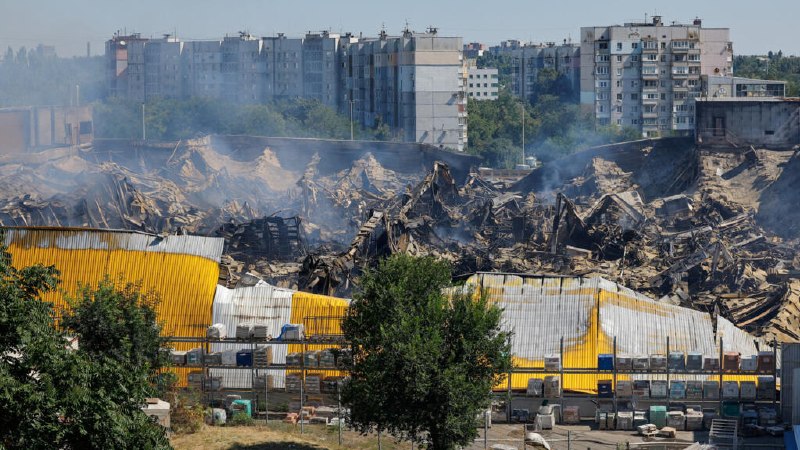
A Togo-flagged civilian vessel was damaged near Izmail on the morning of 17 August 2026, hit during a Russian strike on port infrastructure in Ukraine's Odesa region, according to CNBC. The outlet framed the Russian strike as following one of Ukraine's largest aerial attacks of the war on Moscow, a Ukrainian drone salvo that Kyiv had launched earlier in the same news cycle. On a separate front, a Ukrainian missile strike killed six people and wounded four others in Russia's Belgorod region, including a child, France 24 reported, citing local authorities.
Read together, the day's exchanges describe a war whose geography of mutual retaliation has widened. Ukrainian drones reach the Russian capital; Russian missiles reach the last Ukrainian export corridor on the Danube. A missile strike deep into a Russian border region has killed civilians, including a child, the same morning. The strategic question is no longer whether the two sides can hit each other's heartland. It is how the escalation gets priced by grain markets, Black Sea insurance underwriters, and the governments underwriting Kyiv's air-defence supply.
The strike on the Danube
The CNBC report on the 17 August 2026 attack sequence said Russia struck port infrastructure in Ukraine's Odesa region and damaged a Togo-flagged civilian vessel near Izmail. The same report tied the Russian strike to a preceding Ukrainian drone attack on Moscow, which CNBC described as one of the largest aerial attacks of the war. The available source items do not specify the precise interval between the Moscow drone attack and the Danube strike, nor do they confirm that drones were reported across the Moscow area at a level beyond the capital itself.
Izmail sits on the Danube. Since the wartime blockade of Ukraine's conventional deep-water Black Sea ports, the Danube delta has handled a growing share of Ukrainian grain, oilseed and containerised cargo moving out by river and short-sea routes. The available source items do not specify the Danube's share of total Ukrainian seaborne exports, nor do they describe the corridor as the last route fully outside Russian-occupied coastline. Monexus assesses that the strike nevertheless raises the risk surface for foreign-flagged tonnage transiting the river mouth, and for the Romanian side of the border that watches the same waterway.
The causal framing matters here. CNBC's headline places the Russian strike after the Ukrainian drone attack on Moscow, and the outlet's reporting describes the sequence as a reciprocal exchange. The strongest reading of the available evidence is that the Kremlin is signalling that Ukrainian strikes on Russian territory will be met against economic infrastructure on Ukrainian territory. That is the dominant read, not a confirmed one. Monexus analysis: the alternative reading is that the two strikes were independently scheduled and the timing is coincidental rather than retaliatory. The available reporting does not let us rule that out.
The strike on Belgorod
France 24's English-language service reported on the morning of 17 August 2026 that a Ukrainian missile strike killed six people and wounded four others in Russia's Belgorod region, including a child. The French-language edition of the same outlet carried the same six-death figure on its Telegram channel, citing local authorities. The two items overlap but the sourcing language differs slightly: the English version attributes the casualty reporting to the acting governor, while the French version references local authorities more generally. The headline casualty figure of six dead is consistent across both language editions, which raises the baseline of cross-checking.
Belgorod has been among the most consistently struck Russian border regions since 2023. The presence of a child among the dead, and the precision of the reported missile strike, place this attack at the upper end of the recent pattern. The available source items do not specify whether the strike hit a military or civilian target; the reporting names only the town and the casualty count. The most natural reading is that the strike landed in or near a populated area, given the casualty profile, but the available sources do not confirm the precise target set, and this article has not independently established that the strike hit a military position. Operationally, the casualty count alone does not let us read restraint in either direction.
A counter-narrative also belongs in the frame. Russian official messaging has at various points framed Ukrainian strikes into Belgorod as indiscriminate, including hits on residential infrastructure in cities such as Belgorod and Shebekino. The available source items do not contain that Russian framing for the 17 August strike; the framing is noted here as standing context rather than as a sourced line on this specific attack.
Why the geography is shifting
The wider structural fact is that the war's spatial logic has changed. Monexus analysis: by 2026, deep strikes on Russian logistics, oil depots and command nodes have become a standing feature of the conflict, supported by the maturation of domestically produced Ukrainian long-range drones and by the steady Western supply of cruise missiles and ballistic systems. The Russian counter on the Danube is the corresponding move. If Ukraine can reach the Russian capital, Russia can reach the last functioning Ukrainian export artery.
The economic logic, Monexus assessment, is severe. Ukrainian grain moves through the late summer and early autumn. Any sustained Russian campaign against Izmail, Reni and the smaller river terminals would push shipowners to demand higher war-risk premia, costs that Ukrainian exporters ultimately absorb. Insurance premia through the western Black Sea have been elevated since 2022; the Danube has been the cheaper alternative. Monexus analysis: that differential is now contestable, and the precise effect on shipping rates is something the available source items do not specify. The business-channel read of the day is that the Danube's risk premium is the variable to watch.
Stakes for the next 72 hours
Monexus analysis: the next 72 hours will indicate whether the 17 August exchange is a single retaliatory cycle or the opening of a renewed campaign. The first indicator is the Danube. If port operations at Izmail resume inside 24 to 48 hours and insurance rates hold, the read is that the strike was a calibrated Russian signal, not the start of a sustained bombardment. If a second wave follows within the same window, the calculus for Ukrainian insurers and for Romania, which watches the Danube mouth from its side of the border, shifts.
The second indicator is Moscow. CNBC's report describes the Ukrainian drone attack as one of the largest aerial attacks of the war. Monexus assessment: if the post-strike assessment concludes that Ukrainian long-range drone production can sustain repeated salvos of that scale, the political pressure on the Kremlin to demonstrate a hard response rises. The Russian strike on the Danube is one candidate. A step up the escalation ladder, including strikes on Ukrainian energy infrastructure ahead of winter, is the other. Both sit inside the announced Russian doctrine of reciprocal retaliation as reported by Western wires. The available source items do not specify whether the Kremlin has articulated that doctrine for the 17 August exchange specifically.
The third indicator is the diplomatic backchannel. The available source items do not reference any Ukrainian or Russian negotiating position on 17 August 2026. The reporting reflects combat, not diplomacy. The strikes are not currently framed by either side as a service to a negotiating process.
The 17 August sequence reads as a warning that the war's centre of gravity has moved from the Donbas front line to two new theatres: the Moscow air corridor and the Danube export corridor. Neither side has the air supremacy to shut the other out. Each strike invites a counter-strike. The shipping, insurance, agricultural and diplomatic actors downstream of this tit-for-tat are watching the same clock.
This article relied on three source items: a CNBC report on the Odesa-Danube strike and the preceding Moscow drone attack, plus parallel France 24 English- and French-language items on the Belgorod strike. No Russian state-affiliated source was used as a stand-alone factual basis.
Wire provenance
This editorial synthesis draws on the following public wire/social posts:
- https://www.cnbc.com/2026/08/17/ukraine-war-russia-putin-moscow.html
- https://f24.my/C6pO.g
- https://t.me/france24_en/18245
- https://f24.my/C6pN.g
- https://t.me/france24_fr/22658