Two strike reports in two hours put the channel before the ceasefire
On 17 August 2026, wfwitness posted reports of Israeli strikes on Al Mansouri in southern Lebanon and artillery shelling near Tal Al-Ahmar Al-Sharqi in Quneitra. The record establishes reported locations and timing, not casualties, targets or the wider meaning of the incidents.
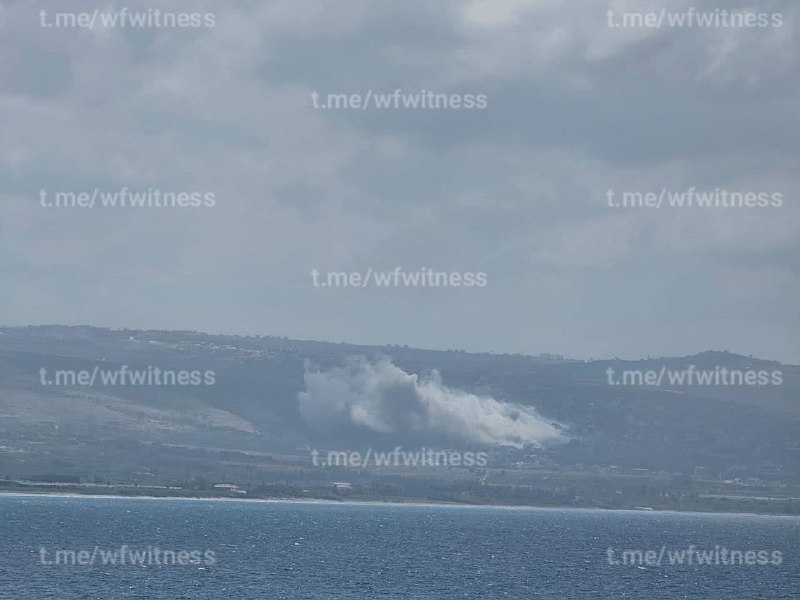
At 10:15 UTC on 17 August 2026, the Telegram channel wfwitness posted that Israeli airstrikes had targeted Al Mansouri, a town in southern Lebanon. Three later posts supplied additional imagery or description of the same reported strike. At 11:25 UTC, the channel separately reported Israeli artillery shelling on Tal Al-Ahmar Al-Sharqi in the Quneitra countryside. The timing and geography are the most solid facts in the available record.
Taken together, the posts show two reported strike events within 110 minutes. They do not establish a coordinated campaign, a ceasefire violation, casualties or the identity of any target. Monexus analysis: the evidence is strongest as a chronology of claims from one monitoring channel, not as a complete account of what happened on the ground.
Two locations, one monitoring channel
The Lebanon posts identify Al Mansouri in southern Lebanon as the target of Israeli airstrikes. The first item appeared at 10:15 UTC, followed by another report at 10:16 UTC. Posts at 10:21 UTC and 10:42 UTC were described as imagery or additional footage of the Israeli airstrike on the town.
The Syria item came at 11:25 UTC and reported Israeli artillery shelling on Tal Al-Ahmar Al-Sharqi in the Quneitra countryside. The source does not specify whether the reported shelling caused damage or casualties. It also does not identify a military unit, weapon platform or intended target.
The distinction matters. A sequence of posts can document a channel's account of an event while leaving the underlying event unresolved. The Al Mansouri items are internally consistent in naming the town and describing airstrikes and imagery. The Quneitra post supplies a different location, weapon type and time. The supplied material does not connect the two reports beyond their appearance in the same channel on the same day.
What the record does not establish
Neither set of posts gives a casualty count. They do not say whether Al Mansouri or Tal Al-Ahmar Al-Sharqi contained civilian or military objects, nor do they describe the people affected. No first-party statement from an Israeli, Lebanese or Syrian authority appears in the supplied source items. The available posts also do not specify the circumstances that preceded the reported strikes.
That limits the conclusions that can responsibly be drawn. The record supports the narrow claim that wfwitness reported Israeli airstrikes on Al Mansouri and Israeli artillery shelling on Tal Al-Ahmar Al-Sharqi during the stated time window. It does not support claims about the targets, operational purpose, damage or political consequences.
The appropriate counterweight is methodological rather than rhetorical. Open-source reports can provide useful early warnings and preserve time-stamped imagery, but repetition across several posts is not independent corroboration when the later items appear to describe the same event. A separate official or independent account would be needed to test the reports materially.
The arithmetic of the available evidence
The two reports cover distinct locations and describe different forms of fire. The first cluster refers to airstrikes in southern Lebanon; the second refers to artillery shelling in the Quneitra countryside. Because the posts provide no further operational detail, assigning a broader strategic meaning would outrun the evidence.
Monexus assessment: the most defensible reading is limited but still useful. The posts establish a compressed reporting sequence, with the Lebanon item appearing 10:15 UTC, imagery posts following through 10:42 UTC, and the Quneitra report at 11:25 UTC. That pattern makes timing visible, but it does not prove coordination or escalation.
The reporting itself is asymmetrical. Four supplied items concern Al Mansouri, while one concerns Tal Al-Ahmar Al-Sharqi. That imbalance may reflect editorial attention, available imagery or the channel's source access. The supplied material does not identify which explanation applies. It is therefore safer to describe a larger volume of reporting on Al Mansouri than to infer greater operational significance there.
What could change the picture
The next useful evidence would be material that establishes what was struck and what the reported fires were intended to affect. A first-party statement, an independently produced report, geolocated imagery, or damage and casualty information could narrow the uncertainty. None of those details is specified in the supplied posts.
The date to watch is 18 August 2026, not because a further event is forecast, but because later reporting could test the initial accounts. Until then, the distinction between a reported strike and a verified strike remains essential. The channel has supplied timestamps, locations and descriptions. The larger story still depends on evidence outside the channel's own posts.
Wire provenance
This editorial synthesis draws on the following public wire/social posts:
- https://t.me/wfwitness/107303
- https://t.me/wfwitness/107304
- https://t.me/wfwitness/107306
- https://t.me/wfwitness/107311
- https://t.me/wfwitness/107314
- https://t.me/WarMonitors/45314