Ghalibaf to Washington: 'stop waiting for the clown crew'
Iran's parliament speaker publicly mocked Treasury Secretary Bessent and Defense Secretary Hegseth, accusing the US of demanding concessions outside any prior agreement.
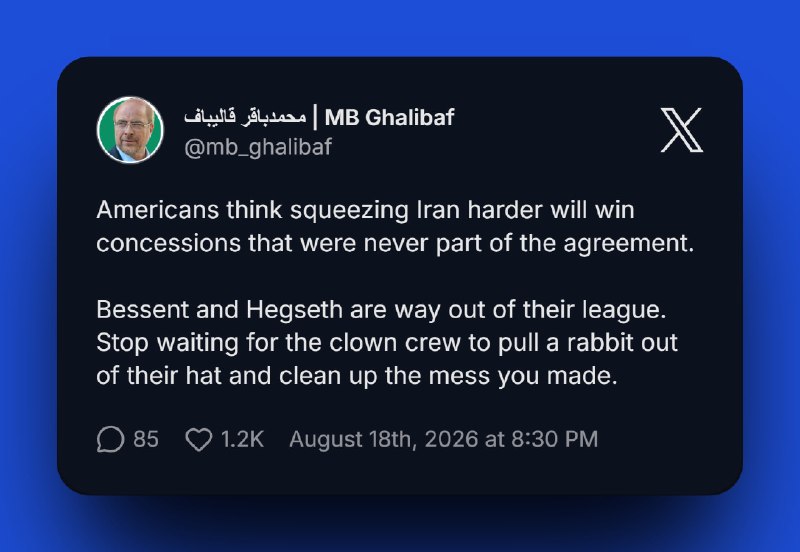
Iran's parliament speaker, Mohammad Bagher Ghalibaf, accused Washington on 18 August 2026 of demanding concessions that were never part of any prior agreement and took personal aim at two senior US officials named as Treasury Secretary Scott Bessent and Defense Secretary Pete Hegseth, calling them "way out of their league" and telling interlocutors to "stop waiting for the clown crew to pull a rabbit out of the hat." The line travelled from an English-language X post through two Telegram channels over the course of roughly half an hour, reaching Iran's state-aligned broadcasters and regional monitoring accounts by the early evening in Europe.
The episode sits inside a war of words that has run alongside the Treasury Department's tightening of secondary-sanctions enforcement on Iranian oil exports (Monexus analysis, based on the cited posts and the choice of cabinet principals Ghalibaf named). It also lands at a moment when the public posture of Iranian officials and the public posture of the US administration appear to be diverging rather than converging. The substance of Ghalibaf's statement, as distributed by the cited channels, is a refusal to expand the negotiation beyond the terms Tehran already considers settled: in his framing, the US side is asking for things that were never agreed.
What the cited posts actually carry
The earliest item in the available record is a retweet by Mohammad Marandi, an academic whose X account is widely followed by Western Iran-watchers, timestamped 17:00 UTC on 18 August 2026, carrying the Ghalibaf quote in English. Roughly eleven minutes later, at 17:11 UTC, the relay channel Clash Report posted the same line on Telegram, attributing the quote directly to "Iran's Ghalibaf" and pairing it with the Bessent-Hegseth attack. At 17:12 UTC, the monitor War Fiy Witness carried a shorter version of the same attribution under an Iran-US flag emoji. Iran's English-language Press TV published the longest cut at 17:30 UTC, framing the same quote with the framing that the US is "squeezing Iran harder to win concessions that were never part of the agreement."
The four items together establish three things: who is identified as the speaker (Ghalibaf, by his title as Iran's parliament speaker in the Press TV and War Fiy Witness versions), who is identified as the target of the attack (Bessent and Hegseth, by name in the Press TV and Clash Report versions), and what the substantive accusation is (the demand for out-of-scope concessions). The cited posts do not contain a full transcript of a parliamentary address, do not specify the venue or date of any speech beyond the day of posting, and do not include reaction from Washington. Read together, the four items are a transmission of a quotable line, not a record of a speech.
Reading the line
The operative sentence, paraphrased from the Press TV and Marandi posts, is that the US side believes harder pressure will produce concessions that were never part of the agreement. The second sentence pairs the two named cabinet officials with the phrase "way out of their league." The third, a separate sentence in the Press TV and Clash Report versions, mocks the negotiating team as a "clown crew" and tells partners to stop waiting for a sudden breakthrough.
Monexus analysis: the construction is deliberate. By naming two officials with both economic-coercion and military portfolios, the post casts the US negotiating team as overmatched across both tracks it is currently operating. By telling partners to "stop waiting" for a diplomatic concession, the post frames the impasse as Washington's choice rather than Tehran's. The structural argument, stripped of the personal invective, is that pressure does not expand the negotiating surface. The cited posts do not specify whether this is a tactical negotiating posture or a long-run doctrinal position, and this article has not independently established which.
The counter-read, and what is missing
The plausible counter-read is that the pressure track is in fact working, and that a public statement from Iran's parliament speaker of this register is itself a signal of strain: the assumption on the US side would be that the harder the invective, the narrower the room. That reading is not in the cited posts, and this article has not independently verified it. The cited posts contain no first-party response from Bessent, Hegseth, the Treasury Department, the Defense Department, or the White House to the Ghalibaf quote, and this article has not independently established whether any such response has been issued.
What is also absent from the cited posts is any reference to a specific negotiating round, a specific date for a next round, a specific sanctions designation, a specific UN process, or a specific counter-proposal from Tehran. The substantive content is limited to the four items listed above. Monexus analysis: the most natural reading of the cited posts is that the line is intended to harden Iran's public position and to put the diplomatic onus on Washington, but the posts do not specify the venue, the channel, or the next procedural step. The simplest read is also the most uncomfortable one for the cited posts: a senior Iranian official, identified by title, has publicly named two US cabinet principals, mocked them by title, and accused them of asking for things that were never agreed, and the response from Washington is not in the available record.
A snapback-style UN measure that landed before any of those dates would harden Iran's position and make Ghalibaf's line the official stance rather than the speaker's. The cited posts do not specify the date of any UN process, and this article has not independently verified whether one is scheduled.
What to watch next
Three threads will determine whether the 18 August quote is a tactical feint or the opening of a longer impasse. The first is whether any first-party statement emerges from Bessent, Hegseth, the Treasury Department, or the Defense Department in response to the quote. The second is whether Iran's broader official messaging, including the foreign ministry and the presidency, reinforces the line or distances itself from it. The third is whether the Omani, Qatari, or other back-channels that have historically mediated US-Iran indirect talks carry any procedural movement in the days that follow. None of these is entailed by the cited posts; all three are the obvious next reads for anyone tracking the file.
The operative fact is narrower than the rhetoric. A senior Iranian official, identified by title across four independent channels, has publicly named two US cabinet principals, mocked them by title, and accused them of asking for things that were never agreed. The cited posts do not specify whether Tehran has filed a counter-proposal through any mediating channel, and this article has not independently verified whether one has been transmitted. The simplest read of the available record is that the negotiation, as described by the Iranian side, has narrowed to a single choice between relief and escalation, and that the two named envoys are the ones being told, on the parliamentary record, that they cannot have it both ways.
Wire provenance
This editorial synthesis draws on the following public wire/social posts:
- https://t.me/presstv/203259
- https://t.me/wfwitness/107465
- https://t.me/ClashReport/92900
- https://x.com/s_m_marandi/status/2089759296376480003