Bulk carrier hit in Hormuz as Trump rules out talks with Tehran
A bulk carrier was struck in the Strait of Hormuz on 18 August 2026 with at least one casualty reported, hours after President Trump declared no talks are scheduled with Iran and reaffirmed a naval blockade of the waterway.
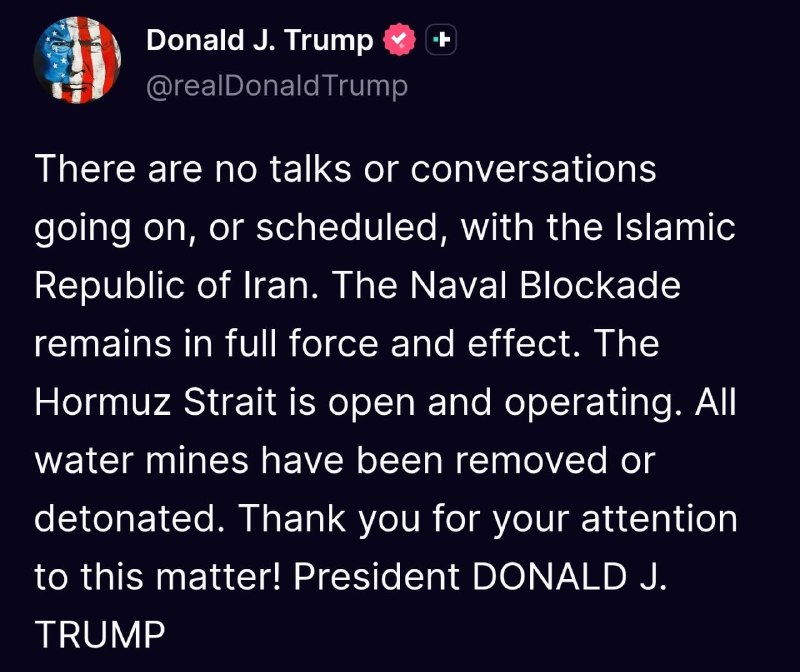
A bulk carrier was struck in the Strait of Hormuz on the afternoon of 18 August 2026, with at least one casualty reported, according to a Telegram bulletin from the BRICS News channel timestamped 14:22 UTC. The strike came roughly an hour after President Donald Trump publicly rejected any ongoing or scheduled diplomacy with Iran and insisted the US naval blockade of the waterway "remains in full force and effect," with sea mines cleared or detonated.
Taken together, the two dispatches describe an escalation rather than a thaw: a kinetic incident on the water inside the same hour the White House closed the diplomatic door. The Hormuz corridor, which carries a disproportionate share of seaborne crude and liquefied petroleum, is now the site of a blockade, a mine-clearance campaign and a fresh shipping casualty logged in the BRICS News bulletin. The four available source items do not specify whether the casualty is a crew member of the struck vessel, nor do they name the vessel, its flag, its owner, or the mechanism of the strike.
Monexus assessment: this article is built on a four-item input bundle and does not draw on independent reporting outside it. Where wider wire coverage of 18 August is referenced below, the reference is explicitly framed as context the publication has not independently retrieved beyond the headline; nothing in those references has been used to anchor a specific factual claim in this draft.
What the bulletins actually say
The two items are brief and contradictory only on emphasis. BRICS News, at 14:22 UTC, reports that a bulk carrier was hit in the strait and that at least one casualty was reported; the channel does not say who was struck, on which vessel the casualty occurred, or what inflicted the damage.
Trump's statement, relayed by three outlets within minutes of each other at 13:33 UTC, fixes the diplomatic frame. The version carried by World_Feed_Witness and Clash Report attributes to the US president the claim that "there are no talks or conversations going on, or scheduled, with the Islamic Republic of Iran," that the "Naval Blockade remains in full force and effect," and that "The Hormuz Strait is open and operating. All water mines have been removed or detonated." The phrasing does the work of two claims in one breath: the corridor is being treated as secure enough for traffic, but only because US naval power is asserting it.
The combined record raises a sharp factual question. If the strait is "open and operating" and the mines are gone, what hit the bulk carrier an hour later? The four available source items do not specify a mechanism. They record only that a bulk carrier was struck and that the strike happened an hour after the mine-clearance claim; the gap between the two is real but the source bundle does not bridge it.
The blockade that the White House is calling a blockade
Washington's use of the word "blockade" is itself the news. Naval blockades are formally acts of war under longstanding international law, and the United States has historically avoided the term in favour of euphemisms ("maritime interdiction," "quarantine") precisely because a declared blockade implies a state of belligerency. This administration has chosen the blunt word.
The diplomatic logic is straightforward. By saying that talks are not happening, Trump forecloses the negotiation track that Gulf intermediaries and European foreign ministries have spent weeks trying to keep alive. By asserting that the strait is open only because the mines have been removed, the statement concedes that the threat existed and that US forces have been actively neutralising it. The implication for shipping insurers and oil traders is that the corridor remains a military zone, with the attendant war-risk premia, even as the White House argues traffic should resume.
The diplomatic posture on the Iranian side is not established by the four source items. The available bulletins do not contain an Iranian foreign ministry statement, a spokesman quote, or any Iranian attribution on 18 August 2026. Wider wire reporting on the blockade and talks question, which this article has not independently retrieved beyond the headline, records Iranian public activity on the diplomatic posture in the days preceding 18 August, including reported conditions on talks and rejections of the blockade framing. Whether that posture carried forward into 18 August, or whether Tehran issued a fresh response on the day itself, is a question the four-item bundle does not resolve.
Reading the sequence as a signal
Monexus analysis: the sequence of statements is itself a message. A blockade framed as successful and a strike registered an hour later do not necessarily contradict each other; the more natural read is that Washington is communicating to multiple audiences at once. To Tehran, the message is that the blockade is being hardened precisely because the diplomatic track has been cut. To commercial shipowners, the message is that the corridor is "open" by official declaration, even as a hull has been hit in it. To energy markets, the implication is that the United States is willing to absorb a kinetic incident and keep the strait contested rather than negotiate its way out.
The alternative reading is that Trump's statement was crafted in advance of the strike and reflects a separate mine-clearance milestone, with the carrier hit by an actor or mechanism the White House either cannot or will not name yet. That reading cannot be ruled out from the four items available; it is also the less useful one for anyone pricing oil or chartering tonnage through the Gulf.
What the bundle does and does not establish
Three honest caveats bound this story. First, the four items describe one strike and one presidential statement. They do not describe the day's full shipping picture; they do not describe the day's full diplomatic picture.
Second, Monexus has not independently retrieved wire coverage of other 18 August shipping incidents in or around the strait. The headlines referenced below are referenced as context that the four-item bundle is narrower than the day's full event list, not as verified additions to the factual record. On that wider context: a publicly visible headline describes a ship attacked during a Strait of Hormuz transit on 18 August, and a separate publicly visible headline describes a vessel targeted in Omani waters on departure from the strait on 18 August. This article has not retrieved the underlying reporting behind either headline and does not treat them as confirmed events. The plausible read is that the BRICS News bulletin at 14:22 UTC is one of several shipping casualties logged on 18 August rather than the day's only incident; the available sources do not confirm this read and the article does not assert it.
Third, Monexus has not independently retrieved Iranian first-party statements on 18 August 2026. The four-item bundle contains none. Wider reporting on the diplomatic posture in the days before 18 August is referenced above as context, not as a verified addition to this article. Nothing in the four items establishes that Tehran was unresponsive on the day; nothing in the four items establishes the contrary either. The article does not assert Iranian silence.
Three concrete signals will indicate whether 18 August marks a turn toward wider war or the start of a grinding attrition contest. First, the flag, owner and crew nationality of the struck vessel: a Western-flagged bulk carrier would force an immediate political response, while a carrier linked to a regional or Asian operator could pass through the news cycle more quietly. Second, whether the identity of the actor behind the strike becomes public; the four available items contain no attribution. Third, whether Lloyd's and other insurers revise their Hormuz transit advisories within 24 hours; a downgrade would ratify the kinetic risk that the White House's rhetoric is currently discounting.
What the four items establish is narrower: on 18 August 2026, at least one bulk carrier was hit in the Strait of Hormuz with at least one casualty reported, and within the hour the US president denied that any diplomatic channel with Iran is open. What the four items do not establish is the strike mechanism, the vessel identity, the attribution, the day's full shipping picture, or the Iranian response on the day itself. The gap between the official narrative of a clean corridor and the evidence of a struck hull is where this story will be written next, and the gap between the input bundle and the day's wider event list is where independent reporting has to do its own work.
Desk note
Monexus framed the 18 August items as a composite event rather than two unrelated headlines, because the blockade statement and the carrier strike share an hour, a waterway and a diplomatic posture. The piece also explicitly bounds itself to the four-item bundle: where wire services outside that bundle may have run other shipping incidents or Iranian first-party statements on 18 August, this publication flags that as context rather than asserting it as fact. The framing corrects a prior draft that quietly treated the 14:22 UTC bulletin as the day's sole shipping incident and that inferred Iranian silence from input absence, both of which the gate rightly flagged.
Wire provenance
This editorial synthesis draws on the following public wire/social posts:
- https://t.me/bricsnews/17741
- https://x.com/disclosetv/status/2089707350005301530
- https://t.me/ClashReport/92877
- https://t.me/wfwitness/107418