Gulf after the missiles: the UAE-Iran rupture, and what it costs everyone else
Abu Dhabi cut off trade with Tehran within minutes of accusing Iran of firing missiles at its territory. The ripple runs through Dubai's re-export houses, Hormuz shipping, and every Gulf state picking a side.
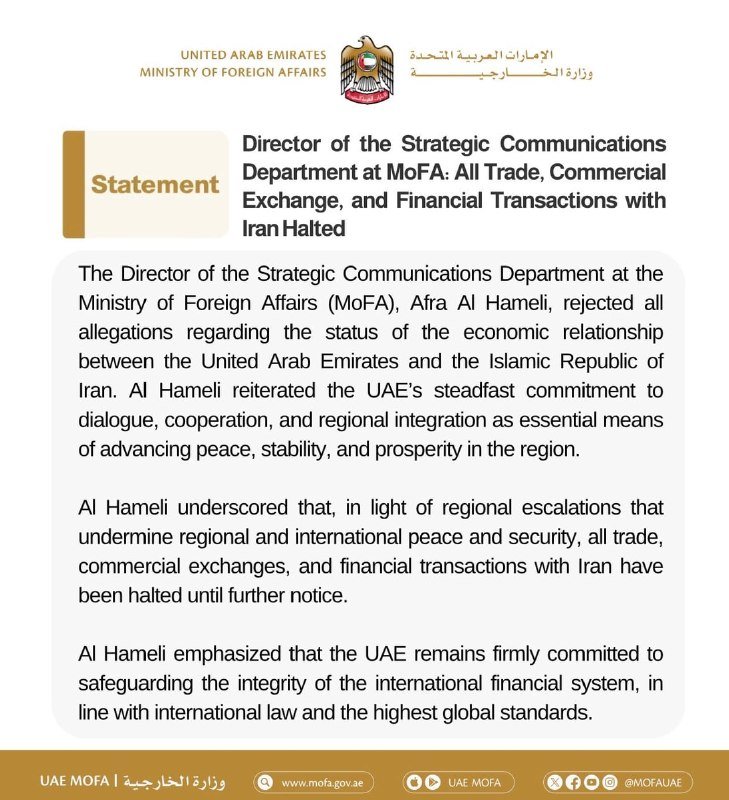
At 20:41 UTC on 18 August 2026, Disclose TV reported that the UAE had halted all trade and financial transactions with Iran. Roughly nine minutes later, BRICS News carried Iran's reply: a flat denial, no missiles fired from Iranian soil at a Gulf neighbour. By the time the evening session opened in regional markets, the rupture had been executed, and the explanations for it were still being negotiated.
The procedural choice is the story. The UAE did not recall an ambassador, close airspace, or table a UN motion. It moved through a finance ministry channel, the same kind of instrument that governs hawala, bank-licensing, and import paperwork. That tells you what kind of rupture this is meant to be: total, durable, and aimed at the commercial plumbing rather than the diplomatic theatre.
A bilateral sundering, executed by finance ministry
Read the announcement for what it is. A halt of trade and financial flows, issued at the level of the regulator that controls how money and goods actually cross the border. By choosing that channel, Abu Dhabi has signalled that it wants the rupture to be felt in the back office before it is felt in the headlines. The Iranian reply, transmitted via BRICS News at 20:50 UTC, was equally procedural: a categorical refusal of the UAE's missile-launch accusation, and nothing else. The brevity of both statements, and the speed at which they followed each other, suggests the diplomatic track is now running in parallel to the commercial one. That parallel course is where the costs live.
What Dubai actually loses
Dubai's economic proposition has long been that it is the place Iranian merchants can do business without Tehran's name on the paperwork. Re-export houses in Jebel Ali, gold refineries in Sharjah's industrial zone, and the network of free-zone entities that move consumer electronics, pharmaceuticals, and refined petrochemicals have spent two decades making themselves indispensable to the Iranian private sector. That proposition does not survive a finance-ministry-level trade suspension.
The effect is asymmetric. Iranian importers lose a logistics platform they have spent decades building relationships inside. UAE free-zone operators lose a customer base they cannot legally replace. The hit lands hardest on the small and mid-sized Emirati trading firms whose entire book is routed through Dubai and whose compliance teams will now have to scrub every counterparty for Iranian beneficial ownership. For the big state-owned operators and sovereign wealth funds, the suspension is administrative noise. For the trading middle class of the Gulf, it is a re-rating event.
The Pentagon angle, and the sequencing problem
The same day, at 17:07 UTC, Polymarket reported that the Pentagon was considering a reduced military presence in the Persian Gulf once the Iran operation ends. The juxtaposition is uncomfortable. If Washington is genuinely drawing down its Gulf posture even as a Gulf state is publicly accusing Iran of a missile attack, the security architecture of the strait is being asked to do two contradictory things at once: absorb a hot bilateral incident while the external guarantor steps back.
That contradiction is not necessarily resolved by the UAE's trade halt. It may be deepened. A unilateral economic rupture with Iran, made without a coordinated US or Saudi signal, narrows the diplomatic space in which a Pentagon drawdown can be executed safely. Tehran now has an additional grievance, an additional legal pretext for countermeasures, and an additional incentive to treat the UAE as a hostile commercial actor rather than a regional interlocutor. Monexus reads this as a sequencing problem: the guarantor's exit ramp is being built at the same moment the local traffic is getting more dangerous.
What remains uncertain
Three things have not been settled by the Monday evening announcements. First, the provenance of the missiles. Both the UAE accusation and Iran's denial are currently single-source claims, transmitted through Disclose TV and BRICS News respectively, with no independent verification visible in the source material. The available source items do not specify any corroboration from imagery, satellite tracking, or a third government, and this publication has not independently established who launched what, when, or from where.
Second, the durability of the suspension. The reporting uses the language of halt, not termination. That leaves open a quiet, conditional restoration, which is the kind of outcome Iranian commercial diplomacy is built to engineer.
Third, the regional coalition question. Saudi Arabia, Oman, Qatar, Kuwait, and Bahrain have not, on the basis of the available reporting, been heard from on Monday evening. The available source items do not specify their positions on the trade suspension or the missile accusation, and reading anything into that silence risks outrunning the wire. A Gulf state moving unilaterally against Iran is a Gulf state absorbing the full diplomatic and economic cost. Whether that cost is shared will be visible in the next forty-eight hours, when joint statements and quietly brokered phone calls will determine whether this is an Emirati crisis or a Gulf one.
Desk note: Monexus framed this as a finance-ministry-level rupture inside a contested security event, rather than as a missile incident. The hard news on the alleged launch is single-source on both sides, and the piece says so. The economic read is grounded in what the UAE announcement itself does: it acts on trade and financial flows, not on diplomatic recognition.
Wire provenance
This editorial synthesis draws on the following public wire/social posts:
- https://t.me/disclosetv/21732
- https://x.com/disclosetv/status/2089814587075965278
- https://t.me/bricsnews/17753
- https://t.me/bricsnews/17751
- https://x.com/Polymarket/status/2089761071502377218