Beijing pitches a multipolar AI rulebook as Nvidia's cloud loophole moves to Congress
On 19 August 2026, Beijing framed artificial intelligence as a 'shared treasure for all' while Unitree's 600% debut on mainland exchanges signalled investor conviction in Chinese humanoid hardware and US lawmakers prepared to close the overseas-compute loophole Nvidia chips have been slipping through.
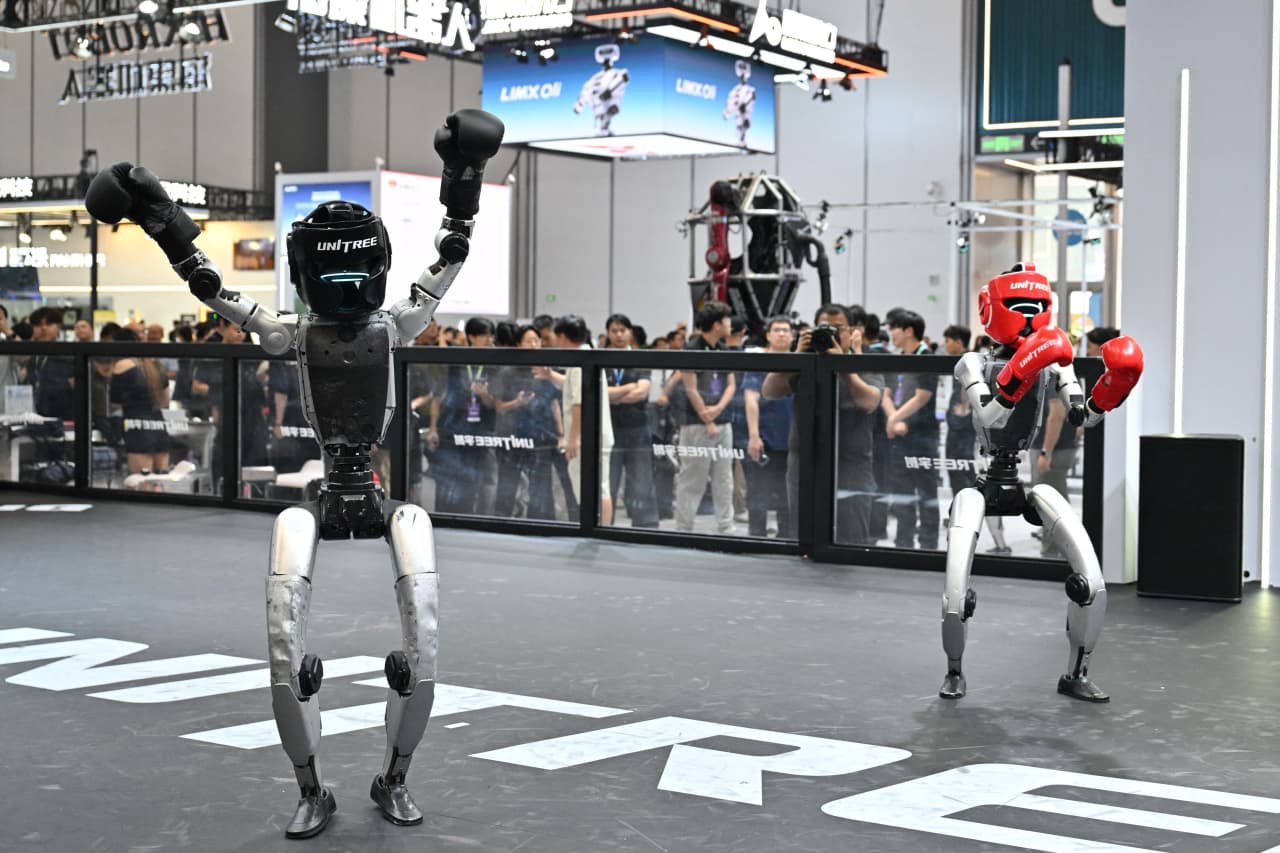
Unitree Robotics, a Chinese maker of humanoid robots, opened on a mainland Chinese exchange on 19 August 2026 and finished the session up more than 600%, according to MarketWatch. The outlet framed it as the first humanoid-robot firm to list in mainland China, a milestone that turned a private robotics story into a public capital-markets event in a single trading day.
That listing landed in the same news cycle as a more pointed diplomatic message. At the regular Foreign Ministry briefing in Beijing on 19 August 2026, spokesperson Lin Jian characterised artificial intelligence as "the crystallisation of human wisdom and a shared treasure for all," and argued against "forced sides," "blocs," and a "zero-sum mindset" in how the technology is governed. The framing was distributed in English by CGTN's official X account. Hours earlier, CNBC had reported that the US Congress is weighing fresh legislation to close an emerging gap in Washington's chip-export regime: Chinese AI firms have been accessing advanced Nvidia compute capacity through overseas data centres, a route that sits outside the existing licensing perimeter.
Three threads, one stack
Unitree's debut, the Foreign Ministry line on AI governance, and the tightening of US chip rules form a single stack: capital, diplomacy, and industrial policy reinforcing each other. The robotics listing gives the Chinese ecosystem a liquid public benchmark at exactly the moment Washington is trying to slow Chinese compute capacity. The Foreign Ministry statement positions Beijing as the defender of an open, multipolar AI order, against an emerging architecture of national-security restrictions. And the Nvidia loophole story shows that the frontier of US-China tech competition has moved from the chip itself to the cloud it travels through.
Monexus analysis: read together, the three stories describe an industrial-policy machine that is harder to dislodge than the chip-by-chip framing of US export controls assumes. China's robotics manufacturers benefit from a deep domestic supply chain, sustained state-backed capital, and a stock exchange willing to absorb a 600% first-day move. Capital is voting with order flow; diplomacy is voting with language. The US response, as CNBC describes it, is to legislate faster, but legislation moves on Capitol Hill timescales while the underlying compute footprint moves on cloud-deployment timescales.
The export-control gap
The current US export-control regime, as reported by CNBC on 19 August 2026, restricts the shipment of Nvidia's highest-end accelerators to customers in mainland China. The loophole is straightforward: a Chinese AI firm can rent Nvidia compute inside a data centre located outside mainland China, in jurisdictions that still have full access to the silicon. From Washington's perspective, that rerouting neutralises the licensing regime; from Beijing's perspective, it is an ordinary commercial transaction in a third country.
CNBC's reporting indicates that lawmakers are now weighing legislation to close the gap by requiring export licences for the overseas compute capacity itself, not only for the chip crossing a border. The practical question is whether the licensing regime can move at cloud-deployment speed, and whether allied jurisdictions will adopt compatible rules. The Chinese Foreign Ministry's "no blocs" framing is, in part, a response to that pressure: it asks other capitals to refuse to extend US export controls extraterritorially. Whether third-country governments will treat AI compute as a controlled dual-use item, on par with the semiconductor itself, is the open policy question of the autumn.
What the market is voting for
Unitree's first session, closing above 600% per MarketWatch, is more than a meme print. It prices in a market view that Chinese humanoid hardware can scale, that there will be customers at home and abroad, and that the public capital structure exists to finance that build-out. The listing also creates a tradable proxy for a sector the rest of the world cannot yet buy at mainland scale. Investors who want exposure to humanoid robots outside of US-listed peers now have a mainland-listed alternative; the bid, on day one, was enormous.
At the same time, the Foreign Ministry's "shared treasure" line is not just rhetoric. It pre-positions China as the country of open weights and open compute, by contrast with the US, which is now associated with widening restrictions. That is a useful negotiating posture: it puts the burden of justifying new restrictions on Washington, and it gives Beijing a clean line to repeat in front of capitals that are themselves being asked to enforce US-aligned controls. The Unitree listing then closes the loop: capital, policy, and diplomacy pointing in the same direction.
The Chinese position, in its strongest form
Beijing's argument, made through Lin Jian on 19 August 2026 and circulated in English by CGTN, has three planks. First, AI is a general-purpose technology and a common inheritance, so national-security carve-outs of the US kind are an overreach. Second, restricting compute access through allied jurisdictions amounts to forming a bloc, which Beijing opposes on principle and which slows development globally. Third, China is itself willing to engage in governance discussions, but only on terms that treat all states as equal partners. That case deserves to be heard on its merits: the export-control regime has a credible national-security rationale, but it does also have an industrial-policy upside for chipmakers selling into the markets that remain licensed, and it does raise prices and slow diffusion in third countries. The Chinese counter-frame is at least a coherent description of those second-order effects.
What the US position looks like from the other side
From Washington, the picture is different. The chip controls were written on the premise that frontier compute is a strategic asset, on par with advanced lithography or aerospace components, and that letting it flow to Chinese frontier-model developers narrows a margin the US currently holds. The loophole story, as CNBC reports, suggests the controls have a leak: compute is migrating rather than being supplied. From that vantage point, closing the cloud-access gap is a tightening of an existing line, not the start of a new one. The hard policy question is whether US-aligned controls, applied extraterritorially, can be enforced without rupturing allied cooperation on the original chip regime.
Stakes, and what to watch
The autumn legislative calendar will be the next stress test. If the language CNBC describes lands in a House or Senate vehicle and reaches a floor vote before the year-end recess, the cloud-access question moves from reporting into law. The Chinese response, almost certainly, will be a coordinated diplomatic push at the UN General Assembly in September 2026, where Beijing will repeat the "no blocs, no zero-sum" framing in a multilateral setting. Investors, for their part, will read the tape: a 600% debut on the first humanoid listing in mainland China is a strong, if narrow, vote of confidence in the Chinese robotics supply chain, and any sustained follow-through in the next several sessions will matter more than the headline print.
What the sources do not specify
The available reporting does not specify the size of Unitree's offering, the free float on its debut, the identities of cornerstone investors, or the company's headquarters city. The CNBC reporting on the export-control gap describes the policy direction but does not specify which Congressional vehicle will carry the legislation or which lawmakers are leading it. The Chinese Foreign Ministry briefing, as captured by CGTN, gives the framing line but does not name a specific Chinese ministry or regulator responsible for AI-governance proposals. Those gaps are worth flagging rather than filling with speculation.
The throughline
Three stories, one cycle. A public capital-markets event that priced Chinese humanoid robotics at a premium; a diplomatic statement that positioned Beijing as the defender of an open, multipolar AI order; and a legislative tightening in Washington aimed at the seam where the chip controls have been leaking. The contest is no longer about whether AI will be a domain of rivalry. It is about who gets to write the rulebook that governs how compute, models, and robots cross borders, and at what speed the rulebook can move.
Desk note: Monexus ran the US-wire line on the export-control gap alongside the Chinese official read and the MarketWatch tape on Unitree's debut. Where the three diverge on what the next eighteen months look like, the piece names the divergence rather than collapsing it.
Wire provenance
This editorial synthesis draws on the following public wire/social posts:
- https://news.cgtn.com/news/2026-08-19/China-says-no-forced-sides-no-blocs-no-zero-sum-mindset-on-AI-1PJL8psQmha/p.html
- https://x.com/CGTNOfficial/status/2090068768525324537
- https://www.cnbc.com/2026/08/19/china-ai-nvidia-chips-us-export-controls.html
- https://www.marketwatch.com/story/chinese-robotic-companys-stock-soars-over-600-in-trading-debut-e735426d?mod=mw_rss_topstories
- https://news.cgtn.com/news/2026-08-19/China-says-no-forced-sides-no-blocs-no-zero-sum-mindset-on-AI-1PJL8psQmha/p.html
- https://x.com/CGTNOfficial/status/2090068768525324537
- https://www.cnbc.com/2026/08/19/china-ai-nvidia-chips-us-export-controls.html
- https://www.marketwatch.com/story/chinese-robotic-companys-stock-soars-over-600-in-trading-debut-e735426d?mod=mw_rss_topstories