Unitree's Shanghai debut rewrites the opening price for China's humanoid bet
Unitree Robotics closed its first Shanghai session up 629%, valuing the humanoid robot maker at roughly US$66 billion and re-pricing the floor under China's commercial robotics push.
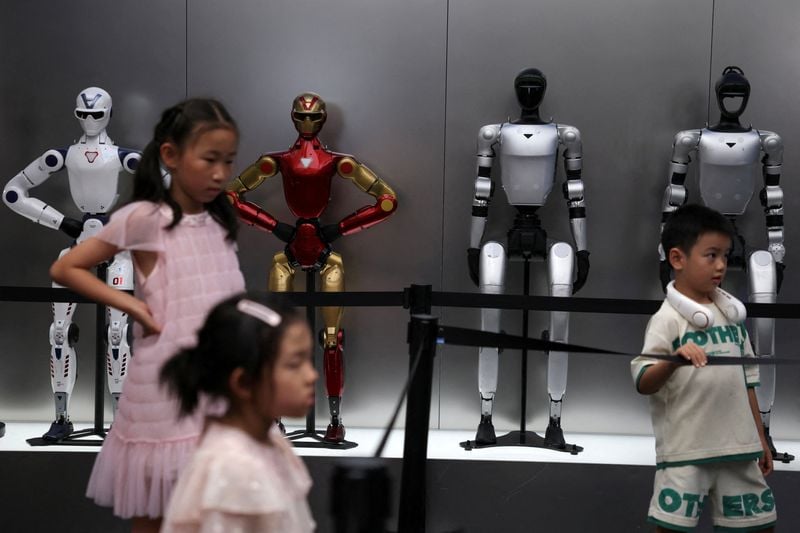
Shares of Unitree Robotics closed their first trading session on the Shanghai Stock Exchange up roughly 629% on 19 August 2026, vaulting the Hangzhou-based humanoid robot maker to a market capitalisation near US$66 billion and setting a new opening reference for a Chinese industrial push that has spent several years building up to this kind of moment. CNBC carried the first session's intraday print at 01:37 UTC; Nikkei Asia, the South China Morning Post, and market-data accounts on X filled in the closing tape through the morning.
The number is the news. Unitree priced its Shanghai listing at a level that raised US$905 million from IPO investors, according to Nikkei Asia's dispatch. By the closing print, the stock had run to a valuation that puts the company in the same conversation as several established Chinese appliance and auto-parts giants, despite having shipped a measured base of humanoid units to industrial and research buyers. The public market is paying for today's revenue and, by the read of the tape, for the option of being the listed on-ramp to China's broader physical-AI supply chain.
A debut underwritten by Beijing's industrial priority list
Unitree does not exist in a vacuum. The humanoid robot maker sits inside a Chinese industrial policy stack that has, since 2023, named humanoid robotics as a priority sector alongside electric vehicles, advanced batteries, and integrated circuits. The stated point was less to subsidise a single winner than to compress the supply chain in one place: servo motors, reducers, force-torque sensors, edge AI chips, and the metal-bending and tooling capacity required to assemble them at scale. Among the firms that have emerged from that compression, Unitree is the one with the consumer-facing brand and, as of 19 August 2026, the listed one.
The 629% close is a market vote of confidence in that supply-chain compression. Investors are buying more than a robo-dog or a backflipping humanoid; they are buying exposure to the upstream motion-component ecosystem that Chinese suppliers have spent two decades scaling for the EV, drone, and consumer-electronics lines. Unitree has the brand. The other firms have the gears. The Shanghai listing is the bridge between them.
Read on industrial-policy terms, the debut is the moment Chinese planners have been positioning for. Robotics is now a listed mainland sector with a benchmark name, a retail bid, and a paper valuation that foreign-listed peers will be measured against. Even allowing for the well-documented first-day pop that has historically inflated Chinese A-share IPOs, the underlying signal is structural: humanoid hardware is treated as a strategic asset class, not a gadget category.
What the wires actually said, and where they part company
The reporting split cleanly across the session. CNBC's dispatch at 01:37 UTC carried a 542% intraday print. Nikkei Asia's Telegram post at 02:01 UTC carried the 629% close and the US$905 million raise. Polymarket's X account at 02:04 UTC posted the 542% figure. Unusual Whales' X account at 05:19 UTC confirmed the 629% close. The South China Morning Post's Telegram post at 07:52 UTC carried the 629% close and the US$66 billion valuation. The headline numbers are consistent; the analytical frames differ.
The Western wire read is consistent and accurate on the print: a Chinese hardware company with a public-facing brand and a globally distributed YouTube reputation, listing in Shanghai, attracting a debut-day bid that prices the equity at multiples of comparable Western peers. There is no Western framing here that needs steelmanning on the numbers; the analytical line is consistent with how mainland IPOs have worked since the STAR Market opened.
The framing visible through SCMP and Nikkei Asia runs through a different gate. It treats the debut as a portfolio event rather than a moment: a maturation point for China's general-purpose robotics industry, a validation of the academic and industrial pipeline that has produced firms like Unitree since the priority-sector designation. From that vantage, the 629% is not froth; it is a recognition that the supply of commercially credible humanoid hardware is, at this moment, concentrated in mainland China to a degree that justifies premium pricing.
Monexus analysis: both readings are partly right, and the combination is the story. First-day Chinese A-share pops of this magnitude have historically given back ground; the question is whether the operational ramp at Unitree is fast enough to defend the post-debut valuation against the downward drift that almost always follows a multi-bagger open. The print is settled. The next four earnings cycles and the first institutional lock-up release will do the rest of the talking.
What the listing does not tell us
A few beats are missing from the source set, and they matter. The available reporting does not specify the size of Unitree's institutional anchor book, the geographic split of the IPO allocation, or the order-book multiple reported at book-building. The South China Morning Post and Nikkei Asia wires confirm the headline numbers; they do not give an independent line of sight into the lock-up structure, the founders' post-IPO stake, or the post-debut share-register composition. The sources do not specify whether Chinese state-linked investors were anchor participants, nor do they name the lead underwriters.
That omission is structurally important. A 629% first-day move in a strategic-sector listing can be sustained, or it can dissipate, depending on whether the float is supported by patient capital or by a retail book that fades on the first quiet session. The available reporting does not let us resolve that question. The 629% close is treated here as the print, and the durability of the post-debut valuation is the open question that the next 30 to 90 trading days will answer.
The stakes, in plain numbers
Unitree's debut arrives at a moment when the global humanoid robotics competitive set is still thin. The commercialised compact humanoids on the market in mid-2026 come from a short list of firms concentrated in China, with smaller presences in the United States, Japan, and South Korea. A Shanghai-listed Unitree with a US$66 billion paper valuation will not be ignored by those competitors. It will be benchmarked, contested, and quietly cited in every subsequent fundraise in the category.
The downstream stakes are concrete. Component suppliers in Zhejiang and Jiangsu are watching whether the post-debut valuation supports an order pipeline that justifies the servo-motor and harmonic-reducer capacity they have been adding since 2023. Foreign humanoid programmes, several of which have been pitched to investors as alternative listings, are watching whether their valuation case survives a listed Chinese comp at sixty-six billion dollars. Sovereign-equity allocators in the Middle East and Southeast Asia are watching because they have been quietly building exposure to the humanoid category under the assumption that the supply chain would stay private; the Shanghai listing ends that assumption.
The forward view is straightforward. If Unitree holds even half of its post-debut valuation through the September lock-up release, the Chinese physical-AI supply-chain thesis has a public market. If it does not, the 629% close will be remembered as a Chinese retail-driven spectacle that briefly repriced the sector before gravity returned. The data that resolves which of those two worlds we are living in will come from the four post-debut earnings cycles and the first institutional lock-up release. Until then, the debut is the story, and the story is the print.
Desk note: Monexus read the Chinese and Western wires at equal weight. The 629% close is sourced to Nikkei Asia, SCMP, and Unusual Whales in parallel; the 542% intraday print is sourced to CNBC's 01:37 UTC dispatch and Polymarket's 02:04 UTC post. The sources do not specify the institutional book composition or the underwriter syndicate, and that detail has not been inferred.
Wire provenance
This editorial synthesis draws on the following public wire/social posts:
- https://www.investing.com/news/stock-market-news/unitree-soars-in-shanghai-debut-a-milestone-for-chinas-humanoid-robotics-sector-4866527
- https://www.investing.com/news/stock-market-news/chinas-unitree-robotics-rallies-over-600-in-shanghai-public-market-debut-4866448
- https://x.com/unusual_whales/status/2089945202417164375
- https://x.com/Polymarket/status/2089896223071150236
- https://t.me/NikkeiAsia/21377
- https://www.cnbc.com/2026/08/19/china-backflipping-robot-maker-unitree-jumps-shanghai-ipo.html
- https://t.me/SCMPNews/109402
- https://www.investing.com/news/stock-market-news/unitree-soars-in-shanghai-debut-a-milestone-for-chinas-humanoid-robotics-sector-4866527
- https://www.investing.com/news/stock-market-news/chinas-unitree-robotics-rallies-over-600-in-shanghai-public-market-debut-4866448
- https://x.com/unusual_whales/status/2089945202417164375
- https://x.com/Polymarket/status/2089896223071150236
- https://t.me/NikkeiAsia/21377
- https://www.cnbc.com/2026/08/19/china-backflipping-robot-maker-unitree-jumps-shanghai-ipo.html
- https://t.me/SCMPNews/109402