Show, Then Sell: China’s Robot Industry Hits a Harder Pivot Under EU and AI Scrutiny
At Beijing’s World Robot Conference, Chinese humanoid makers describe a ‘critical juncture’ between demo and order book, while Brussels opens a regulatory front with a probe into JD.com and Polymarket prices China’s shot at a frontier model at ten percent.
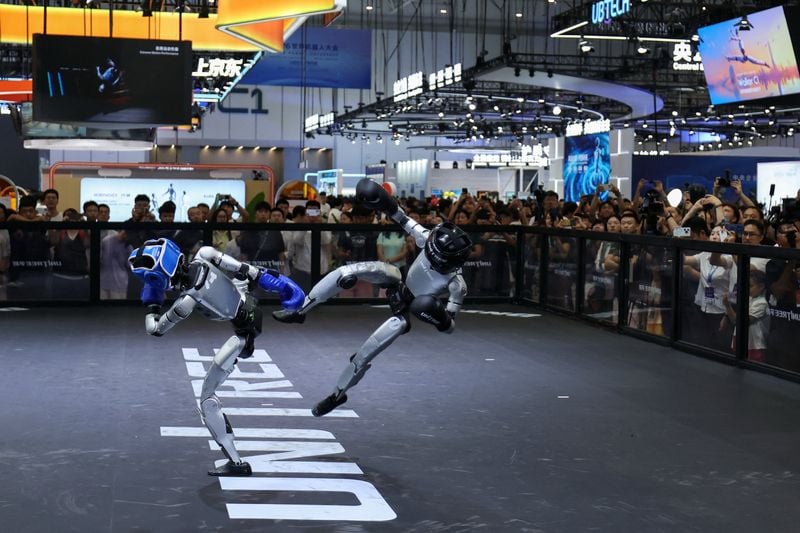
The robots are still dancing. Around them, the conversation has changed. At the 2026 edition of the World Robot Conference in Beijing, the headline finding reported by the South China Morning Post on 19 August 2026 is that Chinese humanoid firms face a "critical juncture" at which spectacle must give way to orders. The trade-press read from Investing.com on the same day runs the same way: exhibitors are seeking a path to mass adoption, not another round of choreography for cameras.
What makes 19 August 2026 a useful vantage point is that three pressures on China’s robotics build-out landed in the same news cycle. A regulatory opening of a new front between Beijing and Brussels over an e-commerce platform. A maturing competitive landscape inside China, in which dozens of firms are chasing a customer base that has not yet materialised at scale. And a continuing AI-model race in which US export controls still constrain Chinese access to the highest-end compute. Each front is being reported separately; the more useful read is that they are now colliding.
This article tracks how those three threads connect, what the showcased hardware actually looked like in the reporting, where the model race leaves Chinese vendors, and which unknowns will decide whether the "critical juncture" tilts towards mass adoption or a multi-year shake-out. The framing throughout is the article’s own; the reporting base is the 19 August 2026 wire.
The Brussels front
On 19 August 2026, the South China Morning Post reported that Chinese authorities have instructed companies not to co-operate with the European Union’s investigation into JD.com, the country’s second-largest e-commerce platform. The reporting frames the move as a deepening regulatory clash, with Beijing shifting from rhetorical pushback to operational non-co-operation.
The file matters for robotics because the platforms that anchor Chinese retail logistics have been the same ones piloting warehouse automation, last-mile delivery hardware, and humanoid pilots inside their own networks; the available source items do not specify whether JD.com itself runs such pilots, and this article has not independently established that detail. What the SCMP report does establish is that, if Beijing tightens the valve on what data and testimony can leave the country, the European read on Chinese pricing and supply chains becomes harder to verify, and so does the read on the parts of those supply chains that actually touch domestic robotics.
The Chinese position, in plain terms, is that the EU is selectively targeting Chinese platforms while leaving American counterparts alone, and that the measures are protectionist dressed up as competition policy. The European position, equally plain, is that the conduct under investigation is platform-specific, not national-origin-based. Both can be true at the same time; what is new, on SCMP’s reading, is that Beijing has moved from rhetoric to operational non-co-operation. The available source items do not specify which other EU–China regulatory files are active simultaneously; the SCMP report identifies the JD.com file and frames it as part of a deepening clash without enumerating companion probes.
What the showcase actually showed
Coverage of the conference itself, again from the South China Morning Post on 19 August 2026 and from Investing.com on the same day, describes a sector that is trying to convert hype into purchase orders. Two patterns show up in the reporting. First, the supplier base is crowded: dozens of Chinese humanoid firms are competing for what is still a thin commercial base, principally in automotive final assembly, warehousing, and security patrol, but with deployment rates that the source items do not quantify relative to installed production capacity. Second, the audience has shifted: the wire reporting treats the pivot from show-floor optics to procurement conversations as the defining feature of this year’s event, with customers and unit economics now front of mind for exhibitors.
A third thread sits underneath. Humanoid robots that aspire to do general tasks depend on large multimodal models that fuse vision, language, and manipulation. On 19 August 2026, the prediction-market platform Polymarket was pricing a 10 percent probability on a contract framed as whether China will have a top AI model by the end of the year. The market price is itself the data point: the contract is trading at single-digit percentage points, signalling that informed bettors are sceptical of a frontier-model release inside the window.
Assessment: the "critical juncture" framing in the SCMP reporting is descriptive of the supplier economics rather than a forecast. The capital is largely in place, the components are largely in place, and policy backing is in place. What the source reporting does not establish is whether a single reference customer with a recurring purchase order has emerged at scale; the conference reporting flags the question without resolving it. Until that question is resolved, the sector is selling forward promise against current losses.
The model race behind the robots
Underneath the mechanical story sits a software one. The Polymarket contract frames the betting surface most directly: a single-digit-percentage price on a Chinese frontier model release within the calendar year implies that the informed market is treating a near-term Chinese breakthrough as unlikely. The Chinese counter-frame, paraphrased for clarity rather than quoted, is that US compute controls are designed to slow Chinese capability rather than enforce a legitimate policy aim, and that domestic substitutes are closing the gap at the inference and training tiers that matter most for industrial deployment. The US position, equally paraphrased, is that advanced compute remains a national-security chokepoint and that the gap is wider than headline model releases suggest.
Both readings share an assumption: the entity that trains the strongest underlying model will inherit a default position in the robotics operating system that runs on top of it. The Polymarket contract is a sentiment thermometer on that question rather than a forecast of any specific release. The price print of 10 percent reads as the market’s current posture: sceptical, but not zero.
A separate signal from the same news cycle sits in a Telegram relay of Trump remarks on China carried by the Clash Report channel on 19 August 2026, in which Trump said of a Chinese state room: "They have the great room. They have a room that’s phenomenal." The remark is a travel anecdote rather than a policy signal on robotics, AI, or the EU dispute, and is recorded here only to keep the wire ledger intact; the substantive thread does not turn on it.
What is still open
Three unknowns will decide whether the "critical juncture" tilts towards mass adoption or towards a multi-year shake-out. First, the EU–China regulatory file: if Beijing’s non-co-operation posture hardens into a broader pattern across platforms, the cost of doing business between the two markets rises for everyone, and Chinese robotics suppliers lose a route to European reference customers. Second, the unit-economics curve: the SCMP reporting flags that hardware costs have to fall substantially before recurring purchase orders in warehousing and light manufacturing make economic sense, without quantifying the gap. Third, the model question: a credible Chinese competitor at the frontier of general-purpose manipulation models would change the calculus of every humanoid vendor currently relying on US-licensed or open-source weights.
The available source items do not specify which of those three vectors resolves first. The dominant posture in the 19 August 2026 wire is that commercial disclosures over the coming quarters, not the dance routines, will determine who is still standing. That posture is descriptive of the reporting on hand; it is not, on this evidence, a forecast the desk is willing to put a date on.
This article draws on Chinese and Western-wire reporting from 19 August 2026, treated as primary sourcing on each side. Monexus frames the EU–China dispute over JD.com as a regulatory escalation rather than a tariff event, treats the Polymarket AI-model contract as a sentiment indicator rather than a forecast, and treats the Clash Report Trump item as a wire-ledger artefact rather than a substantive input to the article’s thesis.
Wire provenance
This editorial synthesis draws on the following public wire/social posts:
- https://www.scmp.com/news/china/diplomacy/article/3364599/china-blocks-firms-aiding-eus-jdcom-probe-regulatory-clash-deepens
- https://t.me/SCMPNews/109441
- https://www.scmp.com/tech/big-tech/article/3364582/spectacle-scale-why-chinas-robotics-firms-face-critical-juncture
- https://t.me/SCMPNews/109434
- https://www.investing.com/news/stock-market-news/china-robot-makers-flock-to-beijing-show-seek-path-to-mass-adoption-4866754
- https://poly.market/yVmfoAK
- https://x.com/Polymarket/status/2090077313635324109
- https://t.me/ClashReport/92985
- https://www.scmp.com/news/china/diplomacy/article/3364599/china-blocks-firms-aiding-eus-jdcom-probe-regulatory-clash-deepens
- https://t.me/SCMPNews/109441
- https://www.scmp.com/tech/big-tech/article/3364582/spectacle-scale-why-chinas-robotics-firms-face-critical-juncture
- https://t.me/SCMPNews/109434
- https://www.investing.com/news/stock-market-news/china-robot-makers-flock-to-beijing-show-seek-path-to-mass-adoption-4866754
- https://poly.market/yVmfoAK
- https://x.com/Polymarket/status/2090077313635324109
- https://t.me/ClashReport/92985