Tehran's counter: Araghchi frames Trump's new sanctions threat as a Washington distraction
Iran's foreign minister calls Trump's freshly announced 'Economic D-Day' economic terrorism and a distraction from US fiscal strain; the policy Washington is doubling down on is the same one it has run since 2018.
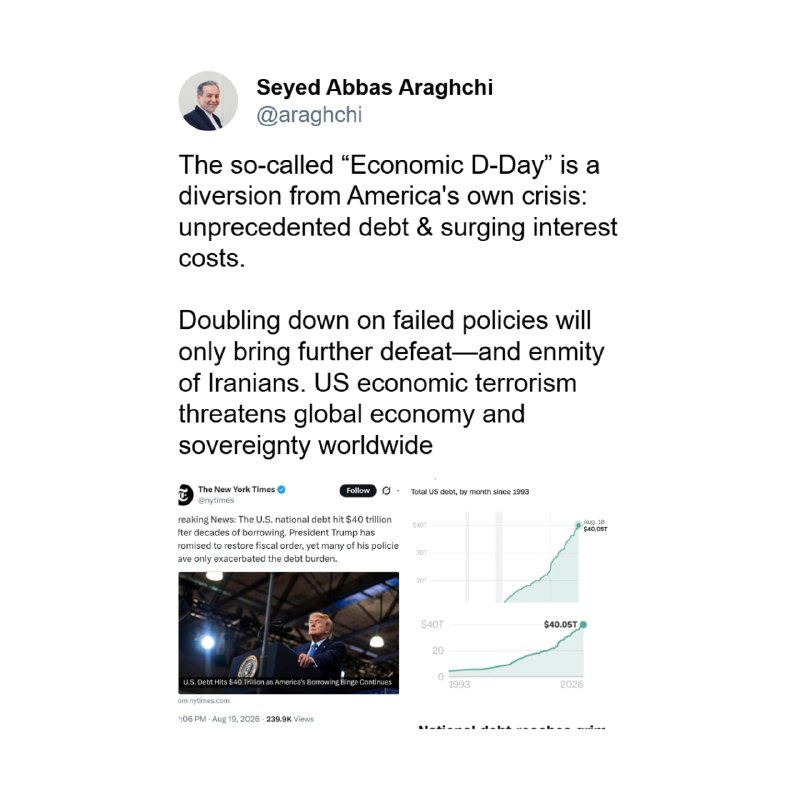
Tehran widened the rebuttal a notch on 20 August 2026. Within hours of Foreign Minister Abbas Araghchi's televised condemnation of President Donald Trump's freshly announced sanctions package as "economic terrorism," Deputy Foreign Minister for Legal and International Affairs Kazem Gharibabadi took the same argument further: the United States, he said, had already failed at military aggression, and the "next defeat" Washington would suffer was the "economic war" it was now threatening against Iran. Gharibabadi's remarks were published by the official IRNA English channel at 09:43 UTC on 20 August 2026, the same channel having carried Araghchi's own statement earlier in the day.
The exchange is more than diplomatic theatre. It puts a public label on the policy Washington has run toward Tehran since 2018, and it gives Iran's negotiating team the framing it has wanted for months: that the United States is reaching for sanctions because its other tools have run out. Read together, the cited posts trace the same argument from at least four Iranian-aligned outlets across a single morning, which suggests the response was choreographed rather than improvised.
The US line, in Trump's own words
The trigger was Trump's announcement of what he called an "Economic D-Day" against Iran, carried by CGTN's official X account at 08:30 UTC on 20 August 2026. CGTN's English-language post reported Araghchi's response, in which the Iranian foreign minister dismissed the "Economic D-Day" announcement and warned of consequences. CGTN's English-language account posted a separate follow-up item the same morning, and Press TV and The Cradle's English desk amplified related messaging within the next hour. There is no indication in the available source items that the White House has published a formal sanctions executive order or Treasury OFAC general license accompanying Trump's remarks; the cited posts contain no such document, and this article has not independently established whether one has been issued.
Tehran's frame: 'economic terrorism'
Araghchi's response, carried by IRNA English and by Press TV earlier in the day, called the threatened measures "economic terrorism" and warned that doubling down on "failed" policies would lead to "further defeat" for Washington. The Cradle's English channel framed the same remarks as a "desperate diversion from US domestic debt crisis," tying the sanctions threat to fiscal strain inside the United States rather than to Iran's behaviour. Gharibabadi's IRNA post at 09:43 UTC extended that argument into a sequenced claim: military pressure failed, economic pressure will fail, and Washington is escalating only because the alternatives have been exhausted. Each of the Iranian-aligned outlets ran the same core claim: the policy is failing, the rhetoric is escalating to cover for that failure, and the cost will be borne by ordinary people in both countries. None of the cited posts specifies a particular Iranian concession, sanctions relief, or negotiating track that the new measures are intended to force.
The 'maximum pressure' reading
Politico's analysis, summarised on X by @SprinterPress at 09:16 UTC, is the Western framing of the same moment. Trump's stated aim, Politico's piece argues, was to force Iran to back down through economic pressure; the consequences of that policy are now coming due. The Politico analysis, as relayed by Sprinter Press, treats the sanctions campaign as an escalation of the maximum-pressure posture that has run across both Trump terms, not a departure from it. Monexus assessment: the Politico and Tehran framings agree on one thing, namely that this is a continuation. They disagree on everything else, and the disagreement is itself the story. The maximum-pressure premise is that economic strangulation produces a negotiating partner; the Iranian counter-premise is that the policy has already failed, that more of it produces nothing except resistance, and that Washington's louder threats are a symptom of domestic pressure rather than a strategy.
What is actually new
Less than meets the eye. The source items do not specify any new Treasury designations, any new sectoral measures, any change to existing oil export waivers, or any new secondary-sanctions exposure for third-country buyers. What is documented, across four Iranian-aligned channels and one Politico-relayed Western analysis, is a rhetorical escalation by Trump, a coordinated Iranian response that added a deputy-ministerial voice within roughly ninety minutes of the first IRNA post, and a Politico read that the underlying policy is approaching the limit of what it can deliver. There is no first-party US Treasury or White House document in the cited posts that defines what "Economic D-Day" means in operational terms.
Where this goes next
The exchange locks in a familiar pattern: a Trump statement, an immediate Iranian counter-statement through IRNA and Press TV, and amplification through outlets such as The Cradle that reach audiences in the broader Middle East and the Global South. The addition of Gharibabadi's deputy-ministerial post tightens the choreography: it is no longer only the foreign minister rebutting in his own voice, but a second official adding the explicit claim that the next US defeat is being queued up. Monexus expectation: the next inflection will come from Treasury or the Office of Foreign Assets Control, not from the podium. If a new executive order or general license materialises in the next 48 to 72 hours, the policy moves from rhetoric to mechanism; if nothing is published, the threat stays in the category of pressure-by-announcement. Watch for an OFAC action, not another quote.
What remains uncertain
The cited posts agree that a sanctions escalation has been threatened and that Tehran has rejected it. They disagree, by framing rather than by fact, on why: Washington says leverage; Tehran says distraction. The available source items do not specify the legal form of any new measure, the sectoral targets, the timing of any executive order, or which third-country firms might face secondary exposure. Politico's analysis, as relayed by Sprinter Press, is itself a summary of a longer Politico piece that the available posts do not link to directly, which lowers the certainty of any specific claim about what Politico reported beyond the headline frame. Until OFAC publishes, every "Economic D-Day" headline is, in operational terms, a statement of intent.
Desk note: Monexus ran the Iranian state-aligned posts (IRNA, Press TV, The Cradle, CGTN relays) alongside the Politico-relayed analysis, treating each as counter-claim material with its own provenance rather than as a single unified source. The wire framing leans Washington's way on intent; the Tehran framing leans the Global-South way on causation. Both are in the piece.
Wire provenance
This editorial synthesis draws on the following public wire/social posts:
- https://t.me/Irna_en/38279
- https://t.me/Irna_en/38278
- https://t.me/presstv/203502
- https://t.me/TheCradleMedia/66476
- https://x.com/CGTNOfficial/status/2090348118160347458
- https://x.com/CGTNOfficial/status/2090355657522258074
- https://x.com/SprinterPress/status/2090367237240639803