Bessent puts economic pressure on Iran in the same week as Treasury bond-market jitters
On 20 August 2026, Scott Bessent linked tougher Iran sanctions to a lower likelihood of renewed large-scale US military operations, while separately signalling that Treasury may intervene again in the bond market.
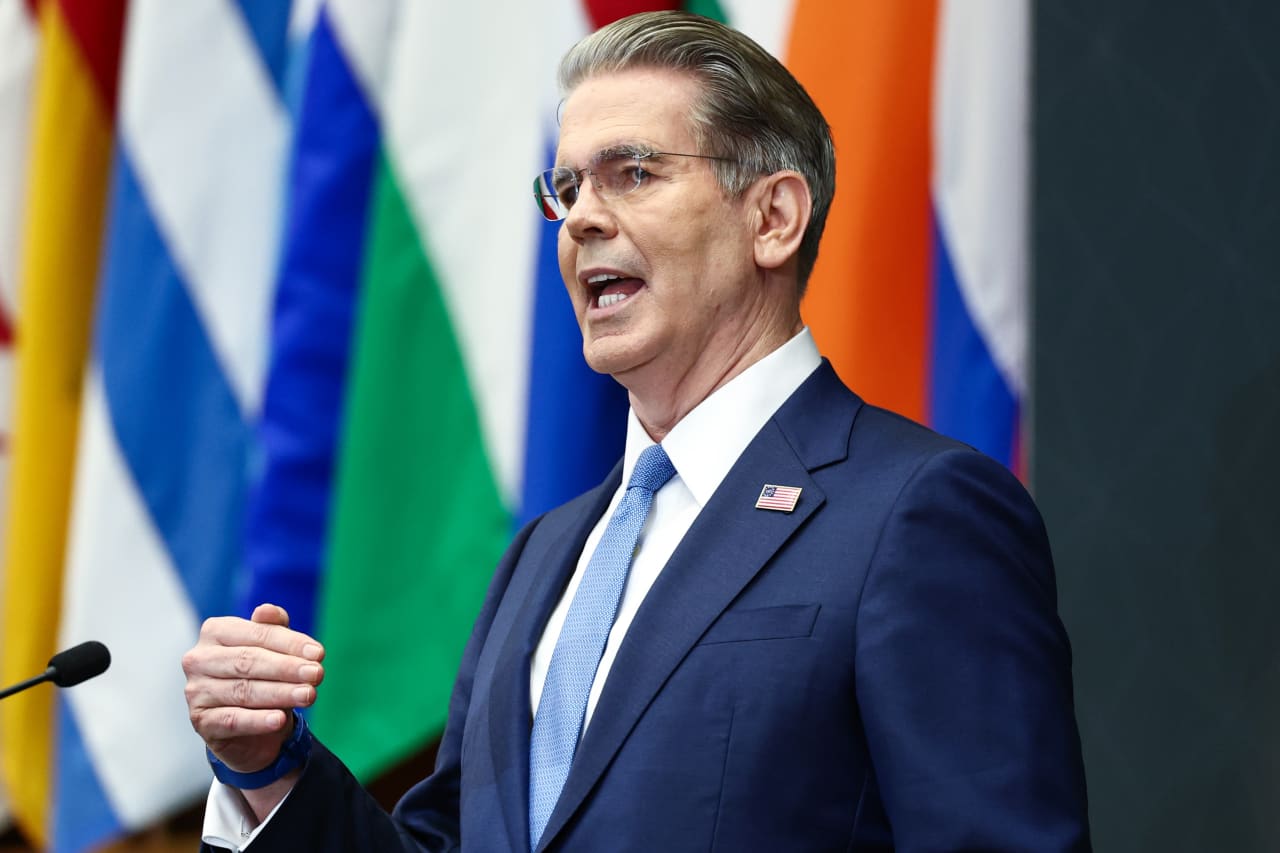
On 20 August 2026, US Treasury Secretary Scott Bessent made two statements that placed economic pressure and market management in the same frame. In remarks reported by CNBC, he said the Trump administration's plan to intensify economic pressure on Iran would make a return to large-scale US military operations less likely. Earlier, a Treasury-linked report said the department would impose what was described as the "harshest sanctions in history" on Iran.
Hours later, Iranian state-aligned PressTV posted footage of Bessent saying of a rise in oil prices, "We've got a spike in oil prices today that I don't really understand." The remark was followed by separate reports that a Treasury bond sell-off had restarted one day after an expanded buyback plan, and that Bessent had said the department retained a "big tool kit" for possible further intervention.
The immediate question is not whether sanctions and bond-market policy belong in the same story. They plainly do. Treasury is the same institution pressing Iran economically and administering a more active response to conditions in US government debt. The harder question is whether economic pressure can substitute for military escalation, and whether Treasury's intervention signals can contain the market's doubts. Monexus assessment: the cleanest reading of the record is that the two episodes are adjacent in time but not demonstrably linked in mechanism.
A sanctions strategy framed as escalation control
CNBC reported on 20 August that the Trump administration planned to intensify economic pressure on Iran and that Bessent considered this likely to reduce the need for further US military operations. Insider Paper relayed the same central point, attributing to Bessent the view that a ramp-up in sanctions made renewed heavy military operations less likely.
That is a significant claim about the administration's preferred instrument. It presents sanctions not simply as punishment for Iranian conduct, but as a way to pursue pressure while reducing the prospect of another large-scale military campaign. It does not, on the evidence available here, establish that the military phase of any previous operation is over. Nor does it amount to a formal assurance that force has been ruled out.
The Treasury sanctions announcement itself came through a Middle East Spectator Telegram post, which described the department as preparing "the harshest sanctions in history." The available source items do not specify the legal authorities, sectors, entities, implementation timetable, or secondary-sanctions provisions in the package. That limits what can responsibly be said about its likely effect on Iran's banking, energy, or shipping networks.
There is also a narrower policy tension. Sanctions can increase the political risk surrounding an oil producer without necessarily removing physical supply immediately. Yet the supplied sources do not provide a measured oil-price move, a crude benchmark, a contract expiry, or a market-wide explanation for the rise Bessent said he did not understand. The connection between the sanctions announcement and the oil move should therefore be treated as an open question, not as a demonstrated causal chain.
The oil remark leaves causality open
At 17:45 UTC on 20 August, PressTV posted a clip of Bessent saying, "We've got a spike in oil prices today that I don't really understand." The wording records genuine uncertainty from the Treasury secretary. It does not identify the cause of the rise.
The announcement of tougher sanctions supplies a plausible market narrative: traders may interpret pressure on an oil-producing country as a source of future supply risk. But plausibility is not evidence. The available reporting does not provide a before-and-after price series, a quoted analyst assessment, or a first-party Treasury explanation linking the move to Iran, shipping, demand, or any other factor.
This distinction matters. Officials routinely separate policy announcements from market commentary to preserve negotiating flexibility and avoid creating self-fulfilling expectations. Monexus assessment: that is the most restrained reading of Bessent's wording. It is not evidence of concealment, nor is it proof that the sanctions announcement had no market effect. It is simply the limit of what the record establishes.
Iranian state media is also a relevant but interested source. PressTV has an institutional reason to emphasize US uncertainty and to connect US policy with economic disruption. Its clip is useful because it preserves the Treasury secretary's words, but the surrounding interpretation should remain separate from the quote itself.
Treasury returns to the bond-market debate
The second market story concerns US government debt. MarketWatch reported at 15:37 UTC on 20 August that a Treasury sell-off had restarted one day after Bessent's expanded buyback plan. A separate MarketWatch report, timestamped 15:25 UTC, said the Treasury could intervene again and quoted Bessent as saying, "We have a big tool kit."
The supplied descriptions establish that the administration was simultaneously defending its sanctions strategy and discussing possible action in the bond market. They do not establish why the buyback plan was originally introduced, how large it was, which maturities it covered, or whether it produced a specific change in yields. The phrase used in MarketWatch's headline, "Bessent's beefed-up buyback plan," is attribution to the outlet's framing, not a verified statement of the secretary's intent.
This distinction prevents a false account of the policy sequence. Treasury may have adopted the plan for liquidity, market functioning, duration management, or another purpose not specified in the available items. MarketWatch's reporting supports the fact that a sell-off resumed after the plan, and that Bessent raised the possibility of additional intervention. It does not support a categorical conclusion that the first plan was intended to calm markets or that its stated purpose failed.
Monexus analysis: the two episodes reveal a Treasury operating across two contested economic theatres. In Iran, pressure is presented as a way to reduce the likelihood of renewed large-scale military operations. In the bond market, intervention is retained as an option against renewed selling. The parallel suggests an administration relying on economic tools to manage both external coercion and domestic financial conditions, but the sources do not establish that these decisions were coordinated or that one market was reacting mechanically to the other.
The limits of economic statecraft
A more restrained reading starts from what can be observed. Treasury is prepared to use sanctions as a principal instrument against Iran. Bessent publicly presented those measures as less likely to require a return to large-scale US military operations. At the same time, the oil-price spike remained unexplained in his public remarks, and Treasury was reported to be considering another intervention in the bond market.
That is enough to identify the central policy choice. Washington is combining coercion abroad with active management at home. The strategy may be intended to contain escalation while preserving US leverage, but its durability cannot be inferred from the announcements alone. Sanctions require enforcement and implementation to matter. Bond-market interventions require enough market confidence to affect pricing. Oil prices respond to expectations about supply and risk, which may be shaped by policy but are not commanded by it.
The alternative explanation is equally important. The Treasury secretary's Iran and bond-market remarks may reflect separate immediate pressures rather than a unified strategy. The available sources do not provide a statement connecting the sanctions package to Treasury securities, nor do they establish that the oil move caused the bond sell-off. A disciplined account should keep the events adjacent, not pretend they form a proven causal sequence.
The stakes are nevertheless concrete. If tougher sanctions fail to constrain Iran without producing a negotiated settlement, the administration's claim that economic pressure can limit military escalation will look weaker. If oil prices remain elevated while the explanation remains unsettled, importers and consumers will bear the cost without a clear policy account. If Treasury purchases are repeatedly needed to support longer-dated government debt, investors may focus more closely on the scale and purpose of intervention. Conversely, if sanctions increase US leverage and bond-market action restores orderly trading, the administration may conclude that economic management delivered outcomes that military escalation would not.
Those are forward-looking judgments, not established outcomes. The next information to watch is operational: the legal texts and implementation timetable for the Iran measures, the size and maturity focus of Treasury's buybacks, any further bond-market intervention, and a sourced explanation for the oil-price move. Until those details are available, the strongest conclusion is also the narrowest: Bessent put economic pressure at the centre of the Iran strategy, while leaving open the scale and purpose of Treasury's next move in the bond market.
Desk note: Monexus framed this as an economic-statecraft and financial-markets story under the defense desk, avoiding an unsupported military chronology and the unsupported assertion that the buyback plan was unveiled specifically to calm the bond market.
Wire provenance
This editorial synthesis draws on the following public wire/social posts:
- https://t.me/presstv/203559
- https://t.me/Middle_East_Spectator/36011
- https://t.me/insiderpaper/44053
- https://www.cnbc.com/2026/08/20/bessent-economy-iran-war-trump.html
- https://www.marketwatch.com/story/treasury-rout-restarts-one-day-after-bessents-beefed-up-buyback-plan-972766a1?mod=mw_rss_topstories
- https://www.marketwatch.com/story/bessent-suggests-treasury-could-intervene-again-in-bond-market-we-have-a-big-tool-kit-358829e1?mod=mw_rss_topstories
- https://t.me/presstv/203559
- https://t.me/Middle_East_Spectator/36011
- https://t.me/insiderpaper/44053
- https://www.cnbc.com/2026/08/20/bessent-economy-iran-war-trump.html
- https://www.marketwatch.com/story/treasury-rout-restarts-one-day-after-bessents-beefed-up-buyback-plan-972766a1?mod=mw_rss_topstories
- https://www.marketwatch.com/story/bessent-suggests-treasury-could-intervene-again-in-bond-market-we-have-a-big-tool-kit-358829e1?mod=mw_rss_topstories