Tehran fires back on three tracks: Iran’s replies to Trump’s economic pressure line, hour by hour
Within an hour of US President Donald Trump’s 20 August announcement of further economic pressure on Iran, three Iranian officials responded by relay: deputy FM Kazem Gharibabadi, foreign minister Abbas Araghchi, and parliamentary security commission member Ebrahim Razaei.
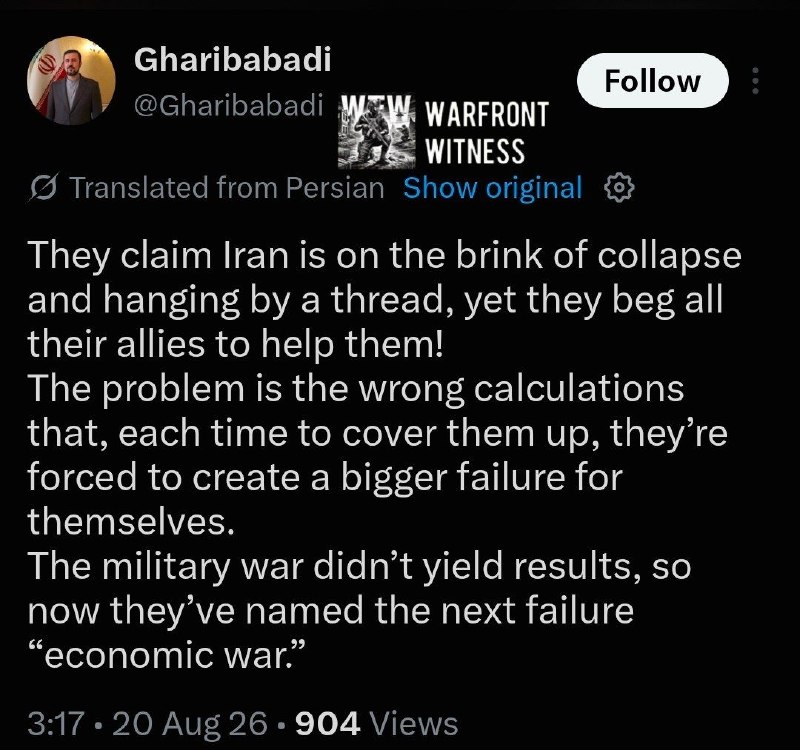
By 07:45 UTC on 20 August 2026, the Telegram feed ClashReport had distilled the morning’s US-Iran exchange into a single line attributed to Iranian Deputy Foreign Minister Kazem Gharibabadi: they claim Iran is on the brink of collapse and "hanging by a thread," he said, "yet they beg all their allies to help them." The phrase landed roughly an hour after US President Donald Trump’s remarks, carried by the war-monitoring channel wfwitness at 06:42 UTC and again at 06:52 UTC, announcing further economic pressure on Iran and asserting that no deal had yet been reached. The deputy minister’s response was the most quoted of the morning. It was not the only one.
The thread evidence contains three distinct Iranian replies circulating in the same hour, not one. Foreign Minister Abbas Araghchi answered in the same wfwitness post that carried the Trump announcement at 06:42 UTC. Ebrahim Razaei of the Iranian Parliament’s National Security and Foreign Policy Commission replied in the wfwitness post at 06:52 UTC. Gharibabadi’s line, circulated by wfwitness at 07:41 UTC and by ClashReport at 07:45 UTC, completed a three-track response within the span of a single news cycle. Treating the Gharibabadi line as the whole of Tehran’s answer flattens what the cited posts actually show.
What Trump said, and how the channels labelled it
The two wfwitness posts timestamped 06:42 UTC and 06:52 UTC carry overlapping excerpts attributed to the US president. The anchor phrase in both is that no deal has been reached and that "no one has given the Islamic Republic of Iran a greater opportunity to make a deal" than the current administration. The framing is transactional, not bellicose: pressure on, door open, the cost of walking through it assigned to Tehran.
The phrase "economic war" sits in the channel’s own framing of the announcement, as carried in the wfwitness headline text. Monexus analysis: that label is editorial on the Telegram side, not necessarily a verbatim presidential phrase in the excerpts circulated. Independent wire outlets have separately attributed the "economic war" framing to the announcement; the cited Telegram posts do not, on their own, establish whether the phrase originates with the president or with the monitoring channel. The body of evidence the desk has is the message and the channel’s characterisation of it, not a primary transcript.
Three Iranian answers, one hour
Reading the wfwitness posts in order changes the picture. The 06:42 UTC post pairs the Trump excerpt with a separate response attributed to Iranian Foreign Minister Abbas Araghchi addressing what the post labels "Economic D-Day." The 06:52 UTC post, an extended cut of the same Trump remarks, is paired with a response attributed to Ebrahim Razaei of parliament’s National Security and Foreign Policy Commission. By 07:41 UTC, wfwitness had relayed Gharibabadi’s criticism of the "economic war" announcement, framed by the deputy minister as delivered via X. By 07:45 UTC, ClashReport had posted a tightened version of the same Gharibabadi line.
Three officials, three platforms, one morning. The cited posts do not specify whether Araghchi and Razaei were also speaking on X, at a press conference, or in a parliamentary session; they specify that the responses were relayed alongside the Trump excerpts within the same hour. The Gharibabadi line, by contrast, is identified in the wfwitness excerpt as a criticism delivered "via X," and the 07:41 UTC timestamp is the relay time, not the original posting time. That distinction matters for any timeline that treats the relay timestamps as the moment of Iranian speech.
The structural frame, in plain prose
What is unfolding is a contest over the meaning of the pressure, conducted in real time across social platforms. Both sides agree a deal is the off-ramp. Both sides agree the economic squeeze is tightening. The US position, as carried in the excerpts, is that the door is open and the cost of walking through it falls on Tehran. The Iranian position, as carried across three officials in one hour, is that the door is a trap and the cost of US coercion is paid by every capital Washington has had to lobby to keep its coalition intact.
The pattern is not new. Economic coercion campaigns work, when they work, by making the cost of non-compliance exceed the cost of compliance for the target. They fail, when they fail, by making the cost of compliance exceed the cost of defiance, or by making the enforcing coalition too expensive to maintain. Iran’s public bet in 2026, as in earlier sanctions cycles, is that the second condition will arrive before the first. Monexus analysis: the speed and plurality of the Iranian replies suggest a coordinated message operation, not a single spokesperson freelancing. Three officials answering within an hour, on the platforms the cited posts identify, is a pattern of state messaging, not an off-the-cuff reaction. The cited posts do not establish whether the coordination was directed from a single office; they establish the pattern.
Stakes and what to watch
If the three-track reply lands with the audiences it is designed for, two things follow. Allied capitals that have so far acquiesced to US Iran policy will start asking, privately and then publicly, what their governments are getting out of the arrangement. And the Iranian negotiating posture, if and when talks resume, will treat any new US offer as a confirmation that the previous round of pressure has failed, which compresses Washington’s leverage at the table.
The countervailing read is that the speed and volume of the replies are themselves a tell. A foreign minister, a parliamentary security commissioner, and a deputy foreign minister all answering within the hour, on social platforms, signals a messaging operation aimed as much at domestic audiences as at Washington. The cited posts do not adjudicate between the two reads. They establish that the messaging is live, that three Iranian officials spoke into the same news cycle, and that the next move, on either end, will be made under a press frame already chosen.
The narrow uncertainty worth flagging: the source items are Telegram relays of video addresses, parliamentary reactions, and X posts. They carry attribution but not primary documents. The cited posts specify the relay times; they do not specify the original posting times for the Iranian replies, the venues at which Araghchi and Razaei spoke, or whether the "Economic D-Day" label originated with the channel, with Araghchi, or elsewhere. Independent confirmation from Reuters, AP, AFP, BBC, Iranian state outlets, or the foreign ministry’s own feed would harden the timeline and the attributions; the available items carry the message but not the medium in full.
How Monexus framed this versus the wire: the cited Telegram channels led with "economic war" as a label on the announcement, and carried three distinct Iranian replies within the hour. The desk has kept the editorial label in the framing layer, surfaced all three replies rather than one, and flagged the relay-versus-original-posting distinction in the timeline. Where independent wire reporting later attributes the "economic war" line directly to the US president or specifies original posting times for the Iranian statements, this piece would need to be updated.
Wire provenance
This editorial synthesis draws on the following public wire/social posts:
- https://t.me/wfwitness/107692
- https://t.me/wfwitness/107693
- https://t.me/wfwitness/107694
- https://t.me/ClashReport/93050