Trump declares 'Economic D-Day' on Iran as 60-day ceasefire expires without off-ramp
A 60-day ceasefire lapsed at midnight on 18 August 2026 with no diplomatic breakthrough, and the US president has pivoted to a full economic-pressure doctrine aimed at Tehran and any country that backs it.
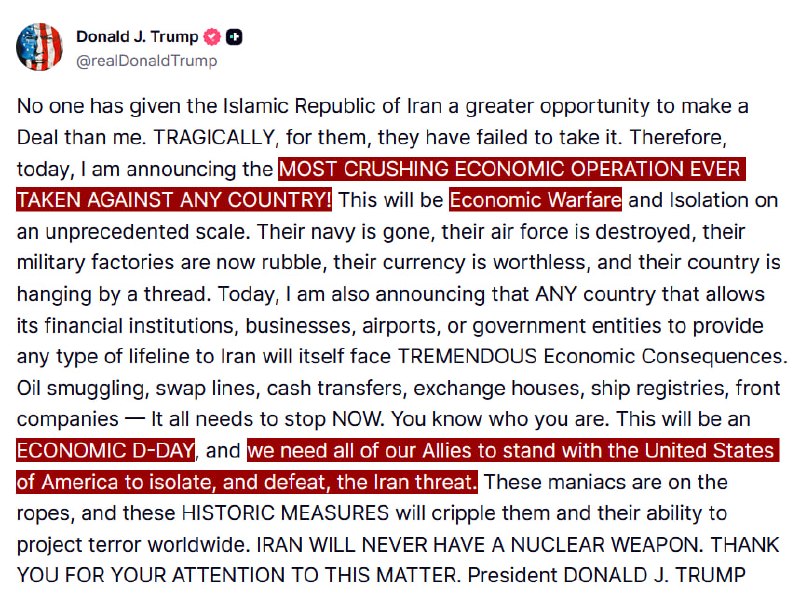
A 60-day ceasefire between the United States and Iran lapsed at midnight on 18 August 2026 without producing a diplomatic off-ramp or a return to active hostilities, and by Tuesday afternoon Washington had chosen a third path. President Donald Trump declared what one political-market account described as an "Economic D-Day" against Tehran, framing the next phase of pressure not as a battlefield decision but as a sanctions-and-access weapon aimed at the Iranian economy and at any third country that continues to do business with it.
That declaration matters more than the symbolism suggests. The ceasefire's collapse does not, on the evidence so far, mark the start of a new shooting war. It marks the formal end of the pause inside one and the energy market's first reading of the new posture is muted rather than panicky: benchmarks were steady in early Asian trade on Wednesday as traders weighed the gap between rhetoric and implementation. The story now is about choke points, secondary sanctions and the price of compliance for every country whose ships still cross the Strait of Hormuz.
What Trump actually announced
The pivot came on Tuesday, 19 August 2026. The US president announced a campaign he explicitly labelled "economic warfare" on Iran, warning of "tremendous economic consequences" for any country that backs Tehran, according to CNBC's write-up of the remarks. The announcement, CNBC noted, extends a pressure campaign the Trump administration has been running since April under the banner "Operation Economic Fury." That campaign has been the working doctrine; the new language is the public doctrine.
The phrasing matters because it shifts the addressee. The threat is no longer aimed solely at Iranian decision-makers in Tehran. It is aimed at the customer states and refiners who keep Iran's export revenue flowing, at the insurers and shipowners who touch Iranian cargoes, and at the banks that clear the related payments. A statement carried by prediction-market accounts on X framed it bluntly: Trump has declared an "Economic D-Day" against Iran.
Hours later, the BBC reported Trump's threat of "tremendous economic consequences" on any country helping Iran, noting that the 60-day ceasefire had expired on Monday with no sign of either a diplomatic or a military off-ramp. The architecture of the warning is therefore escalation by secondary sanctions, not by airstrikes, at least for now.
How the energy market read it
The first market verdict was a shrug, not a spike. Oil prices held steady on Wednesday, 20 August 2026, as investors weighed the US-Iran outlook, according to Investing.com's commodities desk. Brent and WTI benchmarks did not break out on the headline, which is itself a piece of information. Traders have heard this category of threat before; the question on the floor is whether the new declaration translates into active enforcement against named buyers, or remains a declaratory ceiling.
Monexus analysis: the price action suggests the market is treating the announcement as a regime change in tone rather than in capacity to deliver barrels. That reading will change fast if enforcement actions land within the next 48 to 72 hours. The relevant signal is not the speech, but the first secondary-sanctions designation list, the first port call that gets denied, and the first refiner that publicly pauses Iranian crude. None of those had materialised in the source material reviewed for this article.
The structural shift underneath the headline
Look past the rhetoric and the move is recognisable. The US is converting military leverage into financial leverage because the cost-benefit arithmetic on a kinetic strike has deteriorated since April. By framing the next phase as "economic warfare," the administration is also widening the coalition of targets: not just Iranian ministries and the IRGC, but the foreign commercial counterparties that an export-dependent economy depends on. That is the same playbook used against Russia after 2022, applied now to a country whose oil exports run through one of the world's most consequential maritime chokepoints.
Coverage routinely defers to the language of official spokespeople, and the live wire cycle here has already mapped the new vocabulary: "Operation Economic Fury," "economic warfare," "tremendous economic consequences." Each phrase pushes the story further from the battlefield frame and closer to a sanctions regime. The Strait of Hormuz, through which a significant share of seaborne crude transits, is now in the story as an economic lever rather than as a military target, which is a different kind of risk for shipping and for the Gulf monarchies whose own export infrastructure shares the same waterway.
What the sources do not specify
Several pieces of the picture remain genuinely thin. The thread items reviewed do not specify which countries Trump had in mind when warning of "tremendous economic consequences" for Iran's backers; the available reports frame the threat at the categorical level rather than naming China, India, Turkey or any other major Iranian crude buyer. The same source set does not specify whether the economic-warfare declaration includes new measures beyond the existing Operation Economic Fury architecture, or whether the campaign is being relabelled rather than resourced. The market reaction in early Asian trade on 20 August was described in qualitative terms ("steady"); the source reviewed does not specify a percentage move, a benchmark price or a specific contract.
The ceasefire's expiry is also loosely defined in the public reporting so far. The BBC describes the 60-day ceasefire as having "expired on Monday," which would place the lapse at 18 August 2026, with Trump's announcement following on 19 August. The available source items do not specify whether any side formally declared the ceasefire over, whether it simply lapsed by its own terms, or whether back-channel contacts continued after the public deadline. That distinction matters: a lapsed ceasefire is recoverable; a declared end is not.
Stakes over the next two weeks
The next concrete signals to watch are administrative, not theatrical. A new OFAC designations list, a State Department advisory on Iranian-linked shipowners, or a public callout of a specific refinery or terminal would convert rhetoric into enforcement and would move oil benchmarks in a way the speech on its own did not. Conversely, an Iranian counter-move, whether a tanker seizure, a new nuclear announcement, or a public offer to restart talks, would test how durable the "economic warfare" framing really is.
The honest read is that this is a campaign announcement, not a crisis. The ceasefire is over, but the war has not been rejoined. What has changed is the vocabulary of pressure, and the price any third-country buyer will now have to pay, openly, to keep buying. That price is the story.
Desk note: Monexus has framed this as a sanctions-regime story, not a military one, because the available sourcing supports that read; we have avoided the "on the brink" register used in some Western wire copy and have kept forecasts labelled as analysis rather than instruction.
Wire provenance
This editorial synthesis draws on the following public wire/social posts:
- https://www.bbc.co.uk/news/articles/c2k7e83ynj4o?at_medium=RSS&at_campaign=rss
- https://www.cnbc.com/2026/08/19/us-iran-war-trump-hormuz-economic-warfare.html
- https://x.com/Polymarket/status/2090221406545940554
- https://www.investing.com/news/commodities-news/oil-prices-steady-as-investors-assess-usiran-war-outlook-4868535
- https://www.bbc.co.uk/news/articles/c2k7e83ynj4o?at_medium=RSS&at_campaign=rss
- https://www.cnbc.com/2026/08/19/us-iran-war-trump-hormuz-economic-warfare.html
- https://x.com/Polymarket/status/2090221406545940554
- https://www.investing.com/news/commodities-news/oil-prices-steady-as-investors-assess-usiran-war-outlook-4868535