Iran’s army chief marks Defense Industry Day with message tied to indigenous production
On Iran’s National Defense Industry Day on 21 August 2026, army commander Major General Amir Hatami issued a message to the acting defense minister that framed the country’s military-industrial base as the product of domestic labor and indigenous knowledge.
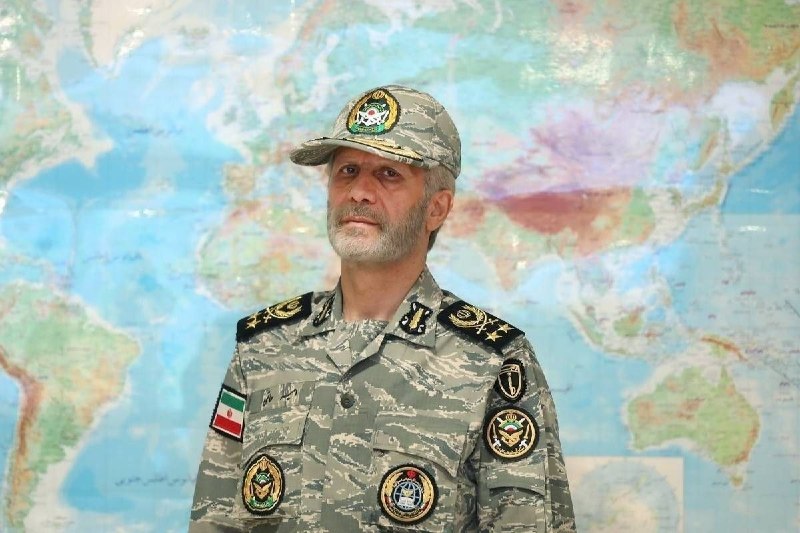
At 15:59 UTC on 21 August 2026, the Telegram channel of Iranian state outlet Press TV published a post, accompanied by a photograph, marking National Defense Industry Day and attributing to army commander Major General Amir Hatami a congratulatory message to Iran’s acting minister of defense and armed forces support. The post was the fifth in a coordinated cascade of state-aligned items that began at 15:25 UTC, when Tasnim News English carried the first iteration, and closed thirty-four minutes later with the visual item from Press TV.
This publication reads the choreography as deliberate. The day’s messaging does not announce a new weapons system, a contract, or a deployment. What it does is restate, in plain language, the political logic that has governed Iran’s defense-industrial posture for years: build at home, advertise at home, and treat every domestic subsystem as a line drawn against external pressure. The significance is rhetorical rather than technical, and that is precisely the point.
The line Hatami drew
The substantive content of the day sits in five posts across four outlets, all timestamped between 15:25 and 15:59 UTC on 21 August 2026. Al-Alam Arabic carried two of them. At 15:27 UTC the channel posted a Hatami line crediting "the efforts of the people of the country in the defense industries" for what had been provided to the armed forces; at 15:28 UTC it carried the framing that defense industries are "not just equipment and systems, but rather an embodiment of confidence in Iranian power and self-sufficiency." A third item, posted by Al-Alam Farsi at 15:28 UTC and titled to the "Commander-in-Chief of the Army," added that "the Iranian nation will not surrender."
The English-language cut, posted by Tasnim News English at 15:25 UTC and attributed to the Commander-in-Chief of the Army, carried a different framing: that "Iran's defense power has changed the equations of the enemies," with that shift located in the work of the Ministry of Defense and Armed Forces Logistics over the preceding years. The Press TV post at 15:59 UTC used different language again, citing faith in Iranian capability, self-sufficiency, and indigenous knowledge, and closing with the line that a nation which builds its defensive shield with the capable hands of its own children will not surrender but will emerge victorious. Read together, the items form a single argument: indigenous production is the cause, strategic effect is the consequence, popular labor is the legitimating agent.
A note on titles. Al-Alam Arabic and Press TV, in the items above, refer to Hatami as Commander of Iran’s Army; the Al-Alam Farsi post and the Tasnim English post style him Commander-in-Chief of the Army. The available source items do not specify whether those titles denote the same role in this context or reflect an editorial preference by each outlet; this article treats both as designations the same senior army post held by Hatami in 2026, without further reconciliation. The ministerial counterpart is referred to as the acting defense minister in Press TV and as the acting minister of defense and armed forces support in Al-Alam Farsi; this article refers to that office in both forms.
State-aligned amplification, by design
The same commemorative occasion surfaced across five Iranian state-aligned items within roughly half an hour on 21 August 2026. Al-Alam Arabic supplied a pair of posts that captured both the political framing (self-sufficiency as embodiment of national confidence) and the industrial framing (the labor of the country’s people), within a minute of each other. Al-Alam Farsi relayed a Persian-language cut with the resistance frame. Tasnim News English provided the English-language iteration aimed at external audiences. Press TV closed the sequence with the visual item.
The distribution pattern is itself the story. Iranian state-aligned outlets do not treat ceremonial messages as routine copy; they treat them as coordinated messaging windows, with Persian-language, Arabic-language, and English-language channels each carrying a tailored cut. The 21 August cascade fits that practice. The Arabic-language cut leans on confidence and self-sufficiency, themes calibrated for an audience that includes Lebanese, Iraqi, and Yemeni viewers in whose political vocabulary self-sufficiency is itself a loaded term. The English-language cut emphasizes a shift in the enemies’ strategic calculus, a frame calibrated for analysts in Washington, London, and Tel Aviv who watch Iranian defense output less for its symbolism than for its implications. The Press TV cut fuses the two, pairing the indigenous-knowledge frame with a closing line on national resolve.
The political function of the industrial base
Monexus analysis: the message reads as a defense of an industrial policy choice rather than a procurement announcement. The strategic logic on display in these items is consistent: indigenous production is the cause, strategic effect is the consequence. The political corollary on display is equally consistent: the labor of ordinary Iranians legitimates the output, and the output legitimates the policy. That is a reciprocal arrangement, and it is harder to dismantle than a procurement line item.
Hatami’s 21 August message works inside that logic. By tying what the armed forces hold today to the efforts of the country’s people in the defense industries, the army chief is restating the social contract that underwrites the industrial base: the Iranian public supplies the labor and the legitimacy, the defense ministry supplies the direction, the armed forces field the product. The arrangement is presented as reciprocal, and therefore durable.
Stakes and what to watch next
The near-term stakes are symbolic but not trivial. The day’s messaging does not, on the available evidence, include any weapons-unveiling or contract announcement. The five cited posts describe a commemorative message, not a procurement event. That itself is informative. The choice to mark the day with a political statement rather than a hardware reveal suggests an intent to consolidate the legitimacy of the industrial base without offering adversaries a fresh technical data point to react to.
Two developments are worth watching. The first is whether the Ministry of Defense and Armed Forces Logistics, Hatami’s counterpart in the message, uses the same window to publish production statistics, facility inaugurations, or export arrangements. The second is whether Western wire reporting in the days that follow treats the message as ceremonial or as a signal. The distinction matters because ceremonial coverage places the day in the domestic-politics column, while signal coverage places it in the deterrence-and-proliferation column. On the evidence available, the latter framing is not yet warranted.
What the available source items do not specify is the substantive content of any new contract, production run, or capability milestone tied to the 2026 commemoration. This article has not independently established whether one was announced through channels not represented in the inputs above. The framing above therefore rests on the five cited posts, on the distribution pattern across state-aligned outlets, and on the longer pattern of Iranian defense-industrial policy that the message echoes rather than extends.
Desk note: Monexus framed this as a messaging event with political, not technical, content. Western wires that treat National Defense Industry Day primarily as a proliferation signal will tend to over-read; outlets that treat it as pure ceremony will tend to miss the social-contract argument the day is built to deliver.
Wire provenance
This editorial synthesis draws on the following public wire/social posts:
- https://t.me/presstv/203677
- https://t.me/alalamarabic/496322
- https://t.me/alalamarabic/496321
- https://t.me/alalamfa/350289
- https://t.me/tasnimnews_en/32390