Israeli demolition and artillery strikes hit Markaba and Arnoun as Russian missile strike kills six in Kryvyi Rih
Three Israeli demolition items and a fourth post combining a second Markaba detonation with an artillery strike on Barachit populated the open-source feed from southern Lebanon on the afternoon of 21 August 2026, the same hour a Russian strike on a Kryvyi Rih shopping centre left at least six dead.
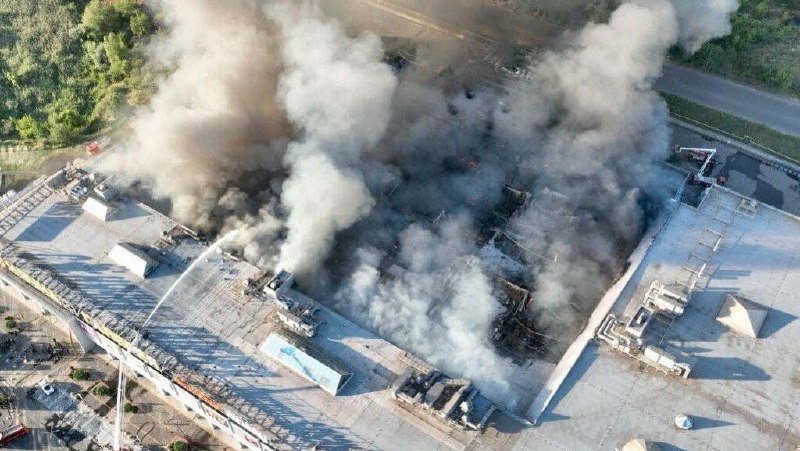
A single open-source Telegram channel logged four items on the afternoon of 21 August 2026 from the southern Lebanon security zone, and a fifth from a Ukrainian city hundreds of kilometres to the north. The first, posted at 16:07 UTC, recorded an Israeli detonation in the town of Markaba. The second, posted at 16:09 UTC, combined a second Israeli detonation in Markaba with an Israeli artillery fire incident against the occupied Lebanese town of Barachit. A third, posted at 16:24 UTC, carried a Russian strike on a shopping centre in Kryvyi Rih, Ukraine, with at least six killed and nearly 100 injured. The fourth, posted at 16:41 UTC, recorded two further Israeli detonations against Arnoun. The Lebanese items came from the same channel, on the same afternoon, in a span of thirty-four minutes.
What the channel shows is a snapshot of two wars running in parallel, and a tightening of the southern Lebanon item count from a single demolition post to a four-post afternoon that mixes engineering work and tube artillery. None of the four Lebanese items names the targeted infrastructure, attributes the operations to a specific Israeli unit, or carries an Israeli or Hezbollah statement attached to the alert.
What the four Lebanese posts contain
The 16:07 UTC post reports an Israeli detonation in the occupied Lebanese town of Markaba within the security zone of southern Lebanon. The 16:09 UTC post combines a second detonation against Markaba with an Israeli artillery fire incident against Barachit, also within the security zone. The 16:41 UTC post reports two Israeli detonations against Arnoun, again within the security zone. The phrase "occupied Lebanese town" is used in each item by the channel itself, not by this publication. None of the four posts reports a casualty figure for the Lebanese strikes, and none reports a Hezbollah rocket or drone response in the same item. The Kryvyi Rih post stands alone in the channel's casualty accounting for the afternoon, with at least six killed and nearly 100 injured.
The four Lebanese items together describe a thirty-four-minute window of activity concentrated in two named towns and one additional town, with demolition work and an artillery item appearing inside the same post. The channel does not classify the work as engineering, counter-Hezbollah, or otherwise, and the framing in this paragraph reflects the channel's own language.
The Ukraine item, separately
At 16:24 UTC the same channel carried a separate report: Russian strikes on a shopping centre in Kryvyi Rih, a mid-sized Ukrainian city west of Dnipro, with at least six dead and nearly 100 injured. The post sits on the same feed minutes apart from the southern Lebanon items because the channel covers two wars. The casualty figures it carries are the only hard counts the channel produced on 21 August 2026 for any of the five items it logged. The available source items do not specify the weapon used, the target's military relevance, or whether a Russian Ministry of Defence briefing followed. This article has not independently established any of those details.
Monexus analysis: the operational signal of the 21 August Lebanese traffic is mixed, not uniform. The channel reports both demolition work and tube artillery in the same post, which suggests the day's pressure combined bulldozers and fire on named towns. The Kryvyi Rih casualty count, by contrast, is a hard number from a populated object inside a city well behind any contact line. Reading the two together is a journalistic exercise in keeping categories separate: a shopping-centre strike with named casualties in a third country is not the same category of event as demolition and artillery items inside a security zone, even when they appear on the same feed minutes apart.
Reading the item count, not the items
What the afternoon suggests, when the items are read as a sequence rather than a single event, is volume rather than breakthrough. The channel has carried southern Lebanon items on earlier days; the 21 August post count of four Lebanese items in thirty-four minutes, including a combined demolition-and-artillery post, is a denser pattern than a single isolated alert would imply. The denser the open-source count, the more visible the work to any monitoring team that watches the feed; the 21 August count is therefore an argument about visibility, not about strategic intent, because the channel does not specify intent.
The counter-reading is that one dense afternoon is a single afternoon, and a single afternoon does not establish a trend. A reader who saw the 16:07 UTC post in isolation would read one demolition item in one town; a reader who saw only the 16:41 UTC post would read two detonations in a different town. Neither reader would see the artillery item, which lives inside the 16:09 UTC post. The combined post is the analytical hinge of the afternoon, because it is where demolition and tube artillery appear on the same record within two minutes of each other and inside the same town cluster.
What remains open
The four Lebanese posts do not name the targeted infrastructure in Markaba, Arnoun, or Barachit. They do not carry a Hezbollah statement, an Israeli military spokesperson briefing, a UNIFIL incident tally, or a Lebanese Prime Minister's office reaction. The Kryvyi Rih post does not name the weapon used, the Russian formation responsible, or whether a Ukrainian Air Force or General Staff statement followed. The available source items do not specify whether any of those statements have been issued at the time of writing, and this article has not independently established that. Any first-party classification of the day's work on either front, Israeli, Hezbollah, Russian, or Ukrainian, is an open question that the supplied thread does not resolve.
Desk note: this article used open-source Telegram channel traffic from a single feed as the wire input; the four southern Lebanon items and the Kryvyi Rih item are presented strictly as channel reports, with the channel's own language preserved and any operational, legal, or strategic reading flagged as analysis.
Wire provenance
This editorial synthesis draws on the following public wire/social posts:
- https://t.me/wfwitness/107853
- https://t.me/wfwitness/107854
- https://t.me/wfwitness/107858
- https://t.me/wfwitness/107855