Five southern Lebanon strikes logged on 21 August, all inside the security zone
Five strike reports on the wfwitness channel hit villages inside the southern Lebanon security zone on 21 August 2026: Markaba twice within two minutes, Arnoun at 16:41 UTC, Touline at 18:43 UTC, and Barachit at 16:09 UTC, with only the Touline entry naming a weapon type.
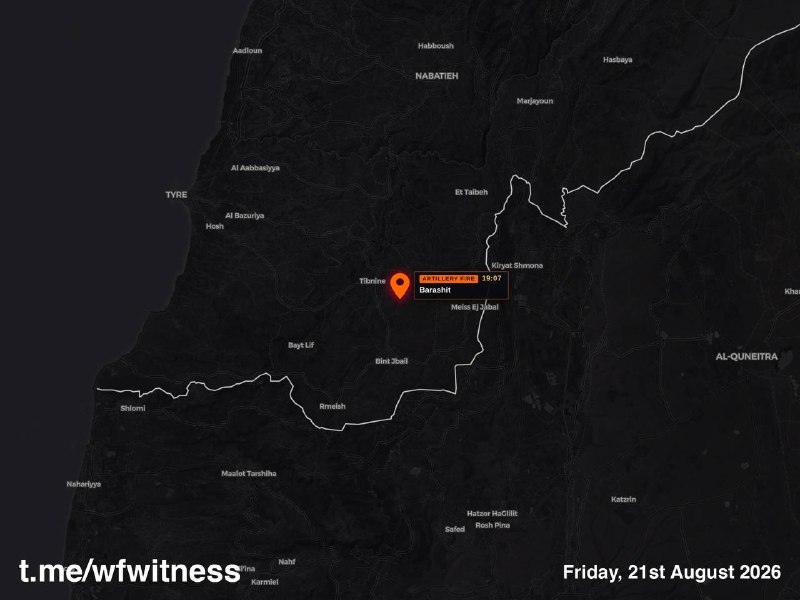
At 18:43 UTC on 21 August 2026, the field channel wfwitness logged Israeli artillery fire on the town of Touline in southern Lebanon, the only entry of the day that named a weapon. The Touline strike was the fifth in a string of reports on the channel between 16:07 and 18:43 UTC, all of them inside the strip wfwitness labels the southern Lebanon security zone, and all of them attributed to Israeli action.
The five entries, taken together, describe a single afternoon of named-village strikes inside one confined band of territory. Four towns appear in the ledger: Markaba twice within two minutes, Arnoun, Touline, and Barachit. Three of the five posts use the word "detonations." One uses "artillery." The phrasing is consistent with what Israeli officials in past reporting cycles have described as targeted strikes, but the channel itself does not cite the IDF Spokesperson, the Lebanese Army, or UNIFIL, and the available source items do not specify casualty figures, the units responsible, or what was struck.
Five posts, one afternoon
The cluster opens at 16:07 UTC with an Israeli detonation at Markaba, described in the post as the "occupied Lebanese town of Markaba." A second Markaba item follows at 16:09 UTC, again using the "occupied Lebanese town" phrasing. The 16:09 UTC post is a longer feed item and contains a second, separate report inside the same Telegram message: an Israeli artillery strike on the "occupied Lebanese town of Barachit," also inside the security zone. That brings the running count to three distinct village strikes within the same two-minute window.
A fourth post at 16:41 UTC reports two detonations at Arnoun, again inside the security zone. The fifth, at 18:43 UTC, is the artillery report on Touline. None of the five carries footage or photographs. None of the five specifies a target type. The pattern across the afternoon is a string of named villages rather than area references.
Reads as: Monexus assessment. The two Markaba entries within 130 seconds are ambiguous on the present evidence. They could reflect two close-sequence strikes on the same village, an IDF after-action correction, or a relay artifact in the wfwitness feed. Telegram war channels operating at speed frequently produce near-duplicate posts in the same minute, and the available source items do not let the desk pick between the readings.
What the ledger does, and does not, establish
Five wfwitness posts, all timestamped 21 August 2026, all inside the strip the channel calls the security zone of southern Lebanon. That is the full factual base for the afternoon. The posts do not specify whether any of the detonations struck homes, agricultural land, or military infrastructure; they do not cite a Hezbollah presence or absence in any of the named villages; they do not carry damage assessments or casualty counts; and they do not name the Israeli unit behind any of the strikes.
The "occupied Lebanese town" phrasing in the Markaba and Barachit entries is the channel's editorial choice, not a fact established by the post itself. The Touline and Arnoun entries drop the qualifier and use "town" or "security zone of southern Lebanon" without it. The variation is small but worth flagging: it tells a careful reader which entries wfwitness is framing as Israeli-held territory and which it is treating as a strike target inside the same band.
Reads as: Monexus assessment. wfwitness is a Telegram channel that aggregates open-source footage and field reports from the Israel-Lebanon border; it is not a primary source for Israeli operations, and the channel's framing should be treated as one input among several. Where a wire service has reported the same events, those confirmations would strengthen the picture; the available source items do not include those confirmations.
The frame the events sit inside
Five named-village strikes inside one strip of territory, in a roughly two-and-a-half-hour window, fit a familiar operational template from the Israel-Lebanon border in recent years. Israeli officials in past cycles have described such strikes as responses to Hezbollah rocket fire, anti-tank launches, or attempted infiltrations, and as part of a maintained near-daily tempo along the Blue Line. The political effect, when the pattern holds, is managed tension inside the ceasefire architecture: enough activity to signal that violations will be met with prompt local retaliation, not enough volume to collapse the broader framework. Reads as: Monexus assessment.
The cost of the pattern falls disproportionately on the named villages themselves. Damage assessments from local authorities, the UN Office for the Coordination of Humanitarian Affairs, or the Lebanese Ministry of Public Health, if they emerge, will lag the Telegram posts by a day or more, and the present source items do not carry those assessments. The villages named in the 21 August posts are small border communities whose names recur in the same Telegram feeds day after day; the ledger gives the reader the village names and the timestamps, and stops there.
What remains uncertain
The 21 August ledger is thin on every dimension that matters for a fuller picture. No casualty figures. No target identification. No footage in the cited posts. No IDF Spokesperson briefing on the record in the source items. No Lebanese Army or UNIFIL statement. Reads as: Monexus assessment. On the present evidence, the article can say what was reported, where, and when, and can flag the channel's framing; it cannot say who was hit, what was hit, or what the strikes mean inside any larger operation that has not yet been sourced.
Desk note: Monexus framing vs the wire. The verifiable record in the cited Telegram thread is the five wfwitness posts above; this article treats them as such. Where wfwitness uses politically loaded language ("occupied Lebanese town"), this publication retains the channel's phrasing inside the quotes and flags the editorial choice in the analysis passages. The desk has not located wire confirmation for the 21 August southern Lebanon strikes within the cited source items, and any update to that picture would be reflected in a revised version of this piece.
Wire provenance
This editorial synthesis draws on the following public wire/social posts:
- https://t.me/wfwitness/107865
- https://t.me/wfwitness/107863
- https://t.me/wfwitness/107858
- https://t.me/wfwitness/107854
- https://t.me/wfwitness/107853