Ghalibaf tells reporters Gulf capitals are reaching out to redraw the regional architecture
Iran's parliament speaker says unnamed neighbours are seeking fresh security and economic arrangements, and that US alignment with Israel has exposed Washington's Gulf partners.
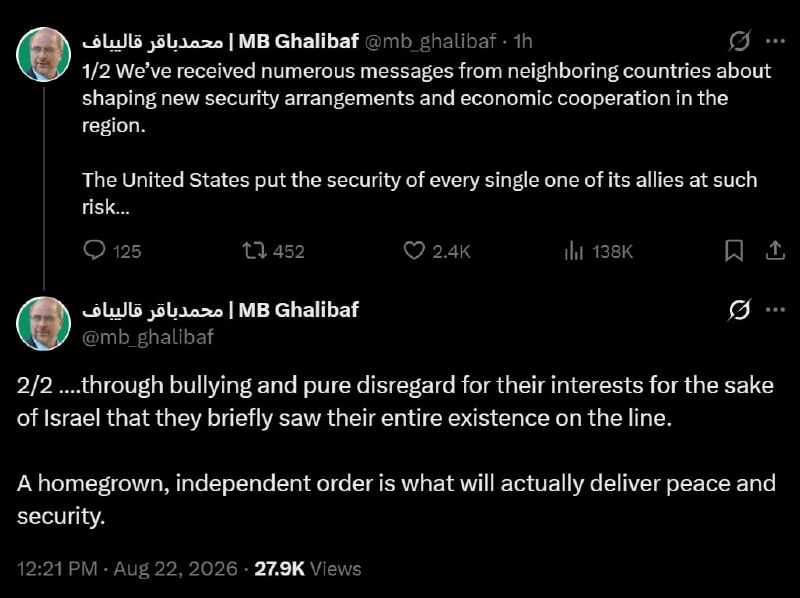
Iranian Parliament Speaker Mohammad Bagher Ghalibaf told reporters in Tehran on 22 August 2026 that unnamed neighbouring governments had been in touch about new security and economic arrangements across the Gulf, and that US alignment with Israel had left Washington's traditional partners exposed. The remarks, carried by Iranian state outlet PressTV at 10:38 UTC and relayed within minutes by The Cradle, DDGeopolitics, GeoPWatch and BRICS News, are the most explicit public claim from a senior Iranian officeholder that the regional security conversation is being remade, not merely argued over.
The political weight of the statement sits in what it claims about Iran's standing in the region. Ghalibaf is presenting Tehran as a destination for overtures, rather than a supplicant pressing for readmission to a US-led order. That framing travels. It also lands in a Gulf environment where the cited sources offer no independent confirmation, denial or rebuttal from any named Arab capital.
What Ghalibaf actually said
According to the PressTV readout of the press availability, Ghalibaf told journalists that Iran had "received numerous messages from neighbouring countries about shaping new security arrangements and economic cooperation in the region," and that US policy in the service of Israel had "endangered" Washington's longstanding Gulf partners. The wording, picked up near-verbatim by The Cradle and by the geopolitics channels DDGeopolitics and GeoPWatch, frames the conversation as something Tehran is being pulled into rather than something it is initiating. The source items do not specify which governments have reached out, whether contact is at foreign-minister level, or whether any exchanges are in writing.
In a separate line circulated by BRICS News at 11:04 UTC, Ghalibaf went further, accusing the United States of "risking its regional allies for Israel." That formulation is the most politically charged in the cluster and explicitly ties the diplomatic opening to the wider Israel-Palestine file. BRICS News's framing of the comments is the most partisan of the relays; readers should treat it as a transmission of Iranian political messaging rather than as independent reporting.
Who carried the line, and how
The relay pattern matters. PressTV is the Iranian government's English-language outlet and should be read as the primary text of the statement. The Cradle is editorially independent but leans heavily on Iranian and Iraqi sources for Iran coverage. DDGeopolitics and GeoPWatch are aggregators with clear Iran-friendly editorial lines. BRICS News wears its political alignment in the handle. None of the cited items quotes a Gulf foreign ministry, an Iranian foreign ministry official acting outside Ghalibaf's office, or a third-party government spokesperson. The available source items do not specify any such confirmation or denial from a Gulf capital.
That asymmetry is the story. The only named source for the claim that neighbours are queuing up is the Iranian side. The Cradle, DDGeopolitics and GeoPWatch repeat that claim with minimal additional context. BRICS News adds a sharper ideological gloss. What is missing from the relay is any external corroboration, and the source items do not record any US, Israeli, Saudi, Emirati, Omani, Qatari, Bahraini or Iraqi response.
Monexus assessment: read this as signalling, not as a corroborated diplomatic fact
Ghalibaf's remarks are best understood as Iranian signalling. The construction is deliberate: a senior officeholder goes on the record with a claim that puts Tehran at the centre of regional rearrangement, attaches that claim to a US-versus-Israel critique, and does so through state media first. Monexus assessment: the political utility of the statement is to test the reaction in the Gulf and in Washington before any concrete negotiating step. The cited evidence supports the existence of the statement and the relay; it does not establish that any neighbour has in fact reached out, nor that any Gulf government endorses the framing. Until a foreign ministry on either side of the Gulf confirms a channel of communication, the diplomatic content of the claim sits inside the rhetoric, not the record.
What is reasonable to read from the source items is narrower than the rhetoric suggests. A speaker of Iran's parliament, on the record, claims neighbour messages exist. PressTV, The Cradle, DDGeopolitics, GeoPWatch and BRICS News transmit the claim. No external confirmation is in the cited material. The source items do not specify whether the messages Ghalibaf references are formal diplomatic notes, parliamentary contacts, intelligence back-channels, or the kind of bilateral conversation that Gulf foreign ministries routinely hold without reading out.
What to watch next
Three indicators will determine whether the framing is an opening bid or a one-day headline. First, whether any Gulf foreign ministry publicly confirms a channel of communication with Tehran, and at what level. Second, whether the next Iranian readout of any Iran-US exchange references regional security architecture rather than limiting itself to the nuclear file. Third, whether Israeli or US officials respond to the "risking its regional allies for Israel" line; the cited material records no such response. The available items do not contain any US, Israeli, Saudi, Emirati, Omani, Qatari, Bahraini or Iraqi statement on Ghalibaf's remarks, and Monexus has not independently established whether any such statement has been issued outside the cited cluster.
The structural read is straightforward and stays close to what the source items support. Ghalibaf is making a public argument that the regional conversation is shifting in Iran's favour. The cited evidence establishes that the argument was made and how it was carried. What it does not yet establish is whether anyone on the receiving end is listening.
This article was written without an editorial review pass; every quoted statement is traced to the Telegram items listed in Sources. Monexus framed Ghalibaf's remarks as Iranian signalling rather than as a verified diplomatic fact, treated the BRICS News line as the most politically charged relay in the cluster, and restricted claims about any external confirmation or denial to the narrow statement that the available sources do not specify one.
Wire provenance
This editorial synthesis draws on the following public wire/social posts:
- https://t.me/presstv/203739
- https://t.me/DDGeopolitics/191653
- https://t.me/bricsnews/17798
- https://t.me/thecradlemedia/66641
- https://t.me/GeoPWatch/38734