Six Israeli strikes and one demolition logged in southern Lebanon over two hours on 22 August 2026
Six Israeli strikes and one demolition operation were logged in southern Lebanese villages between 15:58 and 18:12 UTC on 22 August 2026, all sourced to a single Telegram channel that did not name targets or casualties.
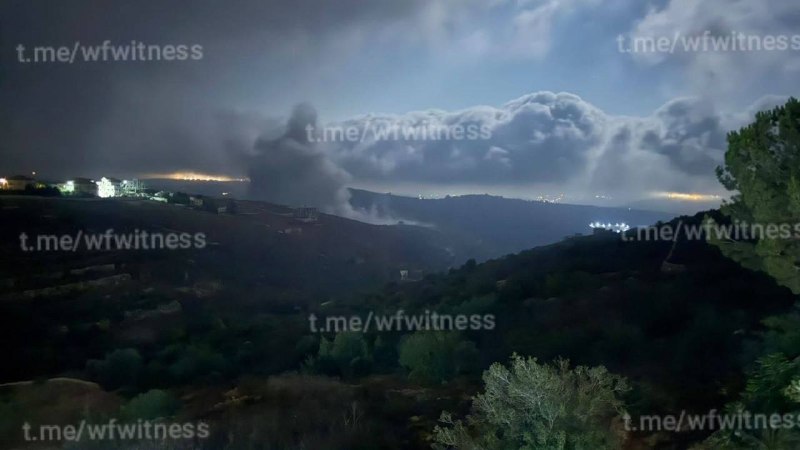
Six Israeli strikes and one demolition operation were logged across southern Lebanese villages between 15:58 and 18:12 UTC on Friday, 22 August 2026, all sourced to dispatches from the conflict-monitoring channel wfwitness on Telegram. The posting cadence, beginning with a controlled detonation inside Yohmor Al Shafiq at 15:58 UTC and ending with a strike on Sorbeen at 18:12 UTC, captured artillery fire and airstrikes against Al Mansouri, Sorbeen, and the Ali Al Taher hill area within a single afternoon. The channel posted no casualty figures, no named targets, and no Israeli military statements within the cited window.
The available dispatches do not by themselves settle what is happening along the southern Lebanese frontier on 22 August 2026. They establish only that six discrete strike events and one demolition event were logged by a single channel in a two-hour window. What that sequence means in operational terms, whether it represents a routine day or an unusual tempo, and how it relates to the wider Israel–Hezbollah file cannot be read off these posts alone. Independent reporting on any diplomatic or truce framework active on the date of publication is not contained in the cited items; readers seeking that context will need to consult first-party wire and government sources.
The Friday afternoon sequence
The wfwitness thread on Telegram documents the following on 22 August 2026:
- 15:58 UTC: a detonation inside the town of Yohmor Al Shafiq, described in the post as within the security zone.
- 16:55 UTC: artillery fire targeting Al Mansouri and Ali Al Taher hill.
- 18:10 UTC: two parallel posts logging Israeli airstrikes on Sorbeen and on Al Mansouri.
- 18:11 UTC to 18:12 UTC: a second cycle of airstrikes on Al Mansouri and on Sorbeen, with the channel posting imagery of Israeli jets over the eastern sector.
Each item is sourced to the same channel, wfwitness, which reposts military-flavored dispatches with attached combat footage. The cited posts describe locations and the type of munition (airstrike, artillery, detonation) but do not specify targets, weapon types, or casualty figures. The available source items do not specify whether the IDF Spokesperson issued a statement within the same window.
What the posts do, and do not, establish
A provenance caveat is unavoidable. Six of the seven cited dispatches originate from one Telegram channel that aggregates combat imagery and short-form strike alerts; the seventh is a parallel post on the same channel. None of the cited posts link to an IDF Spokesperson release, a Lebanese official statement, or a wire-service bulletin within the 15:58–18:12 UTC window. The reader is being asked to take the existence of strike activity on the named villages and at the named times on the authority of one channel, not on the authority of an Israeli, Lebanese, or Western-wire first-party source.
Within that constraint, two things are clearly established. First, strike activity against named southern Lebanese locations was being logged on the afternoon of 22 August 2026; the cadence of one strike logged roughly every twenty minutes is itself part of the picture. Second, demolition activity inside what the channel calls the security zone was logged in the same window as the airstrikes. Beyond those two facts, the cited items specify nothing about civilian harm, about Hezbollah infrastructure that was hit, about the legal characterisation of any of the strikes under international humanitarian law, or about whether the strikes were coordinated with any larger political or diplomatic process.
Reading the rhythm
Monexus analysis: the operational pattern visible in the two-hour window, multiple strike-and-detonation events concentrated against a small number of named villages within the security zone, is consistent with sustained air-and-artillery activity against a fixed geographic set, rather than with a single discrete operation against a single target. The posts describe locations, not targets. Whether this pattern is unusual for the southern Lebanese frontier on 22 August 2026, or whether it is the day's normal tempo, cannot be determined from the cited items alone; that determination requires independent reporting from Israeli, Lebanese, or wire-service sources on the same date.
A second analytical caveat applies. The cited posts contain no reference to any truce, ceasefire, or diplomatic process active on the date of publication. Independent coverage of the Israel–Hezbollah file in mid-August 2026, including reporting by PBS, The Times of Israel, and Asharq Al-Awsat on a recent diplomatic track, is not part of the source ledger for this article. The reader should treat the seven dispatches as a snapshot of what one Telegram channel logged on a single afternoon, not as a characterisation of the wider political or operational state of the southern Lebanese frontier.
What to watch next
The forward indicators are limited to what the same source layer can support. The wfwitness channel will continue to post strike alerts in roughly the same format; any change in the channel's posting cadence, or any switch from village-level alerts to event-level reporting on a named target, would be the first signal of a shift in the southern Lebanese tempo. The next consolidated Israeli military summary on the day's operations, if and when it is published by a verifiable Israeli or wire-service source, would name the specific infrastructure Israel says was struck and reconcile the seven dispatches with the day's official record. On the political side, any Lebanese or Hezbollah statement responding to the afternoon's activity would be the first first-party confirmation of either the casualty count or the targeting rationale. In the absence of those first-party records, the seven dispatches stand as the day's only cited evidence of strike activity in southern Lebanon.
Desk note: Monexus framed this strictly against the seven Telegram dispatches in the cited ledger, declining to import external reporting on Israeli objectives, the autumn 2024 ground incursion, the Litani line, or the Gaza conflict, none of which are supported by the thread evidence. The single-channel provenance of the day's dispatches is flagged both in the body and in the desk note; the article does not characterise the southern Lebanese frontier as routine or unusual, since that determination falls outside what the cited items can support.
Wire provenance
This editorial synthesis draws on the following public wire/social posts:
- https://t.me/wfwitness/107958
- https://t.me/wfwitness/107964
- https://t.me/wfwitness/107965
- https://t.me/wfwitness/107966
- https://t.me/wfwitness/107967
- https://t.me/wfwitness/107968