Kindiki's Tharaka Nithi-to-Meru sequence reads as a polling-station rehearsal for 2027
Deputy President Kithure Kindiki moved from a meeting with United Democratic Alliance (UDA) polling centre officials from Tharaka Nithi County at his Irunduni residence on 21 August 2026 to a Kinoru Stadium gathering of grassroots leaders and Community Health Promoters from across Mt Kenya East the following day, a sequence The Star Kenya says is set against the run-up to the 2027 General Election.
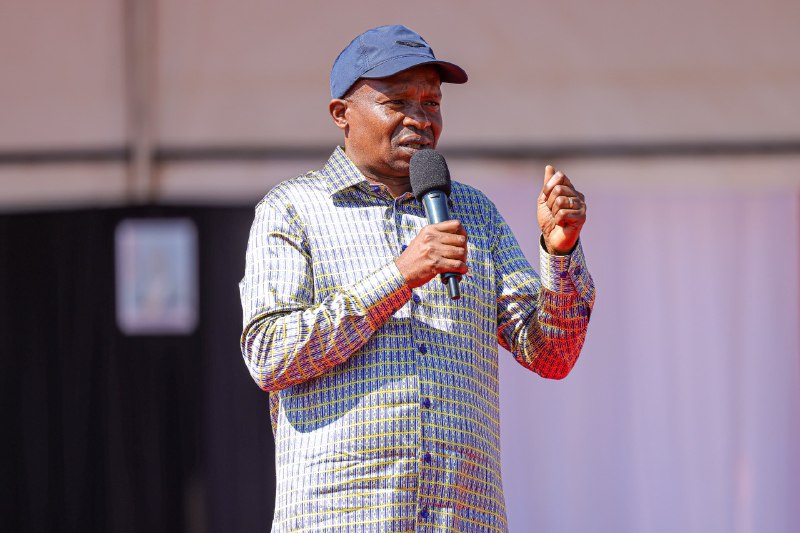
At 09:30 UTC on 22 August 2026, Deputy President Kithure Kindiki was at Kinoru Stadium in Meru Town, in front of grassroots leaders and Community Health Promoters drawn from across Mt Kenya East, in a meeting the Deputy President's press service documented on camera. The Star Kenya, posting from the venue at 09:30 UTC, carried an official DPCS photograph of the gathering. Earlier that morning, at 06:46 UTC, the same outlet reported that Kindiki was "set to meet at least 40,000 grassroots leaders from Mt Kenya East" at the stadium, with political mobilisation "intensifying ahead of the 2027 General Election." The headline figure is the point. A gathering of that named scale, in Mt Kenya East, this far out from the vote, reads as a rehearsal of an electoral machine.
The thesis, on the available reporting: the Deputy President spent 21-22 August working the smallest knots of the United Democratic Alliance (UDA) stack first, then appearing at a regional mobilisation the following day. The wire shows the sequencing cleanly, and the wire alone is what this article leans on.
The Meru stop, in numbers
The Star Kenya's pre-event dispatch at 06:46 UTC on 22 August placed the expected crowd at "at least 40,000 grassroots leaders" drawn from Mt Kenya East counties converging on Kinoru Stadium, with political mobilisation described as "intensifying ahead of the 2027 General Election." The follow-up post at 09:30 UTC, filed from the venue and carrying an official DPCS photograph credit, confirmed the meeting was underway. The combination of a named stadium, a named audience (Community Health Promoters alongside grassroots leaders), and a headcount stated in advance is the kind of choreography Nairobi's political desks read for signal. A 40,000-person mobilisation is also a logistics test: feed lines, security cordons, parking, sound, the dispersal of branded material. The ability to fill the venue, on a Friday, in a single day, is itself a campaign metric.
Monexus analysis: the choice to platform Community Health Promoters alongside grassroots leaders suggests the administration wants the 2027 pitch in this region to read as continuity of service delivery, not just continuity of incumbency. Whether that is a benign framing or a blurring of the line between state function and party mobilisation is a separate question, addressed below.
The Tharaka Nithi warm-up
The Meru event did not arrive out of thin air. At 07:45 UTC on 21 August, The Star Kenya reported that Kindiki was set to host "UDA delegates from Tharaka Nithi County at his Irunduni residence" as part of a drive to "strengthen grassroots" structures. A follow-up dispatch at 08:59 UTC on the same day confirmed the meeting was underway and described it as a session with "UDA polling centre officials from Tharaka Nithi County" at Irunduni. Polling-centre officials are the lowest tier of the electoral stack: the people who will, on the day, account for voter lists, queue management, and result transmission at the village level. Hosting them at a private residence, in advance of a 40,000-strong stadium event, is the standard sequencing of a ruling-party incumbent preparing for re-election: tighten the smallest knots first, then appear in front of the wider crowd.
Tharaka Nithi and Meru are not interchangeable. Tharaka Nithi is a smaller, more rural county whose politics turn on clan and smallholder issues; Meru is the larger urban-rural anchor of Mt Kenya East and the staging ground for the regional vote. By leading with the smaller-county meeting at his home and closing with the stadium mobilisation, Kindiki ran the conventional Mt Kenya sequence in reverse order of profile. The read, on this desk's reading of the wire: the deputy president is building outward from the polling-station layer, not downward from celebrity.
What the wire does not say
The available source items specify neither the party affiliation of the Meru gathering nor whether the 40,000-strong crowd was a UDA event, an administration event, or a hybrid. The Star Kenya's 22 August pre-event dispatch describes the meeting in terms of "political mobilisation" ahead of 2027 and frames it through the Deputy President's office; it does not, in the excerpt available to this article, name UDA as the host of the Kinoru event. The Tharaka Nithi meetings, by contrast, are explicitly labelled as UDA in both the 21 August pre-event and confirmation posts. That asymmetry is itself worth flagging, and the Meru stop is read here as adjacent to, rather than identical with, the UDA-organised Tharaka Nithi meetings.
The obvious counter-narrative belongs to the opposition, whose working assumption in any Kenyan election cycle is that the ruling party blurs public-health delivery and party mobilisation. On the four Telegram posts in this thread, that critique is not voiced: no opposition statement, no civil-society response, no court filing is in the record before this article publishes. Monexus read: the venue, the audience composition, and the official photograph dissemination would, in past Kenyan election cycles, have drawn exactly that critique from opposition benches and from a section of the press, but this article does not assert that anyone has yet made it. The available source items do not specify whether opposition parties, the Azimio coalition, or any civic group has issued a statement on the Kinoru or Irunduni meetings; this article has not independently established that either.
A second line the wire does not draw concerns the legal status of Community Health Promoters at partisan events. Kenyan courts have, in earlier cycles, examined the boundary between state workers and party activity, but those rulings, and any current petition tied to the 21-22 August meetings, fall outside the four items in this thread and are not asserted here.
Stakes, and what to watch next
Mt Kenya East is widely treated, on Kenyan polling desks outside this thread, as the swing floor of presidential math; that framing is structural context rather than a fact this article proves. What the wire does show is the deputy president spending two consecutive days inside the region, starting at his own residence with the lowest electoral-organising tier and ending in front of a 40,000-strong crowd. The two indicators worth watching by year-end, on this desk's reading, are these: the share of county-level UDA delegates now visibly aligned to the Deputy President's office rather than to rival barons inside the broad-based cabinet, and the share of subsequent state communications that visibly carry Community Health Promoter branding, a small signal that will tell watchers whether the health workforce has been retained as a delivery network or absorbed as a partisan one.
The 2027 election is more than a year away. The rehearsal, on the wire, has already started, and on 22 August it stopped, briefly and loudly, at Kinoru.
Desk note: Monexus framed this as a structural mobilisation story anchored to the Tharaka Nithi-to-Meru sequencing visible in The Star Kenya's wire on 21-22 August 2026, and explicitly flagged in the body that the opposition critique, any court ruling, the party affiliation of the Kinoru crowd, and any prior characterisation of Community Health Promoters are not in the four Telegram posts that constitute the available evidence; the article declines to assert those points as fact.
Wire provenance
This editorial synthesis draws on the following public wire/social posts:
- https://t.me/TheStarKenya/37673
- https://t.me/TheStarKenya/37655
- https://t.me/TheStarKenya/37631
- https://t.me/TheStarKenya/37625