Ruto's clinker bet: keeping Kenya's resource wealth at home
President William Ruto defends a clinker cement plant in Kitui County as a route to jobs and retained wealth, while the same day's posts report extractive revenue and a public debt portfolio that has crossed notable milestones.
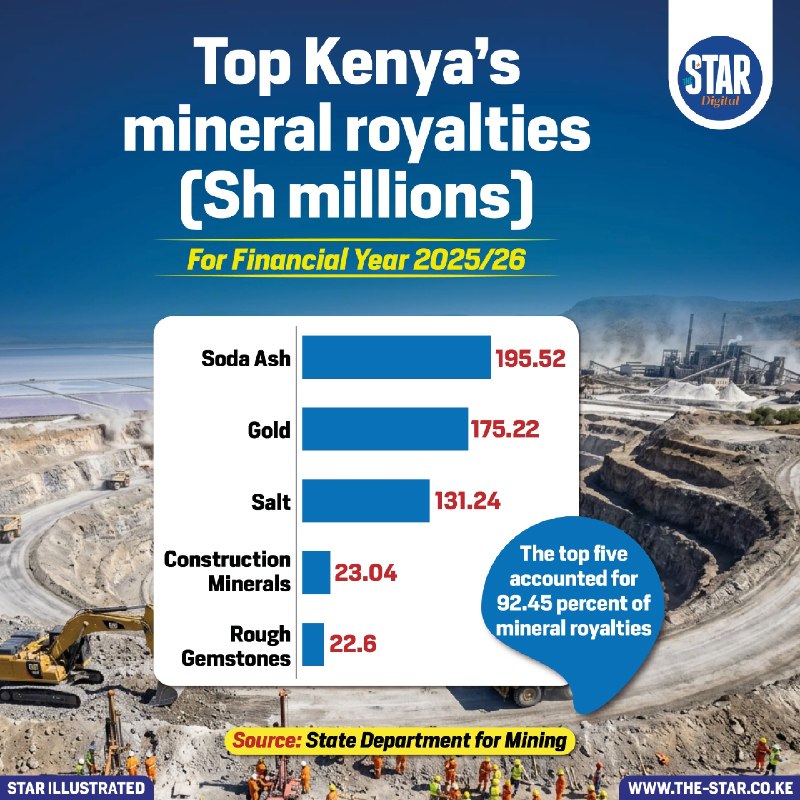
On 27 October 2026, President William Ruto was concluding a four-day development tour of the Ukambani region with a groundbreaking for a clinker cement factory in Ngaie, Kitui County, according to The Star Kenya's Telegram channel. The same day, that channel posted six items that, read together, make one argument: the natural resources beneath Kenya's soil should be processed at home. The argument hangs together. Whether the arithmetic does is another matter, and the posts do not settle it.
Monexus analysis: the cluster describes a government trying to keep more of the value Kenya's land produces inside its borders while carrying a public debt portfolio that the same feed says has crossed notable milestones. A cement plant is a bet that domestic processing will create jobs and industrial depth quickly enough to help service that borrowing. The bet can pay. It can also add a new claim to an old one. The posts summarise the government's case and give almost no figures to test it, so the test has to be built from what the sources leave unspecified.
A groundbreaking and a case made in summary
The posts summarise the president's remarks in indirect speech rather than direct quotation. According to the feed, Ruto defended local clinker production by saying that manufacturing the material in Kenya will create jobs, strengthen industrial capacity and retain more wealth within the country. Another post from the same day reports him calling for increased investment in industrialisation and arguing that Kenya's natural resources offer a competitive advantage. That advantage, the summary says, depends on how responsibly the resources are extracted, processed and converted into finished products. Read together, the two items place a single cement plant inside a larger claim about what Kenya's resources are for.
A third post, also dated 27 October 2026, reports ICT Cabinet Secretary William Kabogo reaffirming Kenya's commitment to strengthening national cybersecurity systems and response capabilities as cyber threats become more advanced. It is the least directly connected item in the cluster. It belongs to the same story nonetheless, because it presents state capacity as an ongoing programme rather than a finished one.
What the ledger shows, and what it does not
The revenue item carries the most weight. The feed reports that Kenya's extractive sector generated significant revenue during the 2025/26 financial year, driven heavily by top-earning natural resources. The source items do not specify the revenue total, which resources led, or how the figure compares with earlier years. A separate post says the public debt portfolio has crossed notable milestones, driven heavily by obligations owed to major international lenders and domestic bondholders. No total appears in that summary either. The two posts describe the income side and the liability side of the same national balance sheet, and neither offers a number a reader could set against the other.
That gap matters for the clinker argument. A processing plant makes the case for itself only if the value it adds exceeds what the same material would earn in a less processed form, and a clinker plant's economics turn on margins the posts do not disclose. The source items do not specify the plant's output, cost or expected revenue. What they supply is the government's position that value should stay in Kenya. That position is where the policy starts, and it is not yet something a reader can audit.
The case for building it at home
The strongest version of the government's position is not hard to construct. Cement is a construction input, and producing it domestically would, in principle, reduce reliance on imported supply, keep more of the margin within Kenyan firms and give Kitui County a manufacturing site with payroll attached. The source items do not state who will own or finance the Ngaie plant, so none of those advantages can yet be measured. Ruto's remarks, as summarised, point to benefits in the form of jobs and retained wealth. Both are easy to announce at a groundbreaking and hard to audit years later.
The skeptical reading has to be built from structure, because the feed does not voice it. A processing plant financed while the public debt crosses milestones adds a claim on future revenue at the same moment it promises to generate some. Whether it lightens or deepens the country's exposure depends on terms the sources do not describe, including the cost of capital, the repayment schedule and who carries the operating risk. A government can be right about the destination and still be wrong about the bill. The available rebuttal is that a debt-financed asset that earns its keep differs from one that does not, and that only the second kind should worry a treasury. That rebuttal holds in principle. The sources do not show which kind this plant will be.
Monexus analysis: who keeps the margin
Monexus analysis: the argument is a familiar one in industrial policy debates, namely that an economy which exports raw output and imports finished goods gives up the most profitable steps in the chain. A cement plant is a modest and concrete form of that argument. Its appeal is that it needs a factory and a payroll rather than a new theory of development. Its risk is that a factory is not the same thing as retained value. Ownership, financing, pricing and the destination of the output decide who captures the margin, and the sources say nothing about any of them.
The stakes are local and time-bound. If the Ngaie plant and projects like it deliver jobs and processing capacity, Kitui and the wider Ukambani region gain an industrial anchor. If the plant is financed on terms that add to a debt line the feed describes as having crossed milestones, lenders would hold the first claim on the gain. The sources give no construction schedule, so the horizon is not visible in this cluster. Monexus expects the first measurable test to come from the next extractive revenue figures and the next public debt update, read side by side, rather than from groundbreaking photographs.
The uncertainties are considerable. Every claim in this article comes from one channel, The Star Kenya's Telegram feed, and the items are summaries of official remarks and reports rather than transcripts or primary documents. The source items do not specify the revenue total, the debt figure, the plant's capacity or cost, its financing or owners, or a completion date. This article has not independently established any of those details, and nothing in it is a verdict on the government's economic record. A reader who wants to test the claims will need the revenue figures, the debt bulletin and the plant's approved specifications.
The figure to watch is not a jobs number, because the feed does not offer one. It is the next extractive revenue release, read beside the next debt update, to see whether the resources Ruto describes as a competitive advantage are becoming productive capacity or collateral for further borrowing.
Desk note: Monexus built this piece from a single Telegram feed rather than wire reporting, so it treats the factory as a test of the debt arithmetic rather than as a finished result.
Wire provenance
This editorial synthesis draws on the following public wire/social posts:
- https://t.me/TheStarKenya/40342
- https://t.me/TheStarKenya/40337
- https://t.me/TheStarKenya/40334
- https://t.me/TheStarKenya/40317
- https://t.me/TheStarKenya/40284
- https://t.me/TheStarKenya/40248