One year after Raila: Ruto courts Odinga's base, and the opposition hunts for a new centre of gravity
A year after Raila Odinga's death, President Ruto is pressing into the Odinga political empire. The remaining opposition is fractured, sentimental, and short on a successor vision.
On 14 October 2026, a year after Raila Odinga's death, President William Ruto used a public stage in Nairobi to do something that would have been unthinkable in his rival's lifetime: openly court the Odinga political empire. The Africa Report's coverage on the same day ran under the headline that Ruto was "marching into Raila's political empire" ahead of the 2027 general election. The message from State House was calibrated, not sentimental. Ruto accused the opposition of promoting "anger, ethnic politics and division" rather than offering a plan capable of transforming Kenya. Within twenty-four hours, obituaries of the Odinga project had begun to read like recruitment pamphlets for it.
What is happening in Kenyan politics is not a transfer of votes. It is the slow auction of an inheritance, conducted in public, while the would-be heirs argue over who gets to carry the name. The 2027 election will not be a referendum on Ruto's record in office, as incumbents often hope. It will be a contest over who is entitled to speak for the man who lost five presidential elections and never held the job.
The courtship, and its timing
Ruto's push into Odinga territory is opportunistic in the most literal sense. The Africa Report's 14 October analysis frames the gambit as a year-on strategy: with the Odinga brand now leaderless, the president is trying to peel off enough of the former prime minister's coalition to neutralise the opposition in 2027 rather than fight it. On the same day, Ruto told a rally that opposition leaders had no clear plan or vision for Kenya, a line that lands differently when the opposition's most charismatic figure has been dead for twelve months. The argument is that what remains of the Odinga movement is a coalition without a story, and a coalition without a story is negotiable.
The framing is not entirely cynical. Ruto's allies have pointed to a genuine policy question: if the opposition cannot produce a programme beyond nostalgia for Raila, voters in Luo Nyanza and the wider Odinga orbit have a real choice to make about what they want in 2027. The president's critics counter that the courtship is itself the programme. Absorbing the Odinga machine, they argue, would convert Kenya's most disciplined opposition movement into a patronage network attached to State House. That would leave Kenyan democracy with a softer centre and a thinner opposition bench at exactly the moment it needs neither.
The inheritors, and the inheritance
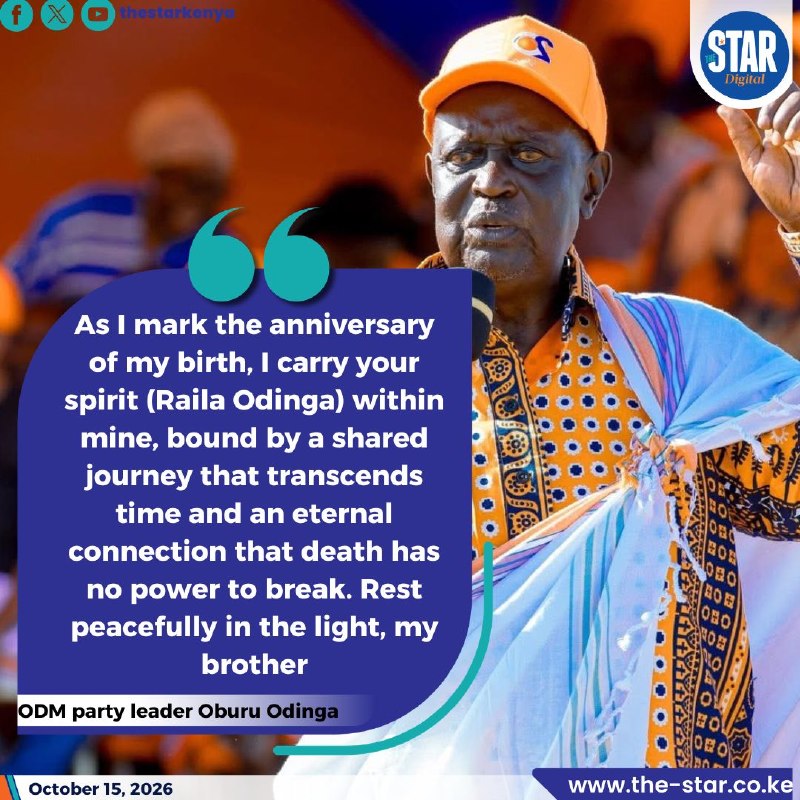
Inside the family, the question is being settled in the language of legacy rather than politics. On 15 October, ODM party leader Oburu Odinga marked his birthday by telling supporters that he "carries the spirit" of his late brother Raila, describing their bond as "eternal and unbroken by death." The phrasing is significant. It is not a claim to the leadership of the Luo or ODM vote; it is a claim to the moral authority of the name. In a politics where Raila's brand was inseparable from his personal biography, the brother is offering continuity without claiming the throne.
Martha Karua, leader of the People's Liberation Party and one of the most experienced operators in the opposition, drew the same line in policy terms. On 15 October, Karua said the late Raila had championed a Kenya where citizens enjoyed "equal rights, dignity and opportunities," and that honouring his legacy meant continuing the fight for those ends. Read together, the two interventions sketch a coalition doctrine: the Odinga name lives in the party, the policy lives in the movement, and the two must remain aligned. Whether that alignment survives contact with Ruto's patronage is the question 2027 will answer.
Monexus assessment: a hegemonic absorption, not a conversion
The most natural reading of the available reporting is that Kenya is watching the absorption of an opposition brand into a sitting presidency, rather than the conversion of the president to the opposition's programme. Ruto has the machinery and the money; the opposition has the memory and the moral vocabulary. In any ordinary transaction, the side that holds the budget wins, and the side that holds the memory gets a statue.
The structural risk runs in both directions. If the absorption succeeds, Kenya enters 2027 with a one-party dominant equilibrium in which the official opposition is small, demoralised, and split between a Karua-style policy bloc and a rump ODM. That would lower the temperature of ethnic mobilisation in the short term, but it would also remove the institutional pressure that has disciplined Kenyan presidencies since 2002. If the absorption fails, and the Odinga coalition regroups around an unimpressive figure, the resulting fragmentation could push disappointed voters toward more confrontational politics than the late Raila ever countenanced. Both outcomes weaken the centre.
What to watch before the camera trucks roll
Three signals will tell Kenyan voters where this is heading. First, the 2027 succession question inside ODM: whether the party ratifies an Oburu-led continuity, opens itself to a younger generation, or allows itself to be hollowed out by defections to the governing coalition. The Star Kenya's reporting on the family remarks suggests the continuity line is being drawn now, but party structures will decide whether that line holds. Second, whether Karua's policy-first framing produces a formal opposition front or remains a series of statements. A coalition with a manifesto competes; a coalition with statements gets absorbed. Third, whether the president's courtship hardens into a coalition agreement or stays at the level of symbolic gestures. Ruto's October messaging reads as still in the wooing phase. The Africa Report's analysis suggests the wooing is the policy.
One thing the available reporting cannot settle is the size of the Odinga vote that is genuinely transferable, as distinct from the share that is merely polite to a sitting president. That number will not be knowable until nominations close and the constituencies are contested. Until then, the auction continues, and both sides will keep reading the late Raila's name in whatever accent suits the room.
Desk note: Monexus framed this as a contested inheritance rather than a coronation, leaning on African wire reporting on the ground rather than Western wire paraphrase. The Karua and Oburu interventions are weighted equally with Ruto's rally messaging; the structural risk is named as absorption, not conversion.
Wire provenance
This editorial synthesis draws on the following public wire/social posts:
- https://www.theafricareport.com/433516/kenya-ruto-marches-into-railas-political-empire-one-year-after-his-death/
- https://t.me/TheStarKenya/39605
- https://t.me/TheStarKenya/39614
- https://t.me/TheStarKenya/39720
- https://t.me/TheStarKenya/39721