Rwanda locks in a decade of Formula One, with the cheque still to be written
Kigali signs a 10-year deal to bring a Grand Prix to Africa from the early 2030s, the first since 1993. The interesting question is who pays, and what Rwanda gets back.
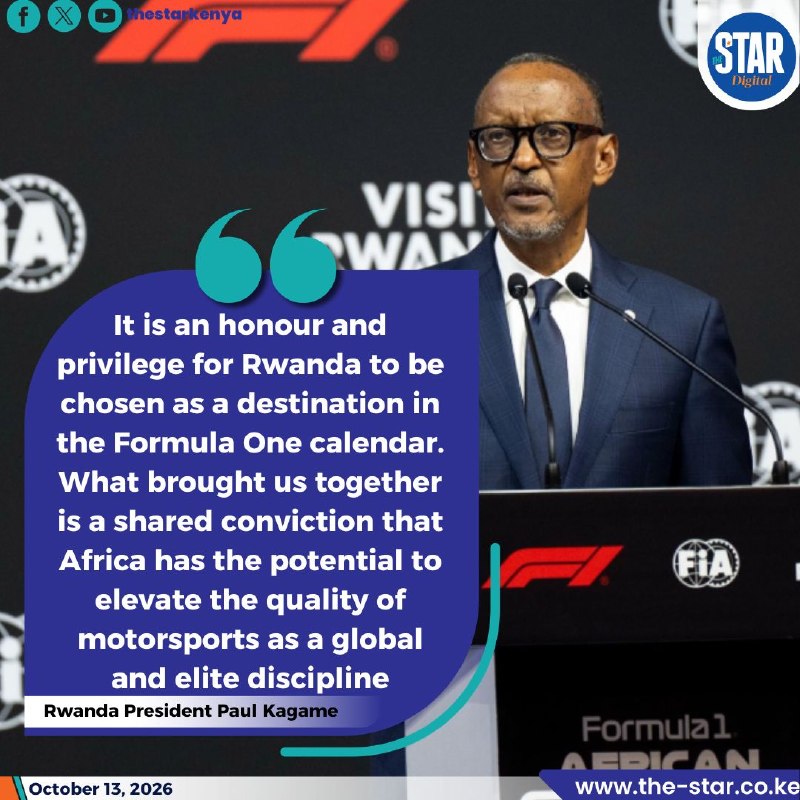
Formula One confirmed on 13 October 2026 that it has signed a 10-year agreement with Rwanda to host a Grand Prix from the early 2030s, returning the championship to the African continent for the first time since 1993 (AllAfrica / 263Chat, 13 October 2026; AllAfrica / The New Times, 13 October 2026). President Paul Kagame said it was an honour for Rwanda to be considered for the Formula One calendar and added that Africa has the potential to elevate motorsport as a global elite discipline (The Star Kenya via Telegram, 13 October 2026, 14:04 UTC). AfricaNews reported the same day that the race is expected in the early 2030s (AfricaNews, 13 October 2026).
The announcement is the easy half of the story. The harder half is the financing: who is underwriting the deal, how the circuit will be built, and what diplomatic return Kigali is buying with a decade of hosting commitments. Sports diplomacy has a measurable cost line, and Rwanda's bill will eventually be paid in foreign exchange rather than in podiums.
The deal on paper
The structure, as announced, is a 10-year calendar commitment running from the early 2030s (AllAfrica / 263Chat, 13 October 2026; AllAfrica / The New Times, 13 October 2026). Formula One's last African round was in 1993 (AfricaNews, 13 October 2026; AllAfrica / 263Chat, 13 October 2026). The 10-year term signals that the parties intend this as a recurring fixture rather than a one-off, and that the sunk cost on both sides is meant to anchor a longer relationship between the championship and the continent.
Kagame's public remarks emphasise capacity rather than gratitude. Africa, he said, has the potential to elevate motorsport as a global elite discipline (The Star Kenya via Telegram, 13 October 2026, 14:04 UTC). The framing matters because it positions Rwanda as a co-author of the championship's expansion, not merely as a recipient of a stop on a developed-world calendar.
What the announcement does not say
The available source items do not specify the financial terms of the agreement, the construction partner for the circuit, or the source of the sponsorship tranche (AllAfrica / The New Times, 13 October 2026; AllAfrica / 263Chat, 13 October 2026). The package price of a modern Grand Prix hosting deal, including circuit build-out, broadcast integration and hospitality build, is not disclosed in the materials published on 13 October 2026.
This is the substantive gap. A 10-year deal is a long-dated liability for any host country, and the way Rwanda chooses to fund it will determine whether the race is read as a tourism investment, a sovereign branding exercise, or something closer to a balance-of-payments bet. The country has courted external capital in recent years, but the supplied source items do not identify which pool is being tapped for this particular line item.
A map of who was not chosen
The selection of Kigali implicitly closes the door, for now, on rival bids that have circulated for years across the continent. AfricaNews reported on 13 October 2026 that Rwanda was chosen to host the race, and the available source items do not name the competing bidders or the criteria Formula One used to choose Kigali over them. A fuller picture would require either an FIA calendar note or a more detailed filing from one of the rival host authorities, neither of which appears in the items reviewed for this article.
The structural read available on these sources is plain. Formula One's commercial model rewards governments that can deliver long-dated commitments and absorb infrastructure risk; the host who can sign for ten years without an annual renegotiation wins the slot. Rwanda has, in recent years, built a portfolio of recurring international sporting events that signals that kind of delivery capacity. Whether the same logic applied here, or whether price and political access dominated the decision, is not stated in the source items.
Stakes and what to watch next
The winners, on the terms of the announcement, are Kigali's tourism economy and the country's international-facing service sector, which get a recurring global marketing event tied to the championship for a decade. The losers are the rival bidders whose decade-long political capital has, for now, been re-routed, although the source items do not specify which jurisdictions those are.
What to watch over the next twelve months: the financial close of the circuit build, the identity of the engineering consortium, and whether the race is officially placed on the FIA calendar in the early 2030s with a confirmed date. The current announcement uses the loose term "early 2030s" (AfricaNews, 13 October 2026; AllAfrica / 263Chat, 13 October 2026), and the conversion of that window into a named round on a dated calendar is the next milestone the market will price. Monexus analysis: the deal is best read as a sports-diplomacy headline stapled to an infrastructure commitment, and the infrastructure commitment is the part the country cares about most.
Desk note: the wire frame this week led with the spectacle of Africa's return to the F1 calendar. Monexus kept that frame and added the capital-flow question, which the available items do not fully answer and which is the more durable story.
Wire provenance
This editorial synthesis draws on the following public wire/social posts:
- http://www.africanews.com/2026/10/13/formula-one-to-return-to-africa-in-early-2030s-in-rwanda/
- https://t.me/TheStarKenya/39559
- https://allafrica.com/stories/202610130387.html
- https://allafrica.com/stories/202610130372.html