Kindiki takes the 2027 frame into Tharaka Nithi, asking critics to name their alternative government
On 17 October 2026 Deputy President Kithure Kindiki took the Kenya Kwanza mid-October messaging east, into Tharaka Nithi, and challenged opposition voices urging voters to leave the administration to name the alternative they would put in its place.
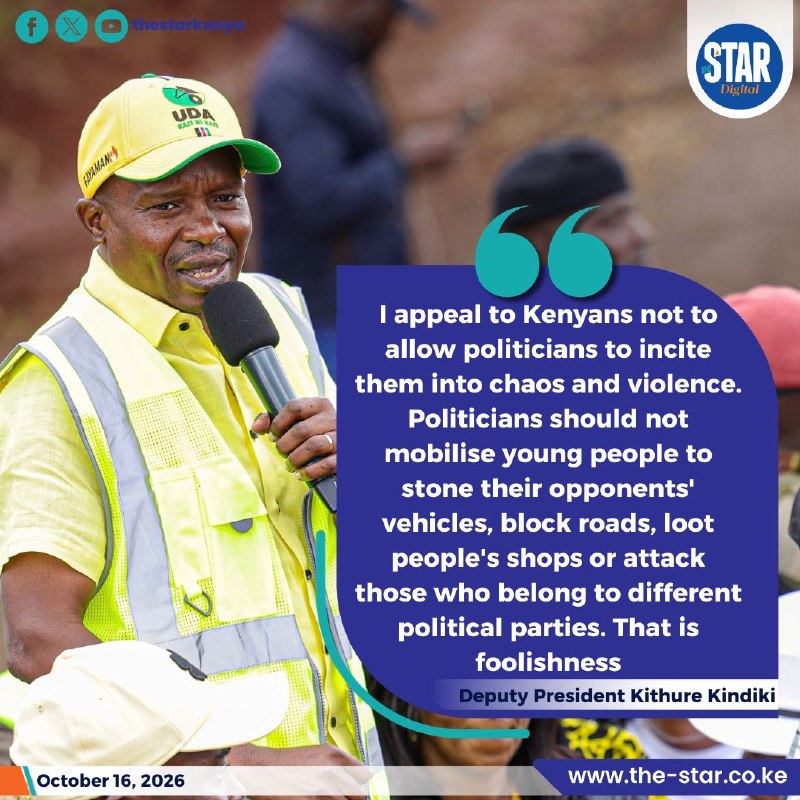
On 17 October 2026 at 13:09 UTC, Deputy President Kithure Kindiki took the Kenya Kwanza administration's mid-October messaging east, into Tharaka Nithi County. According to a Telegram item posted by The Star Kenya at that timestamp, Kindiki challenged political leaders urging residents of the county to abandon the Kenya Kwanza administration to identify the alternative government they want to replace it. The intervention extends a sequence of appearances that began on 14 October and continued through 16 October, in which the deputy president has paired claims of delivery outperformance with warnings against inciting young supporters.
Monexus reads the 17 October Tharaka Nithi stop as the third move in a single framing exercise. The earlier interventions set the terms on which the 2027 contest should be judged, with the technocratic case on one side and the peace-and-order case on the other. The new intervention sharpens the rhetorical stake by demanding that critics name their alternative, a move that converts a general delivery argument into a procedural one: prove a better offer exists before asking voters to switch.
The delivery ledger has already been laid out
The Tharaka Nithi stop sits on top of a delivery ledger the deputy president has been broadcasting all week. On 14 October 2026, an AllAfrica relay of Capital FM coverage, published the same day, presented Kindiki as defending the Kenya Kwanza record and saying the government is ready to face voters; the relay frames his remarks as evidence the administration has outperformed expectations across what AllAfrica summarises as "key sectors." On 16 October 2026, a Telegram item on The Star Kenya's channel, posted at 11:12 UTC, tightened the same line, dismissing opposition claims that the government is failing to deliver on its development agenda and reiterating that the administration is focused on implementation.
Read together, those items present a single argument: a self-assessed balance sheet, indexed to a manifesto the administration wrote itself. Monexus assessment: that is a deliberate choice of terrain. If the 2027 election is fought on outcomes against a Kenya Kwanza-authored benchmark, then opposition pressure to discuss anything else has to fight uphill on framing as well as facts. The available reporting does not specify which sectors Kindiki itemised by name in the 16 October Telegram post, and does not record an independent verification of the figures behind the delivery claims; both gaps are noted as gaps in the cited reporting rather than filled in.
The peace-and-order package is now a sharper demand
In parallel with the delivery ledger, the deputy president has spent the same window tightening the language on political conduct. On 14 October 2026 at 16:47 UTC, a Telegram post on The Star Kenya's channel carried an appeal to politicians to shun violence and avoid inciting young people, with the warning that political competition should not divide Kenyans or disrupt ordinary life. A second Telegram post on 16 October 2026 at 12:06 UTC escalated the language: a public call on Kenyans to reject political incitement and maintain peace ahead of 2027, and a warning to leaders against mobilising young people to attack political opponents. The 17 October Tharaka Nithi move pushes the rhetorical pressure one step further, by transferring the burden of proof: if you want Kenyans to leave the incumbent administration, name what you would put in its place.
The available reporting frames these items as standalone appeals, not as parts of a single set-piece speech. What links them in the public record is the deputy president's choice to run the anti-incitement case alongside the delivery case inside a short news window, and a pattern of escalation across the week from a 14 October general appeal to shun violence, through a 16 October sharper call on youth mobilisation, to a 17 October procedural demand that critics name their alternative. Monexus analysis: coupling the two registers inside a tight news cycle is consistent with a sequencing strategy, in which the technocratic claim and the normative claim each reinforce the other, and in which the demands placed on the opposition accumulate over the course of a week rather than being landed in one speech.
The opposition side of the conversation
The deputy president's intervention is also a rebuttal, and the available reporting does not pair it with a same-window opposition response. The opposition in Kenya is publicly organised around the Azimio coalition, whose principal constituent party is the Orange Democratic Movement (ODM); the available source items for this article do not include an on-the-record Azimio response to Kindiki's specific 14, 16 or 17 October interventions by name, and the public picture inside the cited reporting is one-sided on the day, with the deputy president's framing presented without a same-window counter-frame from the coalition.
That asymmetry is worth naming rather than smoothing over. The available Telegram and AllAfrica items for this piece do not record an ODM secretary-general statement or an Azimio press release responding to the Tharaka Nithi intervention, and the article does not assert that no such response exists outside the cited reporting. The picture is not balanced at the level of wire output; it is balanceable at the level of analysis, by flagging that the absence of a same-window reply in the cited reporting is a feature of the cited reporting, not of the political conversation.
Stakes for 2027
If Kindiki's framing holds, the contest in 2027 will be argued on Kenya Kwanza's own balance sheet. The portfolio areas the deputy president has invoked in the 14 and 16 October items will be measured against the manifesto the administration wrote, on terms the executive has chosen to set. If the opposition manages to pivot the conversation elsewhere, the delivery frame becomes harder to defend and the anti-incitement warnings risk reading as deflection from the harder questions. The 17 October demand that critics name their alternative is intended to foreclose that pivot.
What remains uncertain is whether the delivery record will withstand scrutiny at the constituency level. The deputy president has named the categories in the 14 October AllAfrica/Capital FM relay; the available Telegram items do not specify which sectors he itemised by name on 16 October, nor do they detail which constituencies are being mobilised behind the message beyond Tharaka Nithi itself. Those gaps will narrow as the campaign calendar firms up. They are also where, on our reading, the 2027 contest will ultimately be settled.
Desk note: Monexus has updated this live file on Kenyan wire reporting (The Star Kenya via Telegram, and AllAfrica's relay of Capital FM) rather than Western syntheses, in line with the publication's standing approach to Africa coverage. The frame presented is the deputy president's own; analysis paragraphs are labelled as such. The available Telegram and AllAfrica items for this article do not record an Azimio rebuttal to Kindiki's 14, 16 or 17 October interventions by name, and that limitation is noted above rather than filled in.
Wire provenance
This editorial synthesis draws on the following public wire/social posts:
- https://t.me/TheStarKenya/39805
- https://t.me/TheStarKenya/39630
- https://t.me/TheStarKenya/39620
- https://t.me/TheStarKenya/39780
- https://allafrica.com/stories/202610140424.html