Telegraph reports four-day outage at small UK power plant after alleged Iranian cyberattack
The Telegraph discloses what it calls the first successful Iranian cyberattack on a UK facility: a small British power plant knocked offline for four days last month, with no wider grid impact.
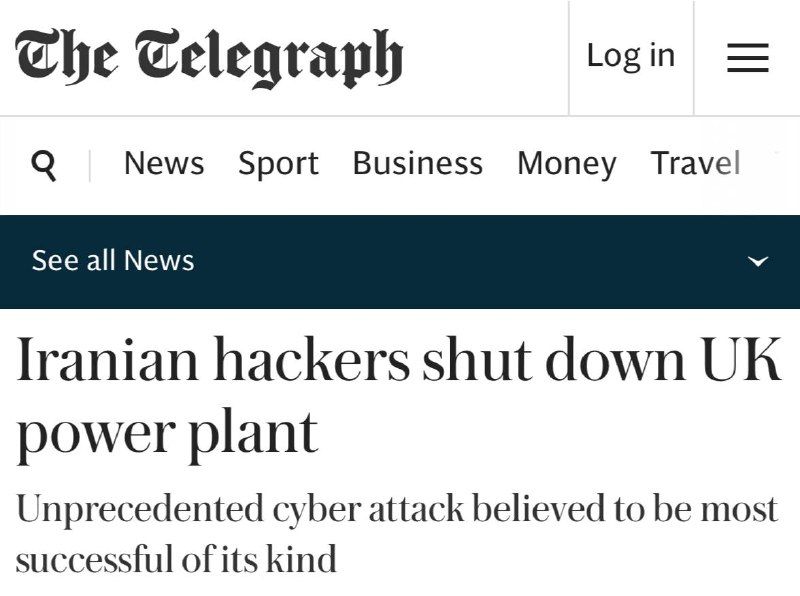
A small British power plant was knocked offline for four days last month in what The Telegraph describes as the first successful Iranian cyberattack against a UK facility. Reporting relayed across Telegram channels on the evening of 22 August 2026 attributes the disclosure to the newspaper, which says hackers affiliated with the Islamic Republic disabled the site before operations were restored.
The incident, if confirmed by UK authorities, marks an escalation in Tehran's long-running digital campaign against Western critical infrastructure. The four-day outage, brief by grid standards but long for an industrial-control compromise, suggests the attackers held their foothold long enough for engineers to be dispatched. The Telegraph, according to one Telegram summary, reports that the four-day outage had no impact on the UK's wider power supply, a detail that shapes the severity of the event from a system-wide perspective even as it sharpens the signalling value to Tehran.
What The Telegraph says happened
According to a Telegram post from Middle East Spectator dated 23 August 2026, citing The Telegraph, Iranian-affiliated hackers shut down a UK power plant and kept it offline for four days in what the paper characterises as a sophisticated cyberattack. A second Telegram post, from Megatron, says the incident occurred last month and is believed to be the first time Iranian operators have successfully disrupted a UK facility in this manner. A third post, from War on Fools Witness, repeats the Telegraph framing and the four-day duration. A fourth post, from Bellum Acta News, adds two material details: the affected site is described as a small British power plant, and British officials did not identify the plant for security reasons, which explains why neither the operator nor the location has been made public.
Bellum Acta News also notes that The Telegraph reported the story on Saturday, consistent with publication around 22 August 2026, and that the four-day outage had no impact on the UK's wider power supply. The Telegraph itself has not, on the basis of the items available to this publication, named the specific threat-actor group, and the UK government has not, in the materials available to Monexus, issued a public attribution. Telegram mirrors of the reporting carry the claim forward but cannot substitute for the newspaper's underlying sourcing, and any technical indicators or first-party confirmation will sit in the Telegraph's piece rather than in the relay chain.
A pattern with a British accent
Iranian digital operations against Western infrastructure are not new. Tehran's state-aligned groups have for years probed Saudi Arabian oil facilities, US water utilities, and Israeli industrial control systems. What changes with this reported incident is the geography: a successful, multi-day outage on British soil would represent a first of its kind, however the Telegraph qualifies that claim, and one that sits awkwardly alongside London's ongoing effort to contain escalation in the Middle East.
The four-day duration matters. Most publicly disclosed intrusions against European energy operators have been intercepted before damage was done, or have produced minutes rather than days of disruption. A compromise that holds a facility offline long enough for engineers to be dispatched suggests either a more capable actor, a less defended target, or both. The Telegraph's description of the site as a small power plant, combined with British officials' decision not to name the operator, points to the third reading: smaller operators tend to run leaner security budgets, and Iranian-linked groups have historically favoured soft targets whose compromise generates outsized signalling value without producing the political cost of striking a transmission-level hub.
There is a counter-narrative worth holding in mind. Iranian cyber capability, as documented in indictments unsealed by the US Department of Justice, is real and persistent, but attribution is contested terrain. A four-day outage at a single small site could also reflect criminal ransomware, insider action, or a third-country actor routing through Iranian infrastructure as cover. Without the Telegraph's underlying reporting, the technical indicators, or a UK government statement, the Iranian tag remains the paper's working claim rather than an established finding. Monexus analysis: until the NCSC, the Department for Energy Security and Net Zero, or the named operator issues a first-party statement, the attribution should be treated as a journalistic lead, not a closure.
What the geometry of the disclosure tells us
The political shape of the disclosure is as important as the technical one. By publishing on a Saturday, with the affected plant unnamed and the wider grid unaffected, The Telegraph has handed London a story that can be investigated without producing immediate public alarm. That is itself a signal about how the British security establishment prefers sensitive cyber incidents to be aired: acknowledged, framed narrowly, and kept at arm's length from systemic risk narratives.
For Tehran, the calculus is different. A short, sharp outage at a peripheral site produces headlines without producing the political cost of an attack on London's financial plumbing or a NATO ally's military networks. The Telegraph's reporting, as relayed by the Telegram channels, frames the event as a first, which maximises the signalling value to any audience watching Iran's digital reach. The fact that British officials declined to name the plant, on security grounds, deepens that signalling rather than diluting it: the target is small, the impact contained, the message unmistakable. That asymmetry is precisely what makes small-site targeting attractive from Tehran's perspective, and it is what British and European defenders will now have to price into their threat models.
There is a second-order read worth flagging. Reporting that the outage had no impact on the UK's wider power supply cuts both ways. It contains the immediate political cost, which is why the story can be carried without triggering system-wide emergency procedures. It also raises the question of why a capable actor would burn operational access against a target whose failure does not register on the grid. The most natural reading, Monexus analysis holds, is that the goal is the headline rather than the disruption: a measurable event that travels through Telegram, through Western wires, and through intelligence readouts, without producing the retaliation threshold that an attack on London infrastructure would.
What to watch next
Three threads will determine whether this story hardens into a confirmed Iranian operation or softens into something more ambiguous. First, will the National Cyber Security Centre or the Department for Energy Security and Net Zero issue a statement confirming the outage, the response, and any attribution? Second, will the operator of the affected plant surface, voluntarily or otherwise, in regulatory filings or in parliamentary questions written in the autumn sitting? Third, will allied services, particularly the US Cybersecurity and Infrastructure Security Agency or its Australian and Canadian equivalents, corroborate the Iranian attribution in their own advisories?
What the cited Telegram posts do not specify, and what this article has not independently established, is whether any first-party UK statement exists, whether the attack produced physical damage beyond the control outage, whether any data was exfiltrated alongside the disruption, or which Iranian-linked group is alleged to be responsible. The Telegraph's underlying reporting, not the Telegram mirrors, is where those answers will sit if they sit anywhere. Until then, the four-day outage at an unnamed small British plant remains a single-source disclosure, reported at arm's length, with a contained blast radius and an outsized signalling payload.
Desk note: Monexus has relied on Telegram-channel reporting of a Telegraph exclusive, not on the Telegraph's own article. The BellumActaNews summary is the only relay that specifies the plant went unnamed on security grounds and that the outage had no impact on the wider UK power supply, and those details have been folded into the body. Until the primary reporting is available, the attribution to Iranian hackers is treated as the paper's claim rather than as an established fact.
Wire provenance
This editorial synthesis draws on the following public wire/social posts:
- https://t.me/Middle_East_Spectator/36025
- https://t.me/megatron_ron/16556
- https://t.me/wfwitness/107979
- https://t.me/BellumActaNews/176609