Britain and France make a fresh bet on a Ukraine that won't stop fighting
On Ukraine's 35th Independence Day, London and Paris promised deeper backing, while a UK-Ukraine data deal quietly widened the war's AI frontier.
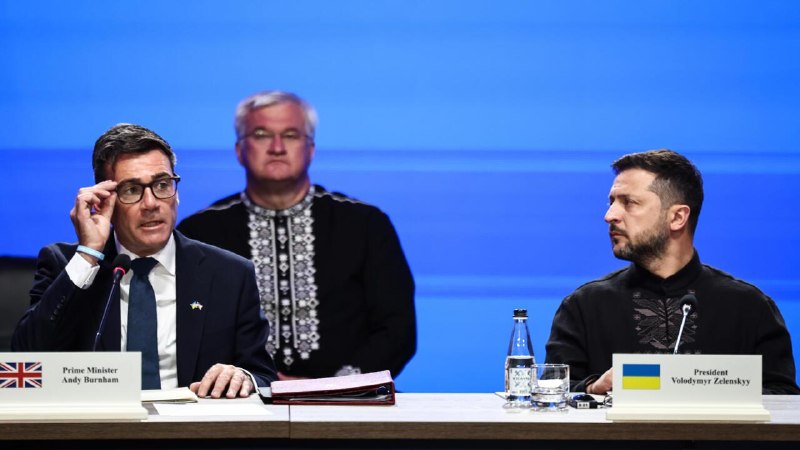
Zelenskyy stood inside a Kyiv ceremony hall on Monday, 24 August 2026, and used the country's 35th Independence Day to repeat the same sentence Kyiv has repeated since the first weeks of the full-scale invasion: Ukraine will keep defending itself. Hours later the diplomatic picture moved around him. Britain and France pledged stronger support for Kyiv, and London signed a separate deal with Ukraine that gives British researchers access to millions of real-world battlefield images to train defence AI systems, according to a 24 August report carried by the Kyiv Post official channel.
The symbolism of the date is doing real work. Independence Day, in any post-Soviet capital, is the moment when the language of sovereignty is loudest. This year the language came bundled with hardware: combat data, and a Western ally willing to absorb it.
A pledge, then a dataset
Reuters reported on the evening of 24 August that Britain and France had promised Kyiv "stronger support" as the country marked Independence Day. The exact terms of the British-French package were not specified in the cited items, and this article has not independently established the value, delivery timetable or weapon categories involved. What is on the public ledger, per the same Reuters dispatch, is the political signal: two of Europe's three biggest military backers of Ukraine are choosing the holiday to recommit, rather than to recalibrate.
The second piece moved faster. Britain and Ukraine signed a deal the same day, according to ClashReport's 24 August Telegram post, giving UK researchers access to millions of real-world battlefield images for the purpose of training defence-oriented AI systems. The dataset, in other words, is being treated as a strategic export. Ukrainian battlefield imagery has become a training resource that London wants inside its own defence AI pipeline.
What the AI deal actually changes
The deal is best read as procurement, not as a press-release flourish. Modern target recognition, artillery correction and drone routing depend on labelled visual data; synthetic data alone has not closed the gap. Ukraine, after forty-six months of high-intensity war on its own territory, holds one of the largest and most varied live-combat image corpora in the world. Granting UK researchers access to it is closer to a long-term defence-industrial concession than to a one-off gesture.
The sources do not specify which UK institutions or companies will receive the data, whether the dataset will be shared beyond British borders, or how privacy and chain-of-custody rules will apply to imagery that may contain identifiable casualties or sensitive tactical information. Those are the questions that will decide whether the deal ages well. If the terms are loose, the dataset becomes a leak risk. If the terms are tight, it becomes a defensible moat for British defence AI.
The politics underneath the ceremony
Zelenskyy's Independence Day message, as carried by the Kyiv Post official channel on 24 August, paired the sovereignty line with a state-awards ceremony for soldiers, civilians and the families of the fallen. That sequencing matters. Every Western capital that visits Kyiv on 24 August now walks into a room where the human cost is being read out loud. The political cost of pulling back has gone up at the same moment that war-weariness framing in some Western publics has intensified.
Britain and France are not the only governments making this calculation. They are the ones doing it visibly this week. The Reuters dispatch sits inside a broader pattern across 2026 in which European capitals have tried to keep their own Ukraine policy legible and continuous, even as the underlying US political clock has become harder to read. Paris and London are, in effect, pre-positioning: making commitments on the holiday so that any later slippage has a named anniversary attached to it.
Stakes, and the date to watch
If the dataset deal is implemented broadly, the strategic effect over a three-to-five-year horizon is that British defence AI enters a feedback loop with live Ukrainian combat footage. That changes export-licensing politics, because the resulting models will be classed as controlled technology. It also changes the politics of the war itself: Ukraine becomes not just a recipient of Western arms, but a supplier of the raw material for the next generation of those arms.
The counter-read is that the AI deal is mostly symbolic. Defence procurement moves slowly; imagery datasets are useful only as good as the labels on them, and the bottleneck in modern target recognition is more often compute and human review than raw pixels. On that reading, Monday's announcement is a mood-setter, not an industrial pivot.
Both readings can be partly right. The honest assessment: the dataset deal is real and consequential in direction, even if its operational payoff is years away. The political pledge from London and Paris is real and consequential now, even if its precise content has not been spelled out.
The date worth circling is not Monday. It is the next round of UK and French defence budgets, and the first public naming of which British institution will sit on the Ukrainian dataset. That is when the holiday language either hardens into contracts or fades back into rhetoric.
Desk note: Monexus framed the Independence Day announcements around the underlying political and industrial substance, the dataset transfer and the renewed pledges, rather than the ceremony itself. The wire line treated it as a solidarity moment; we read it as a procurement story wearing a holiday dress.
Wire provenance
This editorial synthesis draws on the following public wire/social posts:
- https://reut.rs/4gOySl3
- https://t.me/ClashReport/93575
- https://t.me/Kyivpost_official/38987
- https://x.com/Reuters/status/2091996510456086877