Israeli jets and artillery hit multiple towns across southern Lebanon as fighting intensifies
Strikes and artillery fire hit Taybeh, Kfar Ruman, Al-Mansouri and other southern Lebanese towns on 25 August 2026, with Israeli jets again crossing into Lebanese airspace through the evening.
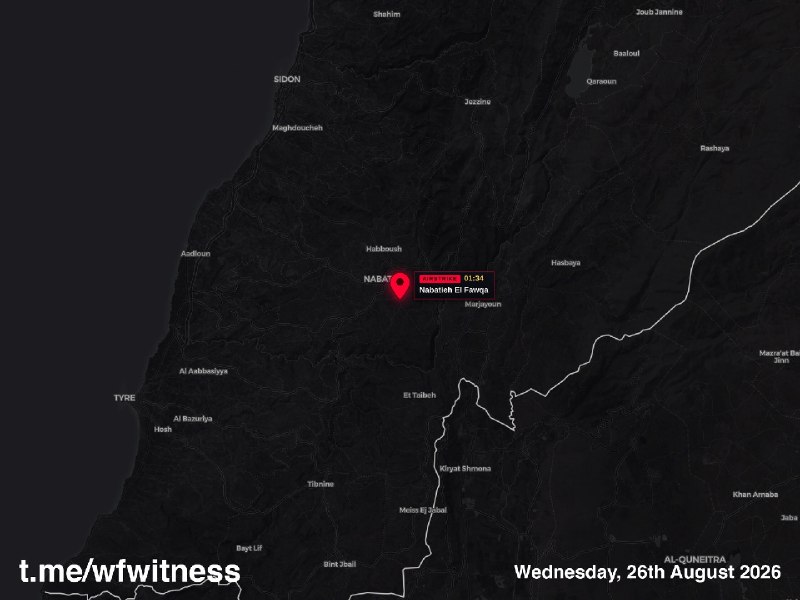
Israeli airstrikes and artillery fire hit at least four towns across southern Lebanon on 25 August 2026, with the barrage intensifying into the late evening as warplanes again entered Lebanese airspace. The pattern, reported almost continuously from late afternoon onward, points to a sustained operational tempo rather than the isolated retaliation that often follows a border incident.
The day's reporting, drawn entirely from open-source channels relaying frontline footage and local bulletins, sketches a single picture: Israeli ground and air units striking villages north of the border, in some cases repeatedly, while Hezbollah-aligned outlets confirm the towns hit. Casualty figures from the available source items are not specified, and the thread does not record an Israeli military statement.
What the open-source record shows
The earliest strikes cited in the available thread came at 17:25 UTC, when the wfwitness channel reported Israeli jets re-entering southern Lebanese airspace. By 20:30 UTC, an airstrike had targeted the town of Kfar Ruman, with footage circulated by the channel shortly after.
Reporting then accelerated. At 20:40 UTC, additional footage of an Israeli airstrike on southern Lebanon was posted to the same channel. Less than a minute later, the outlet Al-Manar, which is Hezbollah-affiliated, said Israeli tank fire had hit Al-Mansouri. The 20:44 UTC update noted Israeli jets again crossing into Lebanese airspace, this time over the western sector.
By 20:46 UTC, artillery had begun hammering Wadi al-Salouq. Ali Et Taher was hit by Israeli artillery fire at 22:30 UTC, according to the channel. The night closed with airstrikes around the towns of Taybeh and Deir Siryan at 22:33 UTC, and around Nabatieh Al-Fawqa at 22:35 UTC.
The geographic spread is notable. Strikes are recorded across a roughly 40-kilometre arc from Kfar Ruman in the west to Nabatieh Al-Fawqa further east, with Wadi al-Salouq sitting between them. The thread does not record which Hezbollah or other non-state units were operating in those villages, nor whether any launches preceded the strikes.
How this compares to the wire narrative
Western wire services were not directly cited in the source items. The thread runs through wfwitness, a Telegram channel that aggregates frontline footage and field bulletins, plus Al-Manar, which is owned by Hezbollah's broadcasting arm. That matters: the open-source record tends to track visible action, the wire record tends to track Israeli military readouts and Lebanese official statements.
This piece has not independently established whether any IDF spokesperson briefing, Lebanese Red Cross statement, or UNIFIL position was issued on 25 August 2026. The available source items do not specify casualty counts, the type of munitions used, or whether the strikes were directed at specific military infrastructure. They do, however, consistently identify Israeli aircraft and artillery as the source of the fire.
The contrast with official readouts is the gap that any reader should keep in mind: the operational tempo is unambiguous, the strategic intent is not.
What the pattern suggests
The day's arc is consistent with a campaign-style tempo rather than tit-for-tat exchange. Israeli aircraft were recorded crossing into Lebanese airspace at least three separate times between 17:25 and 20:44 UTC, with artillery and tank fire layered in between. Four named towns plus a wadi and a second cluster around Taybeh and Nabatieh Al-Fawqa give the day a footprint that single-incident retaliation usually does not.
Monexus assessment: the operational signature, judged by tempo, geographic spread and the simultaneous use of air and ground fires, reads as deliberate pressure on a specific set of villages rather than a reactive salvo. The thread does not record what triggered the day's opening strike at Kfar Ruman at 20:30 UTC, so any reading of causation is provisional.
Stakes and what to watch next
The human cost is the immediate stake. The thread provides no figures for civilians killed or wounded, no assessment of damage to homes, schools or medical facilities, and no readout from Lebanese or UNIFIL authorities. The structural stake is whether the tempo of 25 August marks the start of a wider campaign, a continuation of the post-November 2024 pattern, or a one-day spike.
Three things to watch over the next 48-72 hours:
- Whether the IDF releases a formal operational summary that names the targets and any infrastructure it claims were struck. Without that, the open-source record is descriptive, not explanatory.
- Whether Lebanese authorities, UNIFIL, or international humanitarian agencies issue casualty figures. The wire gap on this score is wider than usual and will narrow within a day or two.
- Whether Hezbollah responds with rocket fire into Israeli territory. The thread records only Israeli action; an escalation metric is the first return strike across the border.
The honest position is narrower than the day's volume of alerts suggests: a real, sustained Israeli operation is visible in the source items, but its scale, its targets and its political frame remain to be established by the readouts that, on the day, the thread did not capture.
How Monexus framed this: where the open-source thread gives continuous frontline footage, the wire gives attribution and context. This piece carries the frontline record and flags the wire gap, rather than substituting one for the other.
Wire provenance
This editorial synthesis draws on the following public wire/social posts:
- https://t.me/wfwitness/108273
- https://t.me/wfwitness/108277
- https://t.me/wfwitness/108282
- https://t.me/wfwitness/108284
- https://t.me/wfwitness/108285
- https://t.me/wfwitness/108286
- https://t.me/wfwitness/108293
- https://t.me/wfwitness/108294
- https://t.me/wfwitness/108295