Wadi al-Salouq hit again as south Lebanon logs four strikes and three jet overflights in thirty-three minutes
Telegram war-monitoring channels logged artillery on Wadi al-Salouq, tank fire on Al-Mansouri, an airstrike on Ali Al-Taher hill and a Sorbine strike that the same channel spelled two different ways, alongside three jet overflights, inside a 20:13 to 20:46 UTC window on 25 August 2026.
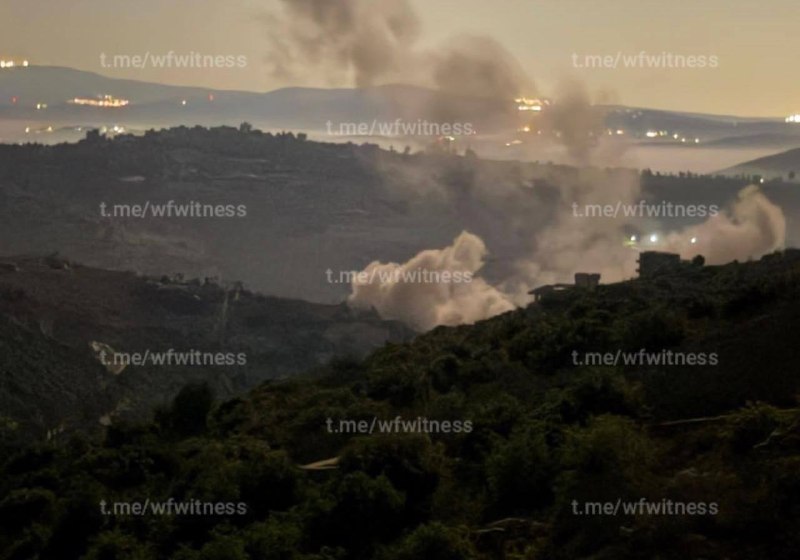
Israeli artillery struck Wadi al-Salouq in southern Lebanon at 20:46 UTC on 25 August 2026, closing a thirty-three-minute burst of cross-border fire that the wfwitness Telegram channel logged across at least four named locations. Inside the same window the channel reported an airstrike on Ali Al-Taher hill, an airstrike on the town the channel itself spelled two different ways, Israeli tank fire on Al-Mansouri attributed to Al-Manar, and three separate alerts of Israeli jets over southern Lebanese airspace. The 20:14 UTC post bundled the second jet overflight with the Ali Al-Taher airstrike report; the 20:13 UTC post logged the first overflight on its own.
The pattern fits the daily tempo that residents and war monitors along the frontier have described for months: artillery, armoured-vehicle fire and airstrikes layered into single reporting windows, with jet overflights serving as the opening and closing punctuation. The clustering of these reports inside thirty-three minutes is not, on the cited evidence alone, proof of a tactical shift. Monexus assessment: what is striking is how much fire can be logged into a single Telegram cluster before any major wire has filed a corresponding story. Israeli officials have framed the operations as targeted action against Hezbollah infrastructure; Hezbollah-aligned outlets including Al-Manar, cited in the Al-Mansouri item, have framed them as strikes on populated towns.
What the wire saw, by the minute
Sorting the available posts by absolute UTC time turns a confusing stream into a cleaner map of the afternoon. The first alert in the cluster, at 20:13 UTC, reported Israeli jets over southern Lebanese airspace. One minute later, at 20:14 UTC, the channel posted another jet-overflight alert bundled with a report of an Israeli airstrike on Ali Al-Taher hill, southern Lebanon. At 20:27 UTC, the channel logged an Israeli airstrike on the town its own post spelled "Sorbbine", and the same post's excerpt already referenced imagery purporting to show the strike's aftermath. At 20:37 UTC, the channel returned to the same strike with what it labelled "Additional Imagery", this time spelling the town "Sorbine". At 20:42 UTC, citing Al-Manar, the channel reported Israeli tank fire on Al-Mansouri. At 20:44 UTC, jets were reported back over south Lebanese airspace, and two minutes after that, at 20:46 UTC, came the Wadi al-Salouq artillery report that closes the cluster.
The Sorbbine/Sorbine discrepancy is a source-level feature, not a typographical choice by this article. The 20:27 UTC post (which carried the strike report and initial imagery in the same excerpt) used the doubled-b spelling; the 20:37 UTC post, which the channel titled "Additional Imagery", dropped one of the b's. Both spellings appear in the channel's own copy within ten minutes of each other. The available source items do not specify casualties, the precise target set for any of the strikes, or whether the IDF Spokesperson issued a statement covering this cluster; the channel does not publish that level of detail in these posts.
The framing contest between Jerusalem, Beirut and the monitors
Israeli security concerns are the established starting point for any serious account of the south Lebanon theatre, including the live-fire detection of rocket-launching squads, weapons storage and command nodes. Equally established: the civilian harm that international agencies and wire services have repeatedly documented in south Lebanese towns along the frontier. War-monitoring channels like wfwitness sit between the two official poles; they aggregate IDF advisories, Lebanese civil-defence reports, footage from town media units, and Hezbollah-aligned outlets such as Al-Manar. Al-Manar's framing, referenced explicitly in the 20:42 UTC post on Al-Mansouri, tends to characterise Israeli fire as indiscriminate and directed at inhabited towns; the Israeli defence establishment has consistently characterised its strikes as targeted, with civilian harm acknowledged as a regrettable by-product of the proximity of military assets to residential areas.
The 25 August cluster is small, but it captures the same triadic contest that has shaped coverage of the border since hostilities escalated in late 2023: an Israeli security framing centred on Hezbollah infrastructure, a Lebanese framing centred on civilian exposure, and a third layer of independent monitors attempting to log events as they happen. Monexus finds that the relative weight given to each frame in the daily news cycle has more to do with which cameras and reporters are present than with which side has the stronger factual claim in any given incident.
Structural read: the everyday intensity of the south Lebanon front
Read across months rather than minutes, the Wadi al-Salouq strike is a sample of a much larger steady state. South Lebanon has been one of the world's most consistently bombed frontlines for nearly two years, with daily artillery exchanges, periodic larger operations, and a baseline of jet overflights that residents describe as a constant background noise. That baseline matters: it reframes "another strike on the hill south of the Litani" as part of a slow, grinding attrition rather than an episodic crisis. Monexus assessment: the more useful analytical question is not whether any single strike is targeted, but how the cumulative tempo reshapes what humanitarian agencies, Lebanese state institutions and IDF planners each consider normal.
Two structural forces are visible in the cluster. First, the deepening integration of surveillance, drone and loitering-munitions capability into the routine forward posture: jets overhead for minutes at a time, near-instant imagery recycled through Telegram, and artillery corrections that allow fires to be walked on a village within the same reporting cycle. Second, the divergent news ecologies of each side, which determine whether a strike like Ali Al-Taher or Sorbine/Sorbbine attracts a wire correspondent on the ground or remains a Telegram-only event with imagery that no major outlet will reproduce. The asymmetric documentation does not erase the strike, but it does shape whose read of the strike travels furthest.
Stakes, and what to watch next
The proximate stakes are local and human: the residents of Wadi al-Salouq, Sorbine/Sorbbine, Al-Mansouri and the area around Ali Al-Taher hill, who absorb the artillery, tank fire and overflights, and the Lebanese civil-defence crews tasked with reaching wounded in towns that the available posts do not specify. The wider stakes are diplomatic: the south Lebanon front remains an open channel through which a wider regional escalation can be triggered or, alternatively, de-escalated, depending on whether the daily tempo tips over into a larger operation. Investors in regional reconstruction-linked instruments, particularly Lebanese-eurobond holders watching for sovereign-recovery signals, have a direct interest in whether the tempo breaks. None of that is decided by a single thirty-three-minute window, but the window is a useful reminder that the decision-making clock on this frontier runs in minutes rather than weeks.
The first-order uncertainty is descriptive. The cited Telegram posts do not specify casualties, the precise coordinates of each strike, or whether any IDF Spokesperson statement was issued for the 25 August cluster. The channel's own spelling of the town it struck at 20:27 UTC shifted between the first post and the follow-up imagery ten minutes later, which is the kind of small inconsistency that gets cleaned up downstream but, on the cited evidence, has not been. Major wires have not, as of the latest posts in the thread, run with individually sourced accounts of Wadi al-Salouq, Ali Al-Taher, Al-Mansouri or Sorbine/Sorbbine for this thirty-three-minute window. Until they do, this article sticks to what the cited posts actually claim, with the same caveats an Israeli defence briefing or an Al-Manar bulletin would carry in reverse.
Desk note: Monexus framed this as a tempo-and-routing story rather than a strike-by-strike body-count article. The cited inputs are exclusively Telegram-channel reporting, posted to a war-monitoring audience between 20:13 and 20:46 UTC on 25 August 2026, with attribution to Al-Manar for the Al-Mansouri item. We have not introduced casualty figures, target classifications or institutional statements that the source items do not contain, and we have preserved the channel's own Sorbbine/Sorbine spelling variation rather than silently resolving it.
Wire provenance
This editorial synthesis draws on the following public wire/social posts:
- https://t.me/wfwitness/108286
- https://t.me/wfwitness/108285
- https://t.me/wfwitness/108284
- https://t.me/wfwitness/108280
- https://t.me/wfwitness/108276
- https://t.me/wfwitness/108270
- https://t.me/wfwitness/108269