Strait of Hormuz strike on tanker revives pressure on a chokepoint already on watch
An oil tanker was disabled by a projectile off Oman in the early hours of 25 August 2026, according to UKMTO, the latest in a string of incidents through the world's most consequential oil transit lane.
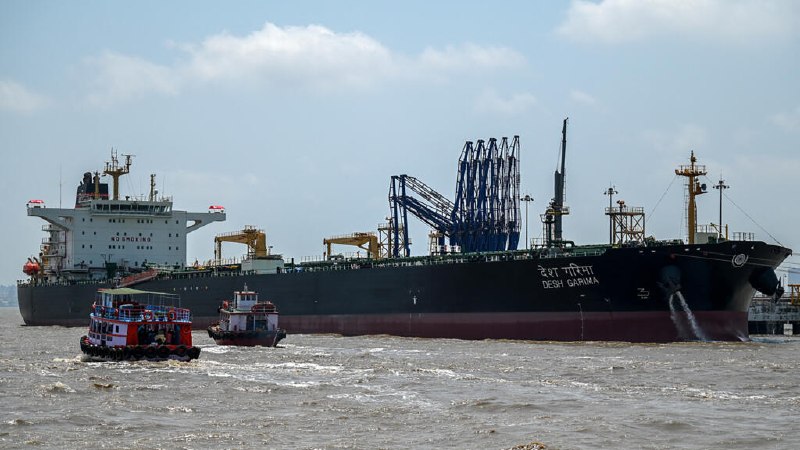
An oil tanker was struck by a projectile in the Strait of Hormuz off the coast of Oman in the early hours of 25 August 2026, the United Kingdom Maritime Trade Operations (UKMTO) said, leaving the vessel damaged and disabled but with no reported casualties among the crew. France 24's Mideast live blog carried the UKMTO advisory, timestamped 03:31 UTC, and the same advisory was reposted to the France 24 Telegram channel at 03:45 UTC. The independent channel DDGeopolitics relayed the warning at 02:25 UTC, quoting the UKMTO wording and pinning the position at roughly 9 nautical miles northeast of Ash Shishah.
The incident landed on a corridor that handles a share of seaborne crude so large that any sustained threat to its traffic moves oil benchmarks within minutes, and any sustained closure would remove supply the market has no ready substitute for. Read against the wider pattern of 2026, the strike is less a surprise than a confirmation: the chokepoint is again contested ground, and the response from insurers, navies and Gulf shipping ministries will set the price of risk for the rest of the year.
A vessel, an alert, a location
UKMTO's wording matters. The advisory described the tanker as damaged and disabled, and said the crew were safe, a phrasing consistent with a kinetic event such as a drone or missile strike rather than a mechanical failure. The reference point given by DDGeopolitics, 9 nautical miles northeast of Ash Shishah, places the vessel in waters well south of the narrowest Iranian-Omani section of the strait but still inside the broader transit funnel through which most crude leaves the Gulf.
The early-morning timing is consistent with earlier attacks on shipping in the region: a low-visibility window in which crews are below alert threshold and AIS spoofing is harder to verify from shore. France 24's Mideast live feed did not name a culprit in the immediate aftermath, and the available source items do not specify the flag state of the vessel, the operating company or the cargo manifest. Monexus finds that the combination of UKMTO's language and the geography points away from a stray accident and toward a deliberate action by an actor with the capability to mount a strike at that range and time, while noting that the cited reporting does not name that actor.
The counter-narrative: a recurring alarm culture
Gulf-state and Western wire coverage has, in recent quarters, treated tanker incidents around the strait as a recurring, almost background feature of the security landscape, and analysts briefed on regional risk have argued that the alert density itself inflates the perceived threat. The counter-narrative is that maritime insurance premiums already price in a baseline of drone and limpet-mine risk, that navies have routinised their responses, and that operators have learned to layer defences. Under that read, a single disabled tanker is a logistics event, not a strategic one.
That framing has a real limit. UKMTO advisories of the kind relayed on 25 August are not issued for mechanical failures; the language of "incident" combined with "projectile" is reserved for events that meet a threshold of kinetic contact. The vessel was disabled, which means it lost propulsion or steering and required assistance; that is a far more serious outcome than a near-miss, and the operational consequence for the shipowner is meaningful regardless of whether the broader market absorbs the news.
Monexus assessment: a chokepoint inside a chokepoint
Read together, the Omani incident sits inside a larger pattern that the published reporting only partly captures. The Strait of Hormuz is the most consequential single chokepoint in the global oil trade, but it is not the only one in the broader Gulf transit system, and the regional pattern of recent years has been to push attacks out of the strait itself and into the approaches: the waters east of Fujairah, the Gulf of Oman, the approaches to Ash Shishah and Salalah. From a structural standpoint, this widens the surface area that any naval mission has to cover, and it forces commercial operators into longer, costlier routing even when the principal lane remains technically passable.
The other piece of the structural picture is information asymmetry. UKMTO advisories are reliable but slow; OSINT trackers on Telegram and X (Twitter) often surface coordinates and imagery before official channels update. Insurers and charterers price to the faster signal. That gap matters: a market that reacts to Telegram imagery before official confirmation is, by construction, more volatile per incident than a market that waits for the wire. The 25 August alert illustrates the pattern rather than breaks it. Monexus assessment: every hour between a Telegram-flagged incident and a wire-confirmed one is, on the pricing side, already priced.
Stakes: who pays if the pattern hardens
If the 25 August strike is the first of a cluster, the immediate losers are the tanker owner, the charterer, and the small group of P&I clubs that absorb the hull loss; the broader losers are Gulf crude exporters whose realised prices depend on the smooth flow of vessels. The available source items do not specify the cargo, the flag or the destination, and the shipowner named in the alert has not been identified in the cited reporting. Monexus finds that the political pressure will fall most heavily on Oman, whose waters absorbed the strike, and on the UAE, whose ports sit on the next vulnerable approach.
The forward question is what the major naval presences in the region, including the Combined Maritime Forces and the European-led maritime mission, do in the days ahead. A formal advisory change, an escort posture shift, or a public attribution would each move the insurance curve. The dates to watch are the next UKMTO update, the next OPEC technical meeting, and the next Lloyd's Joint War Committee bulletin. If none of those move, the strike is absorbed into the baseline. If any of them moves, the price of risk through the strait resets, and the read on the broader trajectory changes with it. The single open question is whether 25 August stands alone or reads as the first datapoint in a new cluster, and the cited reporting does not yet resolve it.
Desk note: Monexus framed the incident as one datapoint in a longer pattern of Hormuz-corridor disruption rather than as an isolated event, and labelled the structural reading as analysis. The wire reporting so far carries the UKMTO alert without attribution or culprit; the broader pattern inference is the desk's, not the wire's.
Wire provenance
This editorial synthesis draws on the following public wire/social posts:
- https://www.france24.com/en/middle-east/20260825-mideast-live-oil-tanker-struck-by-projectile-in-strait-of-hormuz-off-oman
- https://f24.my/C7YW.g
- https://t.me/france24_en/18348
- https://t.me/DDGeopolitics/191816