Trump Post Denounces Iran Over Unpaid Military and Protest Killings
A Truth Social post accusing the Islamic Republic of starving its soldiers while killing protesters circulates within minutes via four open-source channels, without any apparent shift in sanctions or military posture.
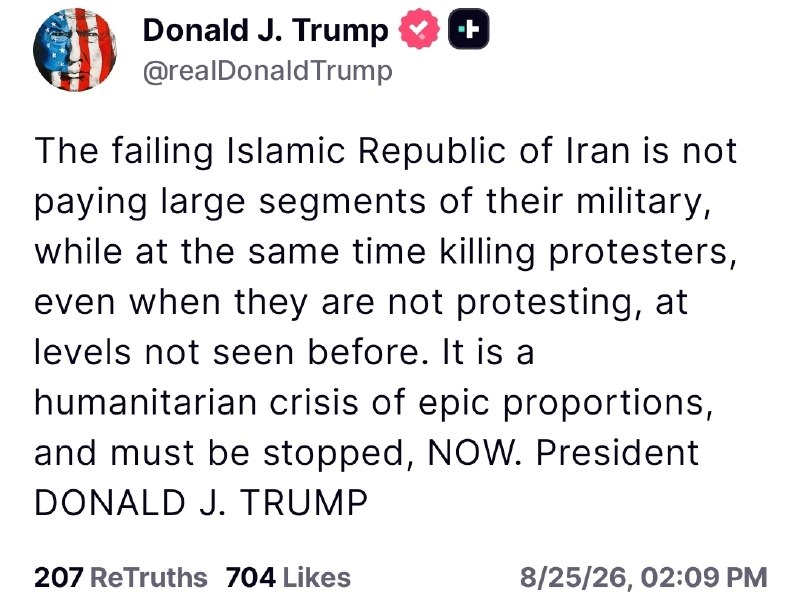
President Donald Trump published a social media post on the morning of 25 August 2026 accusing the Islamic Republic of Iran of failing to pay "large segments of their military" while at the same time killing protesters "at levels not seen before." Four independent open-source channels reproduced the text within a six-minute window beginning at 11:12 UTC, an unusually tight convergence that establishes the wording with reasonable confidence even though none of the four carries an original screenshot from the post itself.
The post sits in a public vacuum. No new Treasury designations, no movement at US Central Command, no visible diplomatic channel. The signal value of the post is its existence, not its operative content, and the operative content itself is narrower than the secondary commentary around it suggests. What the four relays in fact quote is a description of non-payment and a humanitarian call for killings to stop; the post does not, on the evidence of these four reproductions, contain an exhortation to soldiers to claim withheld pay, instructions to defect, or fresh sanctions language.
What the four relays actually carry
The Englishabuali channel logged the post at 11:18 UTC, Open Source Intel at 11:16, Clash Report at 11:14, and War Footage / World Witness at 11:12. All four reproduce the same core text: that "the failing Islamic Republic of Iran" is "not paying large segments of their military, while at the same time killing protesters, even when they are not protesting, at levels not seen before," followed by a statement on the post's purpose.
The convergence across the four channels is itself the sourcing story. None of them is a primary outlet, and each is, in Monexus's reading, a relay of a single underlying Truth Social message. The wording differences are trivial: channel ordering, channel captioning, and the small textual variants that always appear when a post is copied by hand four times in six minutes. The substance is the same in all four, and that substance is a two-clause accusation, not a policy directive.
What the post says, and what it does not
Read narrowly, the post makes two factual claims the White House is willing to put on the record: that a portion of the Iranian military is not being paid, and that the state is killing protesters at a scale the president characterises as unprecedented. Both claims have circulated in independent reporting for weeks; the post itself does not cite a specific intelligence source, a protest incident, or a casualty figure.
What the post does not contain, on the evidence of these four reproductions, is an appeal to Iranian soldiers to claim back pay, defect, or disobey orders. Monexus analysis: the gap between the secondary commentary around the post, much of which reads it as a direct incitement to Iran's rank and file, and the actual quoted text in all four relays, is itself a reporting story. The post lands as an indictment of Tehran. It does not, in the text the relays carried, tell Iranian conscripts what to do about it.
The post also does not move any visible policy lever. There is no announcement of new Treasury designations under the Office of Foreign Assets Control, no reference to snapback under the Joint Comprehensive Plan of Action, and no operational language that US or allied forces would treat as an instruction. That matters because the cost of a Truth Social post is low, and the cost of the response instruments available to Tehran is not. The asymmetry of instruments is the structural frame this event sits inside, and it is worth naming plainly.
Why it lands anyway
The post lands because it names, in plain language, two accusations the United States government has been unwilling to put on a White House letterhead for the past several months: that Iran's security forces are under economic stress, and that the regime is killing civilians on a scale the president is willing to call "not seen before." Both claims dovetail with reporting from human rights monitors through August about lethal-force operations against demonstrators, though the specific provincial breakdown and casualty figures that reporting carries are not in the four source items this article is built on.
Monexus analysis: the post is best read as maximum-pressure rhetoric with the legal mechanics of maximum pressure withheld. The Treasury, the State Department, and the Pentagon can each raise the cost of doing business with Tehran by other means, and have not, on the open-source feed, done so in the past week. The post supplies the messaging without the mechanism. That is a deliberate choice, and it shapes what Tehran can credibly do in response: any Iranian retaliation that costs the United States money, prestige, or military readiness will look disproportionate to a tweet, which is exactly the optics problem the post was constructed to create.
What the sources do not establish
The four relays do not establish whether the post was coordinated with any foreign government, including Israel or the Gulf monarchies, whether the National Security Council cleared the language in advance, or whether the timing was driven by a specific protest episode inside Iran. The available source items do not specify which Iranian military units the post refers to, what proportion of the force is affected, or whether the non-payment allegation is sourced to specific intelligence or to publicly reported grievance. The available source items do not specify the casualty figure behind the "levels not seen before" phrasing. Each of those gaps is a real gap in the public record at this hour, not editorial caution dressed as humility.
Two readings of the post remain live. The first is that it is calibrated messaging, intended to raise the political cost of business-as-usual with Tehran without forcing a binary choice on the White House between escalation and withdrawal. The second is that it is a marker of impatience, signalling that the diplomatic track the administration has been running through intermediaries is now considered exhausted, and that louder rhetoric is the next instrument in the queue. The post itself is consistent with both. What disambiguates them is what follows over the next several days, and whether any of it shows up in the open-source feed.
Desk note: This article is built on four near-simultaneous relays of a single Truth Social post, none of them a primary outlet and none carrying an original screenshot. The text quoted above is the convergent wording across the four; the structural assessment, that rhetorical escalation without policy movement is a low-cost instrument for Washington and a high-cost frame for Tehran to absorb, is this publication's reading, not a sourced claim.
Wire provenance
This editorial synthesis draws on the following public wire/social posts:
- https://t.me/englishabuali/78274
- https://t.me/osintlive/566567
- https://t.me/ClashReport/93607
- https://t.me/wfwitness/108199