Trump floats renaming Lake Ontario as trade jab at Canada
The US president says he is seriously considering rebranding Lake Ontario as "Lake America," a rhetorical escalation in an already tense trade relationship with Ottawa.
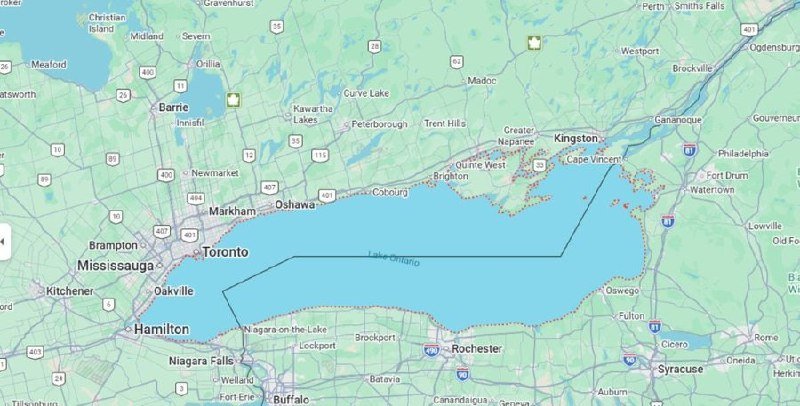
Donald Trump posted a video on 25 August 2026 in which he said the United States is "seriously considering" renaming Lake Ontario, the easternmost of the Great Lakes, as "Lake America," and added that his administration "don't expect to doing much business with Ontario any longer." The remarks, carried on the president's own social channels and amplified by right-leaning aggregators within hours, are the latest rhetorical escalation in a trade fight with Ottawa that has moved from tariffs into the realm of symbolic geography.
The lake straddles the US-Canada border and is shared by the province of Ontario and the US state of New York. Renaming it would be a unilateral act: the name sits on US federal maps, Canadian federal maps, NATO navigational charts, and roughly two centuries of bilateral treaty language. None of those instruments recognise a US prerogative to retitle a body of water that does not belong entirely to the United States. The proposal, in other words, is not a policy so much as a posture, a way of signalling that the relationship with Canada's most populous province, and by extension with the federal government in Ottawa, has been downgraded from negotiation to confrontation.
A lake with two governments on it
The geography matters. Lake Ontario is the eastern gateway of the St Lawrence Seaway, the deep-water channel that moves iron ore, grain, and containerised cargo between the industrial Midwest and the Atlantic. A non-trivial share of US manufacturing inputs enters the country through ports on its shoreline, including Oswego and Rochester in New York. The Canadian side hosts Hamilton, a steel and manufacturing hub whose output is deeply integrated with US auto plants across Lake Erie.
That interdependence is precisely what gives the renaming gambit its bite. Trump did not announce a new tariff line or a Section 232 investigation in the video. He proposed renaming a lake that his own manufacturers rely on to receive Canadian aluminium and to ship finished goods east. The provocation is partly performance: in a White House that has spent 2026 toggling between deal-making and ultimatum, the lake is now part of the bargaining inventory. Whether Ottawa responds with retaliatory measures or with a studied silence will shape how the rest of the trade agenda reads.
The rhetoric of "Lake America"
The phrase lands inside an established pattern. The administration has spent the past year attaching political labels to geographic features, suggesting at various points that the United States should acquire Greenland, reclaim control of the Panama Canal, and rename the Gulf of Mexico the "Gulf of America" on federal maps. The earlier renamings were carried out by administrative fiat and applied only to US government usage. A lake shared with Canada cannot be renamed the same way.
Monexus analysis: the proposal is best read as a trade-negotiation lever rather than a serious cartographic project. Renaming a shared body of water requires at minimum the acquiescence of the other sovereign, and Canada has shown no inclination to accommodate earlier US demands on tariffs and defence spending. Trump's remark functions as a way to keep Ottawa off-balance between rounds of negotiation and to rally a domestic base that reads confrontational posture as competence.
What Canada is likely to hear
Ottawa's reaction, in the available reporting, has been to absorb rather than escalate. Canadian federal officials have historically treated Trump-administration provocations as openings for quiet bilateral work, and provincial premiers in Ontario have a record of preferring that posture. The risk for Ottawa is that silence reads as acquiescence in Washington. The risk for Washington is that a theatrical provocation crowds out the very negotiations the White House says it wants.
The deeper question is whether symbolic fights crowd out substantive ones. Renaming a lake does not move a single container through the Port of Hamilton or change the input costs of a Toledo stamping plant. But it does signal that the United States is willing to spend political capital on gestures whose only constituency is at home. For Canada, the more consequential moves in the same week have been the slow tightening of provincial procurement rules and the federal government's continued courtship of European and Indo-Pacific partners. The lake is the headline. The supply chains underneath it are the policy.
What to watch next
Three dates matter. First, the next round of USMCA review consultations, where Ontario's auto-parts footprint gives the province direct leverage. Second, any White House response to Canada's expected request for clarification on the renaming proposal; a walk-back would mark the proposal as purely rhetorical, while silence or escalation would harden it into policy intent. Third, the St Lawrence Seaway's autumn shipping window, when any actual disruption to cross-border cargo would register quickly in US Midwest industrial output.
The available source items do not specify whether the renaming proposal has been formalised in any executive-order draft or transmitted to the US Board on Geographic Names. The available source items also do not specify whether Canadian officials have issued a public response. This publication will update as either becomes a matter of record.
Desk note: The wire has run Trump's comments straight, with little of the cartographic or trade context that makes them legible. Monexus framed the lake as a shared economic instrument first and a rhetorical object second, and treated the proposal as a trade-negotiation lever rather than a serious renaming bid.
Wire provenance
This editorial synthesis draws on the following public wire/social posts:
- https://x.com/SprinterPress/status/2092240435875832017
- https://x.com/SprinterPress/status/2092236991546917000
- https://x.com/BowesChay/status/2092234034273489092
- https://t.me/insiderpaper/44135
- https://t.co/BrsrP1ryEM