Ruto's Katiba Day gambit: constitution as scaffolding, Mau cash, and a new police uniform
Two years after President Ruto proclaimed August 27 a national observance, his government is recasting the 2010 Constitution as the scaffolding for a new national development charter, while simultaneously moving cash to Mau evictees and rolling out a new police uniform.
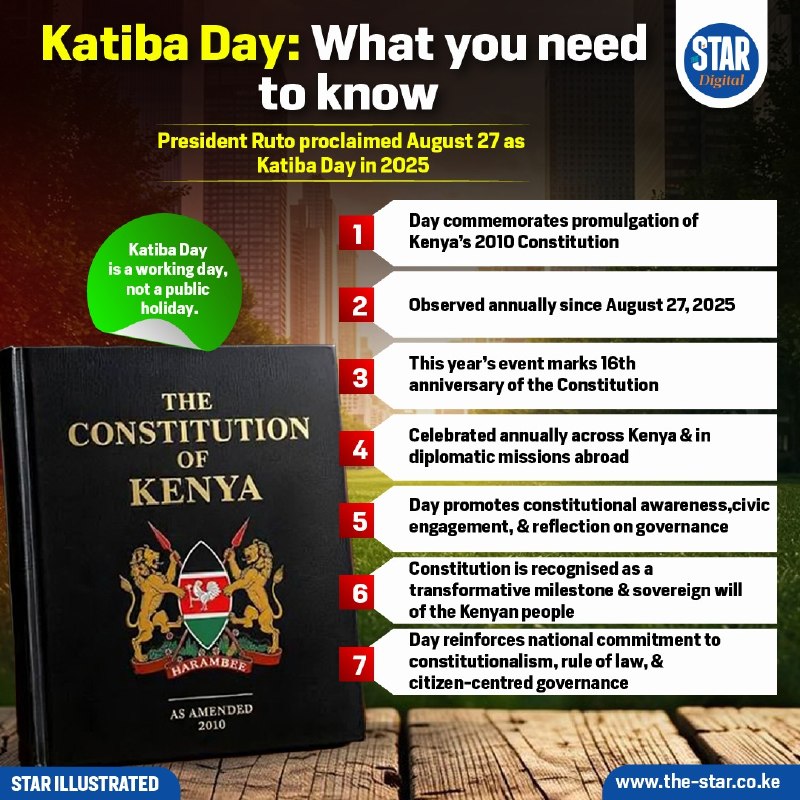
On 27 August 2026, Kenya marked Katiba Day for the second time under a proclamation issued by President William Ruto in 2025. The annual observance commemorates the promulgation of the country's 2010 Constitution and, in the government's framing, is meant to keep the document's aspirations in public view. This year's commemoration came wrapped in something larger. Speaking on the eve of the holiday, Ruto called for a new national development charter anchored on the constitution, an attempt, in his words, to translate the document's aspirations into a concrete agenda for growth, jobs and industrialisation.
The Star Kenya's wire carried the charter call on 27 August, the Mau payout on 26 August, and the planned police-uniform unveiling for Friday 28 August in three separate items. Read together, the sequence looks deliberate: a constitutional moment midweek, a Sh2.6 billion cash promise to a politically visible aggrieved constituency, then a low-cost security-sector gesture on the Friday that follows. Monexus reads the timing as an attempt by the presidency to own the next phase of the conversation about Kenya's post-2010 settlement, rather than defend the record of the last fifteen years.
The constitution as scaffolding
Ruto's pitch on 26 August was that the country needs a development roadmap that turns the 2010 Constitution's commitments into measurable outputs. The framing, as The Star Kenya reported it, treats the constitution as the anchor and the new charter as the implementation instrument. He has not yet published a draft, and the available reporting does not specify the legal vehicle or the binding status such a charter would carry. A document of this kind could sit in one of two places: a political compact without statutory force, sitting alongside the medium-term plans already produced by the National Treasury, or a competing planning instrument that overlaps with the Public Finance Management Act framework.
This is the second year of Katiba Day under the 2025 proclamation, and the symbolism is now an established fixture of the presidency's calendar. The Star Kenya's 27 August item treats the day as an annual national observation; the 2026 edition's political payload is the charter call rather than the commemoration itself.
The Mau payout, and what it signals
On 26 August, Ruto announced that 13,000 people evicted from the Mau Forest will each receive Sh200,000 from the government as compensation. The Star Kenya reported the announcement as a major step in a long-running conservation fight, with the per-person amount implying a headline total of roughly Sh2.6 billion across the 13,000 evictees. The Mau is one of Kenya's most important water towers, and the framing of the payout in The Star Kenya's wire is unequivocal about its scale and political weight.
The available reporting does not specify the timeline for disbursement, the legal vehicle for the compensation, or how the figure was calibrated against replacement-land values in the adjacent counties. Read alongside the Katiba Day announcement, the payout lands as a visible, dated relief effort in the same news cycle as a long-horizon constitutional pitch. The Star Kenya carried both items within twenty-four hours of each other; whether the proximity is sequencing or coincidence is not stated in the wire.
Policing, symbolism and a new uniform
On Friday 28 August 2026, Ruto is set to unveil a new uniform for the Kenya Police Service, marking the return of an earlier design after officers rejected the current navy-blue attire. The Star Kenya's 26 August item frames the move as a wardrobe change with a known political backstory: a previous redesign was rejected by the rank and file, and the Friday unveiling reverses that decision.
The available reporting does not specify whether the rebrand is paired with a substantive police reform agenda, with changes to command structure, or with adjustments to welfare or terms of service. Monexus assessment: on the evidence in the wire, the uniform decision is best read as a low-cost, high-visibility gesture that pairs a constitutional moment with a security-sector acknowledgement, while the policy payload around the police service remains unspecified by the available reporting.
What to watch
Three tests will determine whether the new development charter is a genuine policy instrument or a political artefact. First, does the presidency publish a draft, and is it bound by an existing law or only by political commitment? Second, how the counties, which sit at the centre of Kenya's devolved settlement, are drawn into the drafting process, or whether the charter is produced inside State House. Third, whether the Mau payout becomes a one-off or sets a precedent for other forest evictions. On the uniform, the immediate question is whether the rebrand is paired with a substantive police reform agenda or stands alone.
The nuance the available reporting does not settle is whether the Kenyan opposition reads the charter as a closed-door consolidation or as an open invitation, and whether the Mau compensation framework will be replicated elsewhere. Ruto's wager, as the wire presents it, is that he can attach his name to a national development story before anyone else does.
Desk note: Monexus framed the Katiba Day commemoration, the Mau payout and the planned uniform unveiling as a single coordinated sequence, an analytical reading supported by the dating of the three items in The Star Kenya's wire but not by an explicit government statement tying them together. The Star Kenya's Telegram wire carried each item separately; the synthesis is Monexus's own. Where the wire does not specify a detail (legal vehicle, disbursement timeline, reform agenda), this article says so rather than infer.
Wire provenance
This editorial synthesis draws on the following public wire/social posts:
- https://t.me/TheStarKenya/37829
- https://t.me/TheStarKenya/37825
- https://t.me/TheStarKenya/37786
- https://t.me/TheStarKenya/37766