Qantas prints where the line was drawn, as Australia's Q2 capex slips
Full-year profit landed where consensus expected it, but the Q2 business-investment release showed a 3.6% headline drop with the data-centre build-out named as the fading engine, and the S&P/ASX 200 closed lower on the day.
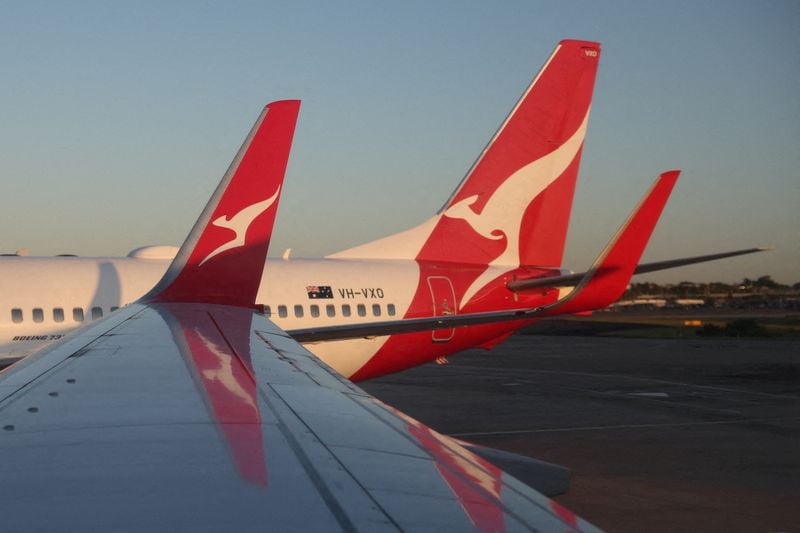
At 01:33 UTC on 27 August 2026, Qantas confirmed the read on its full year: profit met the consensus estimate, the travel-demand backdrop held, and the loyalty division was named alongside it as the second support. By 06:30 UTC the same session, the S&P/ASX 200 had closed down 0.98%. Between those two prints sits the day's tension, and a quiet repricing of what Australian growth is going to look like in the second half of 2026.
Two releases land cleanly. The first is Qantas's full-year result: a meet on estimates, travel demand cited as the demand-side anchor, loyalty growth as the mix-side anchor, with shares up 4.5% on the session. The second is the Australian Q2 business-investment release, which showed a 3.6% headline decline attributed in the reporting to the fading data-centre pipeline. Read against each other, the prints sketch an economy in which a consumer-facing franchise is still clearing the bar while the capital-expenditure cycle behind it is losing the engine that pulled it forward through 2024 and early 2025. Monexus analysis: the Qantas print confirms the demand side of the cycle; the capex release is the first quarterly data point in 2026 that names where the demand side is running out of upstream support.
The Qantas print, parsed
The earnings note published at 01:33 UTC says the full-year profit met estimates on strong travel demand and loyalty growth. The earnings-call transcript at 02:20 UTC carries a different label for the period the print covers: H2 2026, with profit falling and shares rising 4.5% on the read. The executive interview at 02:24 UTC adds the route-level detail, naming a rebound in demand for Australia-US flights. The FY note and the H2 transcript therefore describe the same trading day but different windows into the result. The available source items do not specify the FY-versus-H2 reconciliation between the meeting-estimate number and the year-on-year profit movement, and this article does not establish that reconciliation independently.
Two structural anchors carry the print, per the cited materials. The first is travel demand, framed in the FY note as strong without further sectoral decomposition in the available sources. The second is loyalty growth, framed in the same note as a contributor to the meeting-estimate outcome. The rebounded long-haul corridor to the United States, per the executive interview at 02:24 UTC, is the named bright spot inside the demand story. The thread evidence does not specify a premium-cabin detail, a points-redemption metric, or a load-factor number for any route; this article accordingly does not attach those characterisations to the print.
The Q2 capex print, parsed
The Q2 business-investment release at 02:01 UTC reports the headline at down 3.6%, with data centres named in the headline as the fading driver. The same release frames the move against a prior pipeline that, per the reporting, pulled forward investment into earlier quarters. The available source items do not specify a trend-measure figure, a sectoral breakdown finer than the data-centre attribution, or a quarter-on-quarter versus year-on-year disaggregation; this article accordingly treats the 3.6% decline as the headline number reported and does not impute a trend figure the cited materials do not contain.
The data-centre build-out has, on the cited reporting, been the most reliable capex engine of the cycle. Its fading as a contributor to the Q2 number is consistent with a familiar late-cycle shape in which a pipeline that was pulled forward into 2024 and 2025 produces a tougher comparable in 2026. The Q2 number is the first quarterly data point in 2026 in the cited set that names the fade. Monexus analysis: the print is the first quarterly data point in 2026 to name the fading of the data-centre engine explicitly, which makes it a marker for the cycle even where the headline is within the range of ordinary quarterly volatility.
Where the two prints meet, and where they do not
The two releases describe different parts of the same economy on the same day. Qantas's FY meet on estimates is consistent with the demand side of the cycle still clearing the bar set by the sell-side. The Q2 capex decline is consistent with the upstream capex engine that supported earlier quarters running out of fresh megaproject flow. The correlation is tight enough that a reader could plausibly read the capex print as the lag indicator to the demand print; the available source items do not specify that lag in calendar terms, and this article does not establish it.
The counter-read is that a single quarterly capex print does not, on its own, make a trend. The cited materials do not specify unemployment, household consumption, or housing-cycle readings for the period; those would situate the demand print against a wider set of indicators than the available sources contain. Monexus analysis: the size of the capex print is small relative to the headline noise typical of quarterly investment data, which is why the September 2026 national accounts revision carries weight, it will resolve whether Q2 reads as the first quarter of a softer capex cycle or as a single quarter's air pocket in the comparable base after the data-centre pull-forward.
What to watch into the next window
Three releases sit on top of the next reading window. First, the September 2026 capex revision in the Australian national accounts, which will establish whether the 3.6% Q2 number is the start of a sequence or a single-quarter effect. Second, a further Qantas disclosure that names a loyalty growth metric, which the available sources do not specify but which would convert the "loyalty growth" framing in the FY note into a quantifiable line. Third, a load-factor or capacity reading for the Australia-US corridor, which the cited interview names but does not number. Monexus analysis: the Qantas print is a confirmation of the demand story the FY note carries; the capex print is the one with a tail into the September revision.
Desk note: The cited thread gives the Qantas result as a meet on estimates (FY) and a profit-falling print (H2), with Australia-US demand named and loyalty growth cited. Monexus reads the two prints together, treating the capex release as the first quarterly data point in 2026 to name the data-centre fade, and labels interpretation in place.
Wire provenance
This editorial synthesis draws on the following public wire/social posts:
- https://www.investing.com/news/earnings/qantas-fy-profit-meets-estimates-on-strong-travel-demand-loyalty-growth-4878211
- https://www.investing.com/news/transcripts/earnings-call-transcript-qantas-h2-2026-profit-falls-stock-rises-45-93CH-4878268
- https://www.investing.com/news/stock-market-news/qantas-has-seen-rebound-in-demand-for-australiaus-flights-executive-says-4878273
- https://www.investing.com/news/economic-indicators/australia-q2-business-investment-falls-36-as-data-centre-rush-fades-4878238
- https://www.investing.com/news/stock-market-news/australia-stocks-lower-at-close-of-trade-spasx-200-down-098-4878384
- https://www.investing.com/news/earnings/qantas-fy-profit-meets-estimates-on-strong-travel-demand-loyalty-growth-4878211
- https://www.investing.com/news/transcripts/earnings-call-transcript-qantas-h2-2026-profit-falls-stock-rises-45-93CH-4878268
- https://www.investing.com/news/stock-market-news/qantas-has-seen-rebound-in-demand-for-australiaus-flights-executive-says-4878273
- https://www.investing.com/news/economic-indicators/australia-q2-business-investment-falls-36-as-data-centre-rush-fades-4878238
- https://www.investing.com/news/stock-market-news/australia-stocks-lower-at-close-of-trade-spasx-200-down-098-4878384