Strikes on Kyiv's logistics belt expose the limits of talk
Two days of Iranian-designed drone strikes on ammunition depots and warehouses southwest of Kyiv suggest Moscow has identified the seams in Ukraine's supply chain and intends to widen them, regardless of the diplomatic weather above.
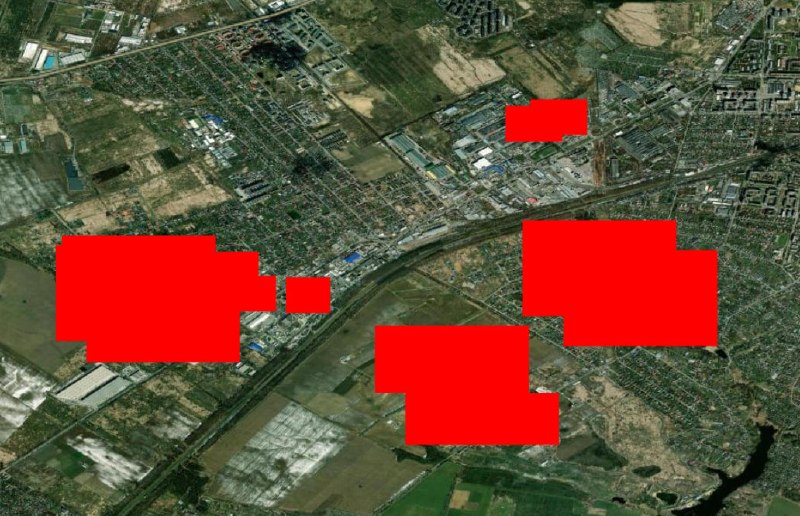
A Russian Geran-4 jet-drone struck an ammunition depot in the village of Myla, Kyiv Oblast, on the evening of 28 August 2026, producing a large secondary detonation and setting the surrounding area alight, according to posts by the Telegram channels AMK_Mapping and intelslava. NASA FIRMS satellite data captured the thermal bloom within hours, with the same imagery showing fires burning at at least four logistics warehouses southwest of Kyiv along or near the M-06 Kyiv-Zhytomyr Highway. Traffic on that artery was partially restricted as a result. The strike is the latest in a two-day Russian drone campaign against ammunition storage and freight infrastructure ringing the capital, and the geography of the targets is the story.
The point is not the single depot. The point is the corridor. Myla sits in Bucha District, on the road and rail axis that connects Kyiv to western Ukraine and, beyond that, to the Polish border. Ammunition depots and logistics warehouses along that axis are not random nodes. They are the bottlenecks through which Western-supplied shells, air defence interceptors and drone components reach the front. A drone that costs a fraction of a cruise missile and explodes a magazine worth months of resupply is, by any rational calculus, the kind of return on investment a country running a grinding war of attrition ought to pursue.
The seams in the supply chain
The reporting from AMK_Mapping is granular in a way that exposes the targeting logic. Posts on 28 August catalogue not one but at least four logistics fires, the village of Myla struck twice within minutes, and visible secondary detonations consistent with stored munitions cooking off. That pattern is too consistent to be incidental. Monexus assessment: Moscow appears to have shifted emphasis in late summer 2026 from energy infrastructure, which dominated headlines through 2024 and 2025, to the unglamorous end of the supply chain. The aim is not spectacle. It is to thin the throughput of Ukrainian firepower at the lowest possible cost in Russian airframes.
There is a counter-narrative worth taking seriously. Ukraine's domestic defence industry has expanded sharply since 2023, and a meaningful share of frontline munitions now originate in factories inside Ukrainian-controlled territory rather than via the M-06. If that share is large enough, the loss of depots along the highway hurts less than it would have a year ago. The cited posts do not specify what share of Ukrainian ammunition stocks currently transits the affected corridor. Until that number is on the record, the targeting logic above is a working hypothesis, not a confirmed strategy.
Why drones, why now
Geran-4 is the export-marketed variant of the Iranian Shahed-136, a slow, cheap, piston-engine loitering munition optimised for hitting fixed, soft or semi-hardened targets. Its operational ceiling is modest; its unit cost is lower; its production runs in Russian and Iranian factories have grown year on year. Used en masse against ammunition depots, it forces Ukrainian fire crews to spend interceptors that cost orders of magnitude more than the incoming threat. The economics favour the attacker once the ammunition store is reliably found.
That last clause is the asymmetry. Cheap drones become strategically meaningful only when paired with intelligence on where the depots are. The cluster of fires along the M-06 suggests that the Russian targeting cycle has matured: reconnaissance has located the warehouses, drones have been tasked against them, and the same corridors are being revisited. Kyiv's problem is no longer that an individual warehouse can be hit. It is that the location data persists.
What the diplomatic weather cannot fix
Talk of ceasefire negotiations, of frozen lines, of meetings in third capitals, recurs in international media on a weekly cadence. The pattern on the ground does not appear to wait for those conversations. Within the last 48 hours, ammunition depots in Bucha District have burned, multiple logistics warehouses along the Kyiv-Zhytomyr corridor have burned, and traffic on the principal supply highway has been partially restricted. None of that advances a settlement. All of it raises the price of any future settlement for Kyiv by eroding the materiel base Ukraine would bring to a negotiating table.
There is a tension at the heart of Western commentary on this war that the August strikes make harder to ignore. Public discussion routinely centres on the political timetable of peace talks, on the personalities around the table, on the wording of communiqués. The hardware war is older than the diplomacy and moves on a different clock. A drone that costs in the low tens of thousands of dollars and destroys a magazine of artillery shells worth several million is not a metaphor. It is the metric by which the next quarter of the war will be measured.
Stakes worth naming
If the targeting pattern of late August continues into autumn 2026, the constraint Ukraine feels at the front will not be personnel first. It will be shells and interceptors, on the schedule that the depots dictate. Western allies face a choice that the diplomatic weather tends to obscure: either the throughput along the M-06 and similar corridors is hardened, dispersed and actively defended, or the depots remain legible to cheap drones and the bill comes due in ground lost in Donetsk and elsewhere. Neither option is cheap. Both are cheaper than the alternative.
The bigger pattern is one this publication has been calling out for months. The contest between an aggressor able to absorb losses in pursuit of incremental gains, and a defending country whose ammunition arrives by road and rail through a small number of identifiable nodes, is not symmetric. The M-06 corridor southwest of Kyiv is one of those nodes. On the evening of 28 August 2026, it was burning. The diplomatic weather above is real. The fire below is at least as real.
Desk note: Monexus framed this strike sequence around the geography of the targets rather than the political theatre around them, and treated the cited Telegram channels as the primary sourcing for an event still developing on the night of publication. Wire confirmation is expected to follow.
Wire provenance
This editorial synthesis draws on the following public wire/social posts:
- https://t.me/AMK_Mapping/36622
- https://t.me/AMK_Mapping/36619
- https://t.me/AMK_Mapping/36617
- https://t.me/AMK_Mapping/36615
- https://t.me/intelslava/93410