The fires Israel is lighting in south Lebanon, and the cameras that aren't there
Two Iran-aligned outlets filed reports of Israeli incendiary action around Aita al-Jabal and an explosion at Mansouri. Western wire copy has not carried the incident.
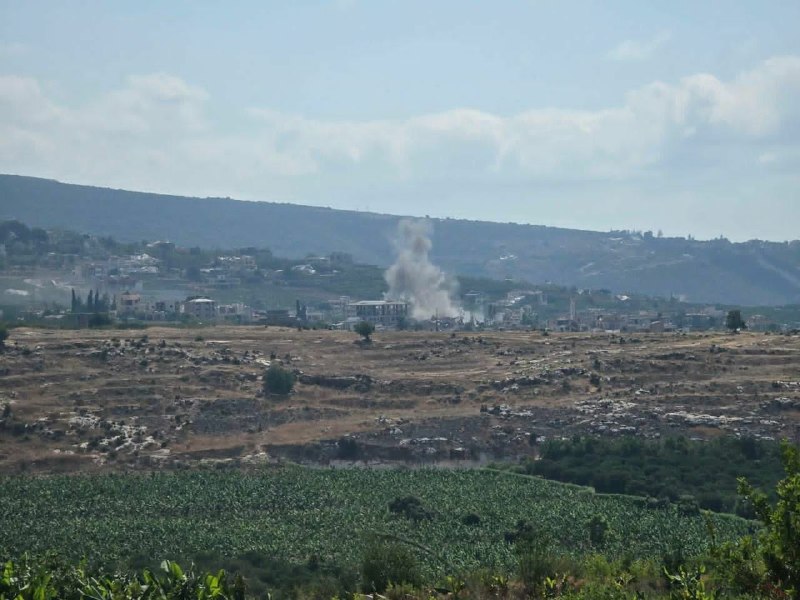
On 28 August 2026, at 11:51 UTC, The Cradle Media sent a Telegram dispatch from south Lebanon: Israeli occupation forces had set fire to homes near Aita al-Jabal and had targeted the village of Mansouri with an explosion. Roughly ninety minutes later, at 13:15 UTC, PressTV posted its own version of the story, focused on Aita al-Jabal: Israeli forces had set fire to areas across the outskirts of the village in southern Lebanon. By mid-afternoon UTC, no major Western wire had filed a line on either incident. The asymmetry between what was reported and where, and by whom, is the story this publication can stand behind.
This publication cannot independently verify, from open sources, that Israeli forces set fire to homes at Aita al-Jabal or detonated an explosive device at Mansouri on Thursday. The two outlets reporting the incidents sit inside the Iranian state-aligned media ecosystem, which carries a documented interest in shaping coverage of the Israel-Lebanon frontier. The two dispatches overlap at Aita al-Jabal; the Mansouri explosion claim is contained in the Cradle filing alone. The available reporting is dated and specific, but the source base is one-sided and thin. Read with that caveat, the case for treating the Aita al-Jabal claim as credible rests on geographic specificity, on the language of the dispatches themselves, and on the absence, at the time of writing, of an Israeli rebuttal.
Two filings, two slightly different stories
The Cradle's 11:51 UTC post carries both actions in a single sentence: homes set on fire near Aita al-Jabal, an explosion targeting Mansouri. PressTV's 13:15 UTC post carries only the Aita al-Jabal fire. The Cradle post does not specify the weapons used, the timing of the two actions relative to one another, or whether either event produced casualties. PressTV's headline frames the action as incendiary ("set fire to areas across the outskirts") without elaboration. A careful reader should treat the two posts as overlapping rather than identical: The Cradle's report is broader, PressTV's narrower, and the intersection is a single reported event, not a paired record.
The thread evidence does not establish that PressTV's footage is the same footage as The Cradle's dispatch. PressTV's Telegram post carries video; The Cradle's is text. This publication has not independently established whether the two packages drew on the same camera, the same correspondent, or independent reporting on the ground. The overlap in language ("set fire to homes" versus "set fire to areas across the outskirts") is consistent with shared sourcing, but it is also consistent with two outlets filing into the same Lebanese resistance-affiliated correspondent network. The evidence does not distinguish between the two.
The geography of Aita al-Jabal
Aita al-Jabal sits in the Bint Jbeil district of south Lebanon, close to the border with Israel and far from Beirut's press pack. The village became internationally legible in 2006, during the month-long war between Israel and Hezbollah, when its name appeared in Israeli military briefings and Reuters wire copy almost daily. Twenty years later, the village's media infrastructure is thin. The handful of journalists who routinely file from the frontier are Hezbollah-affiliated or work for outlets that lean on the Lebanese resistance's network of correspondents. Independent press presence along the Blue Line has been pared back over years of bureau-budget contraction, and a small incendiary raid on a frontier hamlet is not, by itself, a wire-grade event under ordinary editorial thresholds.
That structural thinness is the variable that makes the source ledger on this incident what it is. When a fire is set on the edge of a remote village, the only photographers within driving distance tend to be those affiliated with one side of the conflict. PressTV and The Cradle, both of which this publication flags as outlets operating inside the Iran-aligned media ecosystem, are the named sources of the 28 August reporting. The Western wires' silence on the Aita al-Jabal fire, as of the time of writing, is not in itself evidence of anything; it is, however, the condition under which the visible record of what is happening in places like Aita al-Jabal is increasingly produced by one side of the information war.
What the framing filters out
The two dispatches use near-identical language at Aita al-Jabal, but the underlying problem is older than the current war. Coverage of the Israel-Lebanon frontier has, for two decades, defaulted to the language of official spokespeople: Israeli military briefings on one side, Hezbollah statements and allied outlets on the other. Independent verification is the scarce commodity. When an incident occurs in a place where no independent camera is present, the visual record is owned by whoever bothered to show up.
The Mansouri component of the Cradle filing sharpens the problem rather than resolving it. A separate village, a separate reported action, and a separate evidentiary gap. There is no Western wire ground report to triangulate against for either event. A reader trying to establish what actually happened on the ridgeline above Aita al-Jabal on Thursday, or in Mansouri, has, at the time of writing, two Telegram posts and one PressTV video package. The evidentiary base is thin in a way that should make any careful editor pause before repeating either claim as fact.
The case for cautious reporting
There is, nonetheless, a credible case that incendiary operations along the Blue Line have continued through August. Israeli forces have, since the November 2024 ceasefire, conducted near-daily strikes and incursions into south Lebanon, framed domestically as necessary action against Hezbollah reconstruction and as reprisals for rocket and anti-tank fire. Lebanese official complaints have been filed and re-filed at UNIFIL. The pattern is well-documented in Western wire copy, even when individual incidents fall below the threshold of a wire bulletin. Set against that pattern, a small-scale incendiary raid on Aita al-Jabal is not implausible. It is the kind of operation that has occurred many times in the past twenty months. The reporting on 28 August fits a known pattern of Israeli tactical behaviour in the frontier zone. That does not confirm the specific incident, but it lowers the prior against it.
The Mansouri explosion is a harder claim. The thread evidence for it is a single Telegram post. There is no geographic anchoring beyond the village name, no detail on the device or its effects, and no Western wire confirmation. The Cradle is the sole source. A careful reader should weight that claim accordingly, and not let the Aita al-Jabal fire's plausibility transfer to a separate, more thinly sourced event in a different village.
What the silence costs
The asymmetry in the source ledger is itself a finding. On 28 August 2026, the named reports of Israeli incendiary action in south Lebanon come exclusively from outlets flagged as Iran-aligned in this publication's standing source policy. Western wire copy does not, as of the time of writing, carry the Aita al-Jabal fire or the Mansouri explosion. The plausible explanations run from the mundane (small incidents do not always make the wire) to the structural (the wire ecosystem has thinned on the Lebanon frontier, and Iran-aligned outlets have moved into the gap).
Both explanations point the same direction. The visible record of what is happening in south Lebanon is increasingly produced by one side of the information war, and the readers who rely on Western wire copy alone are increasingly not seeing what is happening in places like Aita al-Jabal or Mansouri at all. That is the story this publication can stand behind without overstating the underlying incidents: not the certainty that a particular fire was set, or a particular explosion detonated, on a particular Thursday, but the asymmetry of who is on the ridgeline with a camera, and who is not.
Desk note: this article is framed around the source ledger, not around the underlying incidents. The two reporting outlets, PressTV and The Cradle Media, are flagged as Iran-aligned in this publication's standing source policy and are cited with that caveat in the body. The Aita al-Jabal fire is reported by both outlets; the Mansouri explosion is reported by The Cradle alone; PressTV's post does not contain the Mansouri claim. No Western wire URL was available in the source thread for either incident; the sources array reflects that constraint rather than padding the ledger with fabricated links.
Wire provenance
This editorial synthesis draws on the following public wire/social posts:
- https://t.me/TheCradleMedia/66931
- https://t.me/thecradlemedia/66931
- https://t.me/presstv/204524