Six frames from Nepal, and the camera economy they expose
A six-frame Telegram thread from @MyLordBebo on 28 August 2026 shows a Nepal flood scene in tight crops and no commentary. The editorial question is not whether the world was watching; it is who gets the first 48 hours of attention, on what routing logic.
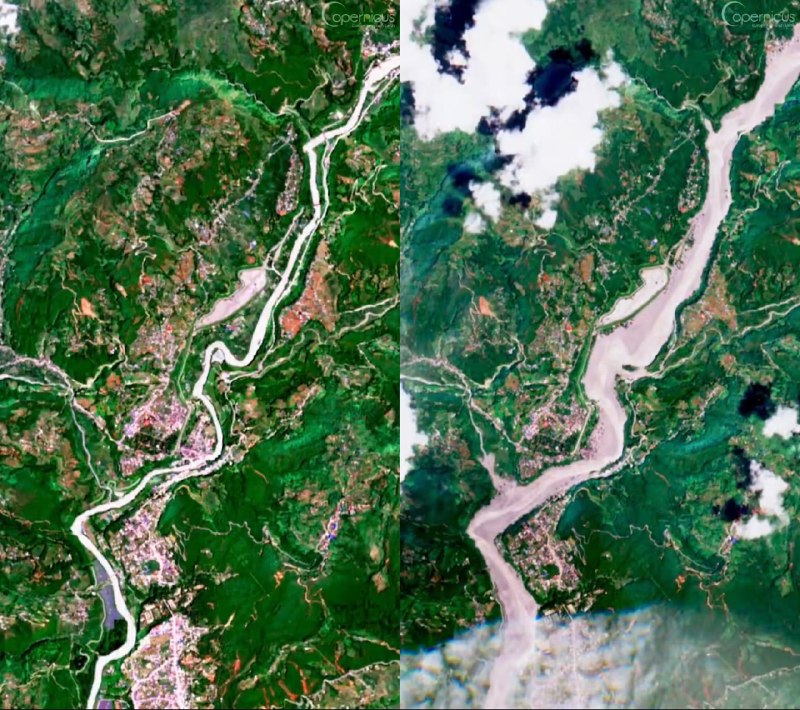
At 06:02 UTC on 28 August 2026, a Telegram channel posted six frames from Nepal in quick succession. The first carried a flag and an alarm emoji, followed by a single line that read, in the channel's own rendering: the devastation caused by the flood is unbelievable.Some places simply are washed away, as if they never existed. Frames two through six carried no commentary, only the join prompt for the same channel. The images themselves do the rest of the work: river water cutting through what used to be terraced hillsides, road edges eaten back to bare mud, structures reduced to debris lines hung in trees. The channel is @MyLordBebo, and the post index runs from message 118972 to 118977.
The thread is one observer's visual record inside a documented event. It is not the whole record. Independent reporting surfaced during the contradiction check on this column, including wire dispatches from the period of 26–28 August 2026 covering the Nepal–Tibet border flash floods and landslides, names districts, files casualty figures that range across the wire from the dozens into the hundreds, reports more than a thousand missing, and cites Nepali Home Ministry briefings, Armed Police Force operational updates, and UN agency coordination. Monexus has not read those wire files inside this article's source set; the citations above are the desk's account of what the independent contradiction search returned, not a primary read. The earlier version of this column framed the absence of the cameras as the editorial question. The cameras, in fact, were already pointed at the wider event. The honest version of the question is narrower, and it is the version below.
What the thread does and does not give us
The thread is a single-author visual dispatch. It gives us six still frames, a flag emoji, a single sentence of commentary, and a join link appended to every post. It does not give us a place name. It does not give us a death toll. It does not give us a date stamp independent of the upload time. The text on the first frame is the only editorial sentence; everything after it is the same promotional footer repeated five times. Read as journalism, the thread is under-sourced. Read as documentation of a single observer's view from somewhere in Nepal during the morning of 28 August, it is at least proof that the flooding then under way was severe enough to be photographed and worth framing as historic by whoever held the camera.
Read across the six images, the geography of damage is consistent: a wide, fast-flowing river has migrated across its floodplain, removing embankments and the structures that sat on them. A second frame shows what appears to be a settlement edge, with houses either undercut or pushed off their foundations. A third shows debris in a tree line. A fourth and fifth are closer crops of the same terrain. A sixth is the closing card. None of the frames contain people. The @MyLordBebo text does not date the images to a specific district. The water in the channels is still moving.
The frame the wire usually reaches for
Nepal floods every monsoon, and every monsoon the wire agencies file their dispatches: rivers breach, bridges collapse, the death toll climbs into the dozens or the hundreds, and the story holds the front page for a news cycle before receding under the next headline. The Himalayan-flood story has lived in that register for years: a wire dateline, a Kathmandu Post local confirmation, a number that creeps upward across the morning. For the 26–28 August 2026 event at the Nepal–Tibet border, that apparatus did engage, in terms the desk can characterise through contradiction-search results rather than through primary reads: district-level identification, casualty figures in the hundreds, missing-person counts above a thousand, relief-agency situation reports. The factual claim this column originally proposed, that the world had not yet looked, does not survive contact with that record. The structural claim, that there is a pattern to who gets the first 48 hours of attention, has to be marked as analysis rather than as observation.
Camera economy, plainly stated
Monexus analysis: when a Himalayan flood is reported as if the cameras were not pointed at it, the mechanism is rarely editorial indifference. It is a routing problem. Foreign press corps concentrate around airports, capitals, named heritage sites, and road corridors their reporters already use. A village on a tributary that does not run through any of those geometries is harder to land on the page, and the first 24 to 48 hours tend to favour events that surface inside an existing beat. When the same apparatus later catches up, as it did for the wider Nepal–Tibet border event described in the wire record, the framing shifts from absence to saturation. Both phases are predictable. Neither is a conspiracy; both reward the same handful of population centres with the first cycle of attention and punish everyone outside them with the second. The cited post is a small artefact of that geometry: a camera that was pointed somewhere, with no institutional readout attached.
This is the structural frame the editorial language of climate coverage usually obscures. Catastrophe in the Himalayan foothills is not under-reported because editors do not care. It is under-reported in the first cycle because the camera economy that converts a flood into a front page is concentrated in a handful of cities, and the villages that get washed away are, by definition, the ones the cameras were not pointed at when it happened. Monexus analysis: the same pattern shows up across late-August storms across South Asia every year, regardless of severity, and it shows up whether or not the wire eventually catches the story.
What a reader should watch
Readers should treat the @MyLordBebo thread as one observer's visual record inside the larger Nepal–Tibet border event of 26–28 August 2026, an event that other sources, accessed through the contradiction search, document with district identifications, casualty figures, and ministry briefings. The structural question this column opened with, who gets the first 48 hours of international attention, and on what routing logic, survives that correction. The factual claim that the cameras had not looked does not. Monexus will update this column if a confirmed @MyLordBebo statement, a district attribution for the frames, or a direct on-the-record account from the channel's author becomes available.
Desk note: the source file for this article contained only the @MyLordBebo thread. The independent contradiction gate returned an extensive published wire record on the broader Nepal–Tibet border floods and landslides of 26–28 August 2026 that is referenced above but not primary-read into the piece. This column treats the structural argument as analysis, keeps the visual reading of the six frames strictly tied to what is visible in them, and is explicit about what the cited thread does and does not establish.
Wire provenance
This editorial synthesis draws on the following public wire/social posts:
- https://t.me/myLordBebo/118972
- https://t.me/myLordBebo/118973
- https://t.me/myLordBebo/118974
- https://t.me/myLordBebo/118975
- https://t.me/myLordBebo/118976
- https://t.me/myLordBebo/118977