Six months into the US–Iran war: interceptor stocks thin, denials multiply, and the stalemate deepens
Six months after the US opened its war on Iran, Pentagon interceptor inventories are reportedly below operational floors, Tehran's security chief is publicly rebutting Trump-administration leaks, and markets have priced in a stalemate with no visible off-ramp.
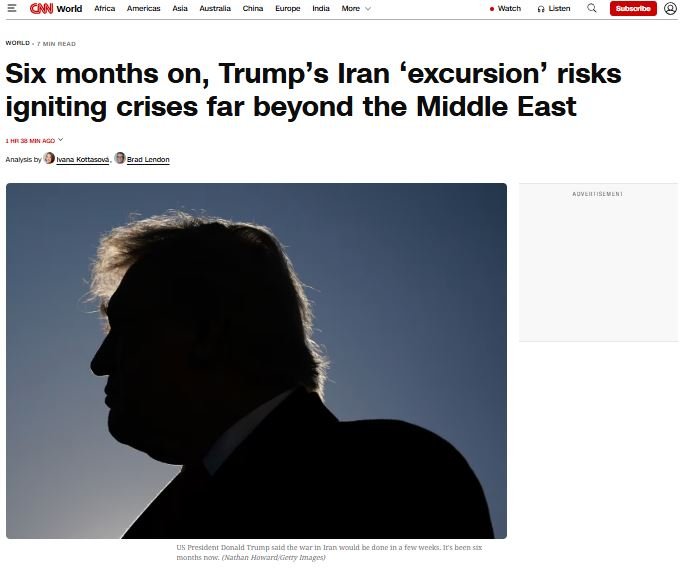
On 28 August 2026, six months to the day after the opening strikes of the US war on Iran, the arithmetic of the conflict has begun to dictate the politics. Middle East Eye reported at 05:59 UTC that the US missile interceptor inventory has fallen to what it described, citing a report, as "beyond critical" levels, driven by consumption rates the war has imposed on Patriot, Thaad and Standard Missile stockpiles. The same morning, at 04:50 UTC, Reuters carried a denial from Iran's security chief of a reported plot against a son of Donald Trump, a story that had circulated in fragments across the previous 48 hours. By midday, Polymarket's markets feed had logged a Trump declaration that Iran is a "failing nation," the kind of rhetorical escalation that, six months in, reads less as opening shot than as mood music for a campaign of pressure that has not produced its promised outcome.
Monexus assessment: what the public record now shows is a war that has outrun its planning assumptions, exhausted at least one category of high-end munitions faster than the Pentagon publicly anticipated, and entered a phase in which neither side can declare victory without re-staging the operation that began the war. The dominant frame in Washington remains that pressure will compound; the dominant frame in Tehran is that endurance has become a strategic asset. Both frames are now under strain at the same time.
The interceptor math
The most consequential sentence in the 28 August reporting cycle is the Middle East Eye characterisation of US missile interceptor inventories. The outlet cited an unnamed report, and the precise figures have not been independently disclosed by the Pentagon; the cited reporting is therefore best treated as a directional warning rather than a verified stock count. Its importance lies in what it implies about operational tempo: a sustained exchange of ballistic and cruise missiles over six months, layered over continued resupply to Israel and the defence of US bases across the Gulf, has consumed interceptors at a rate that public procurement plans did not anticipate.
Two structural points follow. First, interceptor stocks are not interchangeable with the warheads that have to be replaced on the offensive side, but they are the asymmetric bottleneck in any US defence posture in the Gulf. Production lines for Patriot PAC-3 and Standard Missile variants run on multi-year cycles; burning through inventory faster than it can be rebuilt creates a ratchet effect, where each subsequent exchange becomes more costly to absorb. Second, an interceptor shortfall is the kind of fact that, once confirmed by sourcing other than the adversary's, changes the political options available to a president. It tilts the calculus toward de-escalation not because the political will has shifted but because the physical means are thinning.
Tehran's denials, Washington's framing
At 04:50 UTC on 28 August, Reuters reported that Iran's security chief had denied a report of a potential plot targeting a son of Donald Trump. The denial is itself a piece of the picture. Six months into a war, both sides have an interest in controlling the temperature of third-party incidents. A reported assassination plot, even one whose evidentiary basis is thin, performs a particular function: it personalises the conflict for an American domestic audience that has grown accustomed to the war as an abstraction, and it widens the surface area for escalation beyond the formal battlefield.
The denial matters because, in the absence of verifiable evidence either way, the story's half-life is set by the strongest version of the claim, not the most cautious. That is a recurring pattern in this war: leaks that read as fact in Washington news cycles, denials that read as admissions in Tehran-aligned outlets, and a public that receives both without a clear adjudication. The Polymarket-tagged Trump characterisation of Iran as a "failing nation," logged at 22:41 UTC on 27 August, sits inside that same information environment. It is rhetoric, not policy, but it sets the ceiling on what kind of diplomatic off-ramp is politically survivable for the administration.
Six months in, no end in sight
The CNBC framing published on 28 August is the cleanest articulation of where the war has arrived: markets have become accustomed to stalemate. The piece notes that the conflict has far exceeded the four-to-six week window the Trump administration estimated at the outset, a comparison that, six months on, is no longer a talking point but an audit of planning failure.
The structural frame, stated plainly: when a war outlasts the duration its planners publicly committed to, three things tend to happen in sequence. First, the domestic political coalition that supported the opening moves begins to fracture along cost-benefit lines. Second, allied governments begin to differentiate their exposure, with Israel locked in by proximity and European Gulf-bystanders hedging their public posture. Third, the opposing party begins to convert endurance into leverage, since each additional month of stalemate narrows the options of the side that needs a victory to declare. Iran is now in the third phase; the United States is visibly entering the second.
What we verified / what we could not
What we verified from the cited reporting. That on 28 August 2026, Middle East Eye carried reporting characterising US missile interceptor inventories as "beyond critical" due to the Iran war, per an unnamed report. That at 04:50 UTC on 28 August 2026, Reuters reported Iran's security chief had denied a reported plot involving a son of Donald Trump. That on 28 August 2026, CNBC published an analysis noting the war had exceeded the Trump administration's original four-to-six week estimate and that markets had priced in stalemate. That Polymarket's feed on 27 August 2026 carried a Trump declaration describing Iran as a "failing nation."
What we could not verify from the cited sources. Specific interceptor counts, by type (Patriot PAC-3, Thaad, SM-3, SM-6) and by theatre. The originating report on the shortfall, beyond Middle East Eye's characterisation of it. The exact text or venue of the Trump "failing nation" statement. The substance, sourcing, or publication trail of the original plot report that Iran's security chief denied; the cited items do not specify which publication or outlet originated the claim. Any official Pentagon inventory disclosure: the cited items do not specify whether the Department of Defense has publicly commented on stockpile levels since the Middle East Eye report appeared.
The honest reading is that the interceptor story is real in its direction but uncertain in its magnitude, and the plot story is contested on its face. Both are useful as evidence of how the war is being fought: in fragments, with denials and counter-denials doing the work of escalation that the front line no longer reliably provides.
The off-ramp question
The forward question is not whether the stalemate holds. It already has. The question is what kind of exit changes the political cost calculus for the Trump administration before the interceptor numbers force a more visible adjustment. Three pressure points are now visible in the cited material. The first is the inventory itself, where the cited reporting indicates consumption has outrun planning. The second is the information environment, where leaked plots and rhetorical escalations raise the political cost of any negotiation that does not look like victory. The third is the market framing captured by CNBC, where a stalemate has been priced in as the base case and a breakdown would register as the shock.
The plausible alternative read of the same facts is that this is a war entering a grinding phase in which neither side escalates to a decisive blow and neither side negotiates from weakness, with the result that the conflict's duration, rather than its intensity, becomes the determining variable. That reading has the advantage of fitting the cited evidence more tightly than the headline frame of imminent resolution in either direction. It also implies that the next dated event to watch is not a battlefield development but a stockpile disclosure, a budget request, or a third-party-leaked negotiating channel, any of which would break the stalemate without requiring either capital to move first.
Desk note: The wire cycle on 28 August 2026 framed the Iran war through three distinct lenses, inventory, denial, and rhetoric, none of which, taken alone, captures the structural shift. Monexus has treated each as a separate data point and read the pattern across them, rather than adopting any single outlet's frame.
Wire provenance
This editorial synthesis draws on the following public wire/social posts:
- https://middleeasteye.pulse.ly/ij7fcrqe0a
- https://x.com/MiddleEastEye/status/2093217008888185231
- https://reut.rs/4ybBq2S
- https://x.com/Reuters/status/2093199434565693518
- https://www.cnbc.com/2026/08/28/us-iran-war-six-months-trump.html
- https://x.com/Polymarket/status/2093106692774896015