Bitcoin's $80K pressure point meets a stablecoin rebellion at the BIS
Cointelegraph flags a wave of BTC exchange inflows at $80K while relaying the BIS chief's dismissal of stablecoins as a payments rail, as CZ tells a video audience bitcoin will outlast gold.
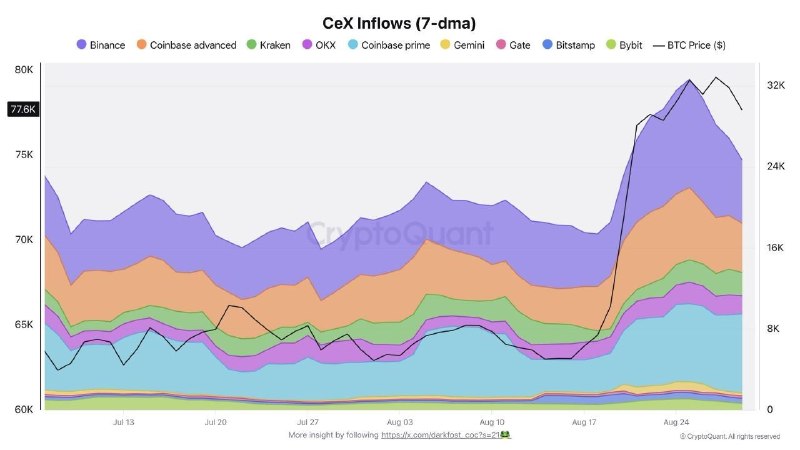
At 19:49 UTC on 29 August 2026, a Cointelegraph Telegram dispatch relayed a read from CryptoQuant analyst Darkfost: BTC exchange inflows are surging, and $80,000 has emerged as the price zone where holders are most willing to part with their coins. The same Telegram channel, posting at 15:36 UTC the same day, framed the head of the Bank for International Settlements as publicly dismissing stablecoins as a credible payment rail at scale and backing tokenised bank deposits instead. Two days earlier, on 27 August, the same channel carried a separate CryptoQuant-sourced signal that bitcoin's Coinbase premium had flipped positive for the first time in 40 days, a Cointelegraph framing of renewed US demand. That same day the channel also published a clip quote from Changpeng Zhao, the former Binance chief executive, declaring that "Bitcoin will be more important than gold," and a separate post asserting that StarkWare had executed the first quantum-safe bitcoin transaction on mainnet.
Three fights, three different horizons: the price tape, the institutional architecture for digital money, and the underlying cryptography. What links them is that Cointelegraph is the only wire in this thread, and every claim below flows from a single Telegram channel's editorial framing rather than from primary documents. Read with that caveat, the dispatches sketch a market that is no longer debating whether digital assets matter, but who controls their plumbing.
The $80K ceiling
The supply story is the simplest. When more coins move onto exchanges, the market reads it as intent to sell. CryptoQuant's exchange-inflow metric has become a popular proxy for that intent precisely because it cannot be faked by a single venue's wash trading. Darkfost's call, as relayed by Cointelegraph on 29 August, frames $80K as the level where profitable holders are willing to crystallise gains; the chart pattern he describes has historically marked short-to-medium-term tops. Two days earlier, on 27 August at 17:46 UTC, a separate Cointelegraph post reported that the Coinbase premium had turned positive for the first time in 40 days, with the channel attributing the read to a CryptoQuant analyst and characterising it as a US-demand signal.
Monexus analysis: the two reads do not necessarily cancel out. Global holders may be distributing into a US bid. If Coinbase's premium stays positive while offshore exchange inflows keep climbing, somebody is selling into strength. That is not a forecast of collapse; it is a description of a two-sided tape. The test for the next session is whether the demand side absorbs the supply without price giving way. The available source items do not specify how the inflow data is broken down by holder cohort or wallet age.
The money already moved
Beneath the price question sits a quieter argument about which rails carry value. The 15:36 UTC Cointelegraph post on 29 August framed the BIS chief as publicly arguing that stablecoins are not credible for payments at scale and that tokenised bank deposits are the better path. The attribution to "BIS chief" is Cointelegraph's framing; the available Telegram text does not name the individual speaker, and this article has not independently established the speaker's identity. The statement, as relayed, is not academic. The BIS is the central-bank club for the world's reserve-currency issuers. When its leadership picks a lane between dollar-pegged tokens and bank-issued tokenised deposits, it is signalling where the formal financial architecture intends to land.
Three readings of the post are defensible. Stablecoin issuers will read it as gatekeeping: keep the issuance of digital money inside regulated banks rather than let it leak to offshore token issuers. Central banks will read it as an affirmation. Crypto-native firms will read it as a declaration that the period of regulatory ambiguity is closing on terms favourable to incumbents. The empirical question is whether tokenised bank deposits can match the cross-border settlement speed that has made stablecoins attractive in the first place. The available source items do not specify a timeline for that build-out, and they do not specify whether a BIS publication or a transcript from a specific venue underpins the remarks.
What CZ wants you to remember
Into that fight walks Changpeng Zhao. The 07:39 UTC Cointelegraph post on 27 August carried his on-camera line, "Bitcoin will be more important than gold," lifted from a video broadcast the channel did not name in the available text. The line is promotional in register, but the timing is not accidental. Gold has set repeated nominal highs over recent quarters as central-bank reserve managers diversify away from dollar exposure. A claim that bitcoin will outpace that shift is, in effect, a claim that the same diversification tailwind will pull crypto reserves alongside physical metal.
Zhao's framing puts stablecoins, bitcoin and gold into a single competition for the safe-haven slot. The BIS's framing, as relayed by Cointelegraph, puts them into separate categories: bitcoin as a speculative asset, stablecoins as a flawed payment instrument, tokenised bank deposits as the real future. Both can be right; they are describing different functions. The risk for readers is collapsing them into one debate about whether "crypto" is winning, when the more interesting question is which crypto asset is best suited to which function.
Ledger meets machine
The 03:24 UTC Cointelegraph post on 27 August carried a heavier claim: that StarkWare had executed the first quantum-safe bitcoin transaction on mainnet. Cointelegraph's word, not StarkWare's: the available source items contain no first-party StarkWare statement, release or technical write-up, and the "first" characterisation is the channel's framing. The claim matters because the cryptography underpinning bitcoin's signature scheme is, in theory, vulnerable to a sufficiently large quantum computer. No such machine is known to be operational today. The threat is a forward-looking engineering constraint, not an active attack.
Monexus assessment: a working quantum-safe path on bitcoin mainnet, if independently verified, would narrow a tail risk that institutional allocators have used to justify keeping crypto exposure small. The available source items do not specify which signature scheme StarkWare used, how the transaction was validated, or whether major node implementations have accepted the change. Until those details are public and reproducible, the announcement is a milestone claim sourced to a single wire, not a standard. The direction of travel is the point: the network is being upgraded faster than its sceptics assume, but the milestone remains a claim, not a consensus.
What to watch into September
Three near-term markers will test these frames. First, the exchange-inflow trajectory into the next weekly close: does the $80K supply band hold or crack? Second, any technical follow-up from StarkWare's mainnet claim, particularly peer review or replication by independent node operators, or a first-party technical disclosure. Third, any BIS publication, speech transcript or press release that names the speaker and the venue behind the stablecoin remarks; the distinction between an off-the-cuff comment and a formal position paper matters for how seriously regulators treat it. The thread evidence contains only Cointelegraph's framing on each, which sets a ceiling on what can be concluded today.
Monexus framed this around the price-versus-architecture axis rather than the speculative-versus-serious framing common in retail crypto coverage. The Cointelegraph dispatches provide the on-chain reads; the institutional and engineering claims are treated as claims attributed to a single wire, not as consensus.
Wire provenance
This editorial synthesis draws on the following public wire/social posts:
- https://t.me/Cointelegraph/71839
- https://t.me/Cointelegraph/71836
- https://t.me/Cointelegraph/71818
- https://t.me/Cointelegraph/71804
- https://t.me/Cointelegraph/71800