Israeli artillery and airstrikes pepper south Lebanon as thunderstorms ground coastal flights
A wave of Israeli airstrikes and artillery fire struck southern Lebanon on Friday evening, with Hadatha, Kafr Rumman and Al Mansouri among the named targets, as separate thunderstorm activity forced aircraft off the Lebanese coast.
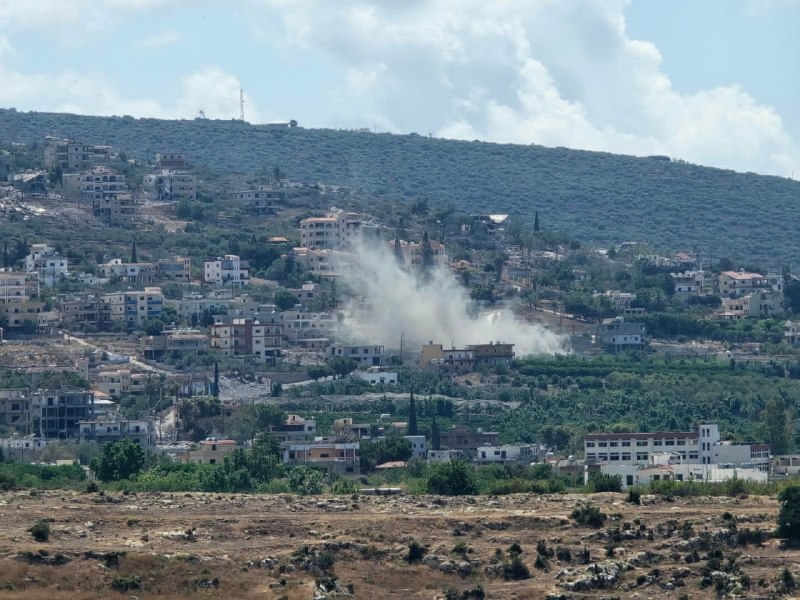
Israeli artillery batteries opened fire on the southern Lebanese village of Hadatha at 21:14 UTC on 29 August 2026, according to a Telegram field-reporting channel that has logged multiple cross-border incidents in recent weeks. The shellfire came roughly ninety minutes after the same channel reported a wave of Israeli airstrikes across the southern district and a pair of drone strikes on the town of Al Mansouri. Earlier the same evening, flight operations along Lebanon's coast were disrupted by intense thunderstorm activity, with aircraft avoiding the northern coastal region. The convergence of combat and weather, in a single four-hour window, captures the layered operating environment facing south Lebanon: an active cross-border campaign running alongside the routine hazards of an August Mediterranean storm cell.
The pattern is the story. Five discrete Lebanon-related reports from the @wfwitness feed on Telegram between 19:10 and 21:14 UTC on 29 August describe overlapping Israeli artillery and air activity at three named southern localities: Hadatha, Kafr Rumman, and Al Mansouri, interspersed with a weather-driven disruption to civil aviation over the coast. Each item is sourced to a single Telegram channel, and each sits inside an information environment in which the Israeli military's English-language statements and the Lebanese state-news apparatus increasingly compete with on-the-ground open-source reporting for primacy.
What the reporting names
The most specific item in the set, posted at 21:14 UTC, identifies Hadatha as the target of Israeli artillery fire. A separate artillery report at 19:10 UTC names Kafr Rumman. The airstrike wave at 20:42 UTC does not name a single locality; a follow-up post at 20:43 UTC identifies Al Mansouri as the target of two drone strikes. None of the available posts specifies casualty figures, weapon types, or which armed group the Israeli strikes were directed against. The channel's reporting is granular on geography and time but thin on outcomes, a familiar signature of real-time cross-border monitoring where confirmed damage assessments typically lag the initial report by hours.
The Lebanon-specific weather item at 19:27 UTC describes severe thunderstorms over the country's coast that forced aircraft to avoid the northern coastal region. The post frames the weather as "unusual" for the period without quantifying the deviation, and it does not state which airports or flight corridors were affected. The available items do not specify whether civil traffic into Beirut was itself disrupted.
The information gradient
This is a single-channel dataset, and the limits of that fact matter. @wfwitness is a Telegram-based field-reporting account whose posts carry the standard disclaimers of an open-source channel and whose reach is amplified by sponsorship slots for an offshore cryptocurrency casino and sportsbook. None of the five Lebanon-related posts cites an Israeli military spokesperson, a Lebanese Armed Forces communiqué, a UNIFIL statement, or any other institutional source. That asymmetry is structural: institutional statements about specific strike locations in south Lebanon generally arrive through Israeli, Lebanese, or UN channels, not through unofficial open-source feeds. The result is a reporting environment in which the wire-level facts, who fired, where, with what, are produced faster by Telegram accounts than by the institutions with primary responsibility for confirming them.
For readers, the practical effect is that the geography of tonight's activity can be reconstructed with reasonable confidence, two named villages plus a coastal town, while the human and operational picture cannot. The available posts do not specify whether the artillery and airstrikes are part of a standing Israeli campaign against Hezbollah infrastructure in south Lebanon, a discrete retaliatory action, or a routine patrol exchange; the source material does not say. Nor do the available posts identify the platforms used: the channel distinguishes artillery fire from airstrikes from drone strikes, but it does not name weapon systems, units, or operating altitudes. This publication treats these reports as described by the channel and unverified beyond it.
What tonight fits inside
Cross-border fire between Israel and Hezbollah-aligned positions in south Lebanon has been a recurring feature of the border landscape since the 2023–2024 war ended in a November 2024 ceasefire framework, with daily exchanges of fire, airstrikes, and drone activity reported by wire services and local outlets at varying tempo. The 29 August 2026 reports sit inside that pattern rather than disrupting it. The dispersion of strike reports across a roughly two-hour window, mixing artillery and air-delivered munitions across multiple villages, is consistent with the strike-package profile that Israeli forces have used in this border area during 2025 and 2026, per routine wire reporting on cross-border exchanges.
The thunderstorm disruption is the harder item to read. Severe August weather over the eastern Mediterranean is not unusual in itself, and the available post's framing of it as "unusual" is itself a channel editorial judgment rather than a meteorological finding. The proximate effect is operational: civil flight paths diverted, which is the kind of small but visible friction that gets logged in real-time reporting. The structural effect, if any, would run through Lebanese civil aviation logistics and any Israeli air operations routed through the same airspace; the available items do not address the latter.
What to watch next
Three things will clarify the picture within 24 to 48 hours. First, any Israeli military statement, typically issued via the IDF Spokesperson's Unit, naming the targets and the armed group against which the strikes were directed. Second, any Lebanese state or LAF statement on civilian impact, particularly in Hadatha and Al Mansouri, where damage assessments usually lag the initial Telegram reports by several hours. Third, whether the Israeli–Lebanese cross-border tempo sustains, eases, or escalates into the weekend; tonight's five-item cluster sits inside a long-running low-intensity exchange, and the cluster's density is worth tracking. The weather system will, by contrast, resolve on its own: Mediterranean thunderstorm cells in late August typically dissipate within 12 to 24 hours.
Desk note: Monexus framed this piece around five discrete Lebanon-related Telegram reports from a single open-source channel, treating the geography as reconstructible and the operational detail as unverified beyond the channel. The article does not assert Israeli intent, Hezbollah involvement, or casualty figures, none of which the available source items establish. Where the wire would carry an IDF statement or a Lebanese casualty count, this piece waits for that material to arrive.
Wire provenance
This editorial synthesis draws on the following public wire/social posts:
- https://t.me/wfwitness/108740
- https://t.me/wfwitness/108737
- https://t.me/wfwitness/108736
- https://t.me/wfwitness/108728
- https://t.me/wfwitness/108723