Kenya's NACADA turns up the tempo in Nairobi's illicit alcohol and narcotics crackdown
Four NACADA-led multi-agency operations across three Nairobi neighbourhoods in 72 hours have seized hundreds of bottles of counterfeit spirits, recovered suspected narcotics and prescription drugs, and put seven suspects in custody, the agency says.
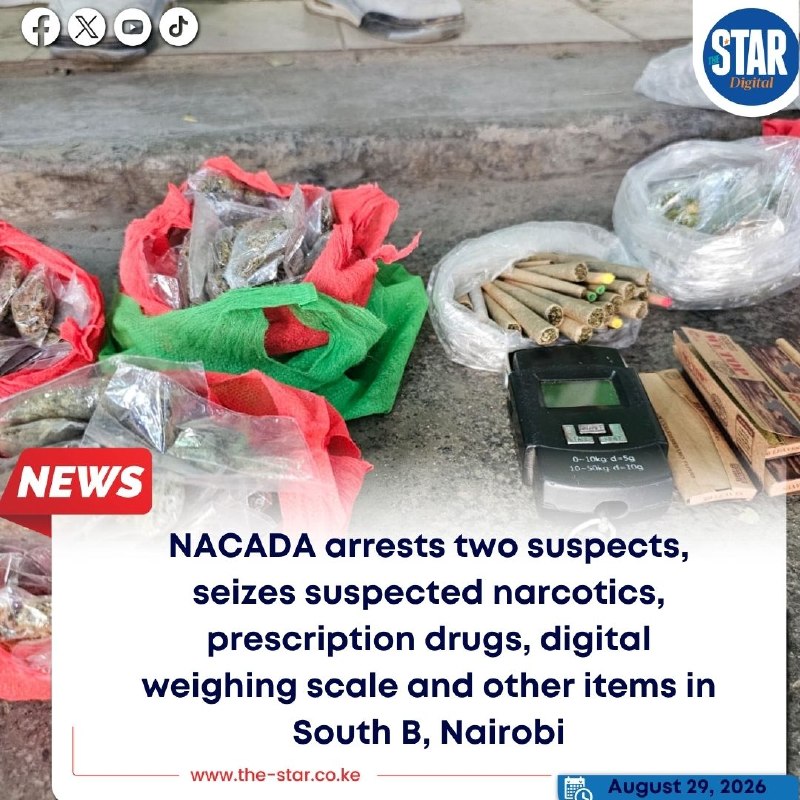
On 26 August 2026, a multi-agency team led by Kenya's National Authority for the Campaign Against Alcohol and Drug Abuse reported the seizure of 868 assorted alcoholic drinks and the arrest of two suspects during a crackdown on illicit alcohol in Eastleigh, Nairobi. The following day, 27 August, a parallel NACADA-led team raided a counterfeiting den in Jericho in the Makadara sub-county, arrested three suspects and seized 315 counterfeit alcoholic drinks. The agency then reported on 29 August that two intelligence-led operations in the South B area had recovered suspected narcotics and prescription drugs, with two suspects arrested. Four operations, three neighbourhoods, seven arrests, and a coordinating agency that has moved into the role of convener rather than regulator.
The pattern is the story. Across a 72-hour window, NACADA has stacked partner agencies into joint task-and-search teams across the capital, pulled bottles and pills into a single enforcement basket, and set a tempo that looks less like a one-off campaign and more like a rolling urban operation. The agency's CEO has put a number on why Nairobi carries the operational centre of gravity: more than half of the country's consumption of life-threatening drinks, by his account, sits inside one city.
The new operating model
NACADA's CEO Anthony Omerikwa framed the agency's posture plainly on 27 August: nationwide crackdowns on counterfeit and illicit alcohol have been intensified, with particular emphasis on operations in Nairobi. According to Omerikwa, as relayed by The Star Kenya, Nairobi accounts for 55% of consumption of life-threatening drinks nationally. The figure does the work of a justification: when one city carries more than half of the dangerous-drinks burden, the operational centre of gravity follows.
The language of the operations also matters. Counterfeit and illicit alcohol are treated by the agency as a single enforcement category, even though the legal pathways for each differ. Counterfeiting is a consumer-protection and tax-revenue crime; illicit brew, particularly the chang'aa and busaa variants that recur in Kenyan seizure tallies, sits inside a public-health frame around methanol poisoning and unregulated ethanol. The 29 August South B operations broaden the basket further by recovering suspected narcotics and prescription drugs alongside the alcohol haul from Eastleigh and the counterfeit bottles from Jericho. By collapsing categories, the agency widens its statutory hook and gives the field playbook more flexibility. A den in Jericho can be hit for counterfeiting. A site in Eastleigh can be hit for illicit alcohol. An address in South B can be hit for narcotics. The headline categories change; the underlying format recurs.
Counter-narrative: what the raids do not show
A stack of seized bottles is a poor proxy for the underlying market. Counterfeit and illicit liquor in Kenyan cities is fed by specific supply chains: duty-free ethanol diverted from industrial buyers, rebranded spirits bottled in informal facilities, and sachets of cheap, often methanol-adjacent liquor sold outside licensed premises. A single raid in Eastleigh removes a node; it does not, on its own, restructure the network. The South B operations, by the agency's own framing, are intelligence-led, which suggests they target specific premises rather than the distribution chain that feeds them.
There is also the question of substitution. Past enforcement pushes in Kenyan cities have produced visible displacement rather than visible reduction: raids in one neighbourhood push supply two wards over, sometimes into the same informal settlements that already sit on the front line of harm-reduction programmes. The agency's public posture treats each raid as an output; the harder metric is whether the per-capita availability of counterfeit spirits in Nairobi has actually moved over the rolling quarter. The cited reporting does not provide that number, and the 29 August South B bulletin is framed as an outcome report without specifying the dates on which the operations themselves took place, which limits how much weight can be put on the rolling tally at any given moment.
A second counter-read sits closer to the political economy. Counterfeit liquor generates tax revenue that the exchequer does not collect, and excise-duty avoidance at industrial scale has been a perennial line item in Kenya's revenue-gap debates. The intensity of the current crackdown can be read, charitably, as a public-health intervention; less charitably, as a revenue-protection exercise that happens to produce the visual language of a drug war. Both readings can be true at once.
What sits underneath the operations
Kenya's drug-and-alcohol landscape has been quietly restructured over the last decade. County governments now hold the licensing pen for bars and bottle stores; NACADA retains the convening and advisory role set out in the 2010 Act that established it; the National Police Service and the Directorate of Criminal Investigations handle arrest and prosecution. The current multi-agency format is the operational expression of a fragmented mandate: no single body owns the problem end-to-end, so the workaround is to stack agencies and rotate the headline category.
Two structural pressures make the current tempo sustainable. First, devolution: county commissioners and sub-county administrators have a direct political incentive to be visibly present at raids in their jurisdictions, because illicit brew is also a constituency issue in low-income wards. Second, donor priorities on non-communicable disease and injury prevention have given Kenyan public-health actors a vocabulary and a reporting template that emphasises enforcement as evidence of programme delivery. Both forces push in the same direction: more operations, more visible seizures, more press lines.
The stakes and what to watch next
The beneficiaries, if the operations hold, are the residents of the wards named in the reporting: South B, Jericho inside Makadara sub-county, and Eastleigh, where the concentration of informal bars and unlicensed depots has long been documented. The cost is borne by the small operators whose livelihoods sit on the wrong side of the excise line, and by the criminal networks whose distribution maps will be redrawn whether or not they are dismantled. The recovery of prescription drugs alongside narcotics in South B, if borne out by the underlying case file, widens the lens further and brings the parallel market in pharmaceuticals inside the same enforcement frame as alcohol.
Three things to watch over the next fortnight. First, whether the Eastleigh, Jericho and South B arrests produce prosecution filings rather than releases without charge, which would indicate that the operations are a genuine investigative pipeline and not a publicity cycle. Second, whether the agency releases a quantified tally of seizures and arrests across the current campaign, which would let outside observers measure displacement rather than assume it. Third, whether county governments in the alcohol-producing heartlands begin to push back on a NACADA-led model that centralises enforcement in Nairobi while leaving the supply side upstream.
The available source items do not specify the identities of the arrested suspects, the precise volume of seized narcotics and prescription drugs recovered in South B, the dates on which the South B operations were conducted, the partner agencies sitting inside the multi-agency teams alongside NACADA, or any prosecution outcome to date. Those gaps are the next things worth watching.
Desk note: The Star Kenya's wire carried four discrete raid bulletins across 72 hours without a synthesised agency statement tying them together; this piece reconstructs that thread and treats the operational cadence, not the individual seizure counts, as the news.
Wire provenance
This editorial synthesis draws on the following public wire/social posts:
- https://t.me/TheStarKenya/37907
- https://t.me/TheStarKenya/37852
- https://t.me/TheStarKenya/37851
- https://t.me/TheStarKenya/37798