Tanzania installs Ndejembi as Vice President after unanimous parliamentary vote
A 324-0 parliamentary vote on Thursday cleared the way for former Energy minister Deogratius Ndejembi to replace Emmanuel Nchimbi, who resigned earlier in the week at the president's request.
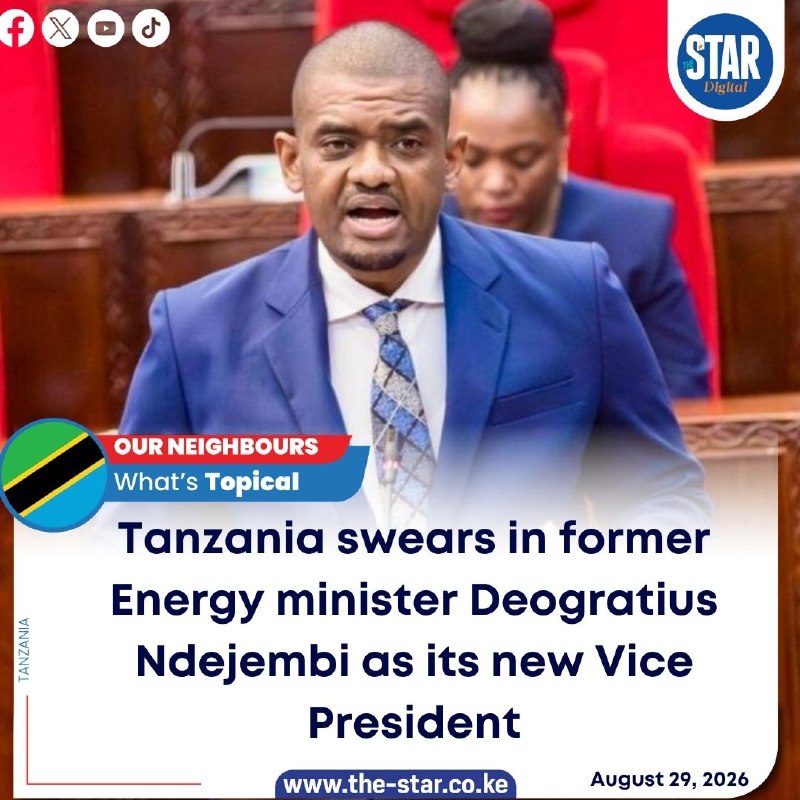
At 08:56 UTC on 29 August 2026, Tanzania swore in former Energy minister Deogratius Ndejembi as its new Vice President, completing a succession that began earlier in the week with the resignation of Emmanuel Nchimbi. The handover was unusually swift by regional standards: parliament cleared the appointment in a single sitting on 28 August, with every one of the 324 members who took part in the vote backing the nominee. Nchimbi had stepped down just days earlier, saying he wanted to respect President Samia Suluhu Hassan's wishes, and the presidency moved to formalise a replacement before the political calendar forced a longer interregnum.
The vote underscores how narrowly the ruling coalition chose to define the moment. There was no contested ballot, no recorded abstention, and no public debate about alternative candidates in the chamber. What the swift unanimity reflects, in Monexus's reading, is a leadership that wants the optics of a settled transition while it still has the numbers to deliver one.
A unanimous vote, with caveats
The parliamentary tally was emphatic on its face. According to The Star Kenya's wire of the parliamentary proceedings, all 324 lawmakers present in Dodoma on 28 August backed Ndejembi's appointment, with no votes recorded against. The chamber did not record any abstentions in the dispatches that reached the press. Ndejembi's swearing-in the following morning at State House closed the loop, with Nchimbi formally out and the former Energy minister formally in.
Two caveats are worth flagging. First, the 324 figure represents legislators who took part in the vote rather than the full chamber, and the cited dispatches do not detail the total size of the National Assembly or how many members were absent from the sitting. Second, a unanimous vote in a system dominated by a single party or a stable ruling coalition is closer to a procedural confirmation than a contest of ideas: the political work happens beforehand, behind closed doors. The published record shows only the endpoint.
The resignation that set the clock
Nchimbi's exit on 26 August set the pace. Africanews reported the same day that the Vice President had resigned "saying he wants to respect President Samia Suluhu Hassan's wishes." State-affiliated coverage in Daily News, syndicated through AllAfrica, framed the move as a request accepted: "President Samia Suluhu Hassan has accepted the resignation of Vice-President Dr Emmanuel Nchimbi, who has stepped down from office and retired from politics and public service." The phrasing in the state press is deliberate, packaging Nchimbi's departure as a graceful bow-out into retirement rather than a forced exit.
The available reporting does not specify a public reason beyond deference to the President. There is no cited statement from Nchimbi explaining policy disagreements, no opposition press conference laying out grounds for the resignation, and no leaked cabinet memo in the dispatches reviewed. Monexus's reading: the reasons were political, not personal, but they have been kept off the public record. That is consistent with how smooth, presidential-driven transitions in the East African region are typically managed.
A short runway for a new officeholder
Ndejembi inherits the office at a moment of unusual continuity rather than rupture. He is a sitting Chama Cha Mapinduzi (CCM) figure who has served as Energy minister in Hassan's cabinet, according to the wire reporting. That gives him the technical fluency for the energy brief and enough familiarity with cabinet process to hit the ground running. The available reporting does not name any specific policy priorities he will take up as Vice President; the constitutional duties of the office include assisting the President and chairing cabinet sessions in the head of state's absence, but the sources reviewed do not detail any portfolio moves tied to his elevation.
There is a structural reason succession matters in this part of the region. Vice presidencies in East Africa have been a persistent pressure point: in Kenya and Uganda, the office has repeatedly functioned as a holding pen for rivals or as a launching pad for succession contests. Tanzania has so far avoided that pattern, partly because the ruling party has tightened its grip on the nomination process and partly because Hassan has used her appointments to consolidate her own position rather than balance factions. Monexus's analysis: Ndejembi's elevation reads less as the opening of a succession drama than as a quiet recalibration of the inner circle.
Stakes and what to watch
The immediate stakes are administrative: continuity at the Vice President's office while Hassan prepares for the next electoral cycle. The medium-term stakes are factional. Nchimbi's retirement from both office and politics, as reported in the state press, removes one figure from the CCM's internal arithmetic, and Ndejembi's promotion inserts another who is closely identified with the President's policy programme. That changes the calculation for any cabinet colleagues who had read the Vice Presidency as a vacancy worth contesting.
Three near-term indicators are worth tracking. First, any cabinet reshuffle that bundles Ndejembi's vacated Energy ministry with other portfolio moves, since the sources reviewed do not yet name a replacement minister. Second, whether Ndejembi travels or speaks publicly on policy in the days after the swearing-in, which would signal how actively Hassan intends to deploy him. Third, how the opposition benches in Dodoma, primarily Chadema and its allies, frame the succession when they re-enter the public record. A muted opposition response would confirm the read that the move was a managed transition; a sharper one would suggest Nchimbi's exit left loose ends the ruling party would rather not discuss.
The available reporting leaves room for doubt on one point. The dispatches describe the parliamentary vote and the swearing-in with consistent detail, but none of the cited items lay out why Nchimbi stepped down at this specific moment, or whether the decision was initiated by the President, requested by Nchimbi, or negotiated between the two. That ambiguity is itself the story. In Tanzania's current political setup, the line between a presidential wish and a free choice is one the system is structured to keep blurred.
Monexus framed this transition by foregrounding the parliamentary mechanics and the state-press framing of Nchimbi's exit, rather than treating either the 324-0 tally or the resignation language at face value.
Wire provenance
This editorial synthesis draws on the following public wire/social posts:
- https://t.me/TheStarKenya/37900
- https://t.me/TheStarKenya/37912
- http://www.africanews.com/2026/08/26/tanzanias-vice-president-emmanuel-nchimbi-resigns/
- https://allafrica.com/stories/202608260275.html