Thunderstorms, airstrikes and aviation disruption converge on Lebanon's coast
Severe coastal thunderstorms forced aircraft away from northern Lebanon on 29 August 2026, hours after Israeli strikes hit Al Mansouri and Kafr Rumman in the south.
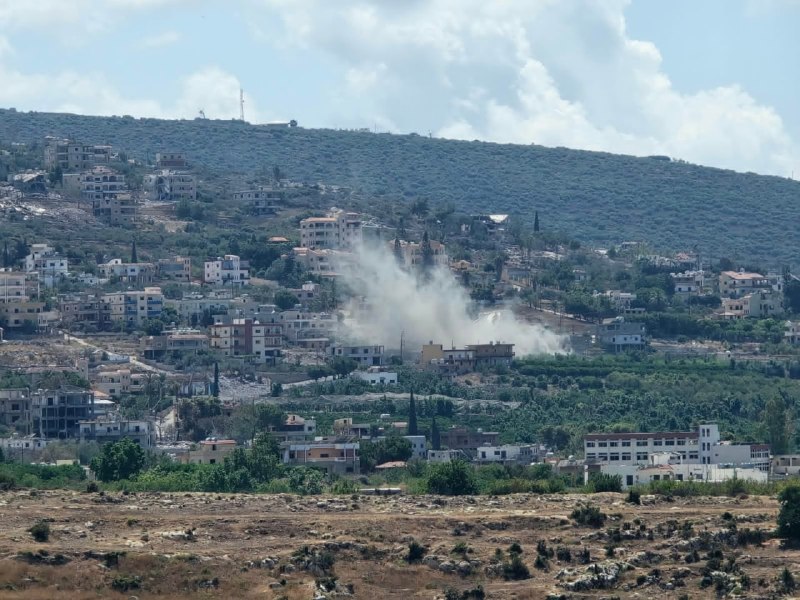
A line of severe thunderstorms rolled across Lebanon's Mediterranean coast on the afternoon of 29 August 2026, lifting tents and decorations off a wedding in Dbayeh and forcing commercial aircraft to steer clear of the northern coastal airspace, according to field footage and aviation posts on the wfwitness Telegram channel. Hours earlier, and roughly 200 kilometres to the south, separate dispatches from the same channel reported Israeli artillery and airstrikes on the southern Lebanese towns of Kafr Rumman and Al Mansouri, framed in the posts as ongoing cross-border fire. The two storylines met in a single news cycle, the one meteorological, the other military, both mediated through the same eyewitness feed.
The storm and the airstrikes are distinct events with separate causes, but they together describe the texture of a late-August day in Lebanon: a coastline battered by unseasonable weather and a south still inside a familiar pattern of Israeli fire. The available reporting establishes the facts of each; what it does not establish is whether the day's storm activity had any operational consequence for Israeli air operations in the south, or for civilian evacuation. The causal question is left open, because the source items do not address it.
What the coast took
Footage posted at 20:02 UTC on 29 August showed a wedding in Dbayeh being torn apart by wind as the thunderstorm line passed, with tents and equipment lifted and guests scrambling for shelter. Earlier in the hour, at 19:51 UTC and again at 19:27 UTC, the same channel reported that aircraft were avoiding the northern coastal region of Lebanon because of intense thunderstorm activity over the coast, with flight disruptions logged across the late afternoon. The framing in both posts explicitly described the weather as unusual for the period. The available source items do not specify which airlines or routes were affected, nor do they quantify cancellations or diversions.
What the south took
The military thread running through the same day began at 17:26 UTC, when wfwitness reported an Israeli airstrike on the town of Al Mansouri in southern Lebanon, and continued at 19:10 UTC with a report of Israeli artillery fire in Kafr Rumman, also in southern Lebanon. The two strikes sit inside what is now a near-daily pattern of Israeli fire into border villages, though the source items do not provide casualty figures, target identification, or a statement from the Israeli military on the specific incidents. wfwitness is a field-channel aggregator rather than an official spokesperson, and its strikes-and-incidents reports are best read as first-pass on-the-ground accounts that require corroboration from wire services or from the IDF Spokesperson's office before any operational conclusion can be drawn.
Reading the day's parallel tracks
Monexus analysis: what is worth noting is the simultaneity, not a causal link. A Mediterranean coast in the grip of an unusual storm system is the same coast that, 200 kilometres south, absorbs near-daily fire from across the border. The two pressures fall on different populations and on different logistical systems (aviation and tourism in one case, civilian shelter and ambulance access in the other), and they should not be folded into a single narrative. The available reporting keeps them apart; this article does the same.
The structural point is simpler than the day suggests. Lebanese state infrastructure is being asked, in the same 24-hour window, to absorb a meteorological stress test on its northern coast and to continue absorbing a military stress test on its southern border. The first is a recurring seasonal hazard; the second is the country's standing condition. Reporting that treats either as anomalous misreads what the country has lived with since October 2023.
What remains open
The most consequential gap in the day's reporting is also the simplest: the available source items contain no information on casualties from either the Al Mansouri airstrike or the Kafr Rumman artillery fire, and no reference to an Israeli military statement confirming, denying, or characterising either incident. The aviation posts name the storm and the coast but do not list airlines, affected flight numbers, or diversions. The wedding footage in Dbayeh is verified as having been posted by wfwitness; the material damage and any injuries from that event are not enumerated in the source. Until wire services or the IDF Spokesperson's office publish on these specific events, this article treats them as eyewitness reports rather than confirmed incidents, and the parallel between weather and war as chronological coincidence rather than anything more.
Desk note: Monexus carried the day as two distinct storylines with a shared time-stamp rather than a single narrative, on the principle that weather and military fire have different causes, different consequences, and different populations bearing them.
Wire provenance
This editorial synthesis draws on the following public wire/social posts:
- https://t.me/wfwitness/108730
- https://t.me/wfwitness/108729
- https://t.me/wfwitness/108728
- https://t.me/wfwitness/108723
- https://t.me/wfwitness/108713