A $102 million ETH bet and Bitcoin's best August since 2017: what's actually moving crypto
A 10x leveraged ether position, a MicroStrategy bitcoin cost basis finally back in the green, and a Barclays read on the AI cloud tax. Late August 2026 has more storylines than tape.
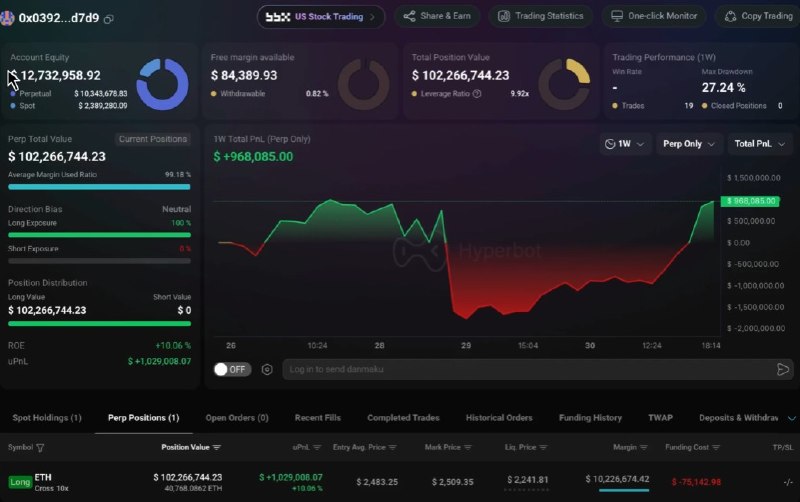
A trader opened a 10x leveraged ether long worth $102 million on 30 August 2026, with an unrealised profit of roughly $1 million already booked within hours, according to a Cointelegraph market update posted to its Telegram channel at 22:31 UTC. The position size is not exceptional on its own; leverage is, and the speed at which it printed green is what market participants screenshot and forward. In a week when the same outlet is flagging Bitcoin's best August since 2017 and Strategy (the enterprise formerly known as MicroStrategy) is back above its average purchase price, the tape is doing what the tape always does at the end of a strong month: concentrate conviction into a handful of high-beta trades, and turn every large fill into a referendum on the cycle.
What the late-August data points actually show, taken together, is a market leaning risk-on with more confidence than the macro headlines suggest. The leveraged ETH bet is the most visible expression. Strategy's bitcoin cost basis flipping back to profit is the institutional tell. Robinhood's total value locked, reported at $700 million roughly a month after the platform rolled out crypto-backed products, is the distribution tell. And a Barclays research note showing that cloud providers capture $35 to $40 of every $100 in AI model revenue is the one that doesn't quite fit, because it reminds readers that the AI trade still routes enormous sums to a small number of infrastructure incumbents regardless of which model wins. Read these four signals together and the picture is not simple bullishness; it is a market that has decided where it wants to be long, and is now arguing about how long the regime lasts.
A 10x ETH long in a still-skittish market
The $102 million 10x ether position, disclosed via Cointelegraph's market wire on 30 August 2026 at 22:31 UTC, is structurally a bet that volatility stays suppressed long enough for the trade to compound. A 10x leverage stack means a roughly 10% adverse move liquidates the position, so the trader is implicitly underwriting either a tight range or a momentum extension that lets them add or scale out before the unwind. The cited unrealised profit of about $1 million inside the first hours suggests entry near a local level that has held, and that the position is being run rather than hedged with options. In a market where funding rates have already carried the cost of being long for weeks, that is a meaningful commitment of capital and patience.
The counter-read is straightforward: the same scale of leverage that prints $1 million in a quiet tape can print a $100 million-plus liquidation cascade in a volatile one. The cited thread does not name the venue, the wallet, or the counterparty, so Monexus cannot independently verify the position's status in real time. What the thread does establish is that the headline was large enough for one of the industry's largest news wires to relay as a market beat on a Sunday evening. That is itself information about sentiment.
Bitcoin's best August since 2017, with Strategy back in the money
The second strand is bitcoin's monthly tape. Cointelegraph's market team posted on both 29 August 2026 at 14:57 UTC and 30 August 2026 at 20:34 UTC that bitcoin is on track for its best August performance since 2017. Two related signals matter alongside that headline. First, Strategy, the corporate treasury vehicle run by executive chairman Michael Saylor, has seen its bitcoin holdings trade back above the company's average acquisition cost for the first time in some months, with Saylor posting the line "We're back" via the outlet's channel at 14:29 UTC on 30 August. Second, the sources do not specify the average cost basis itself, the size of the corporate treasury, or the precise duration that the position spent underwater, so the milestone's financial weight cannot be reconstructed from the available thread alone.
What can be said is that Strategy remains the single largest publicly known corporate holder of bitcoin, that its quarterly mark-to-market disclosures have functioned as a sentiment proxy for the broader cohort of treasury adopters, and that a return to profit changes the political economy of the corporate-treasury thesis. Boards that watched the position mark down through 2024 and into early 2025 had reasons to defer; boards that now watch it back in the green have reasons to imitate. Monexus analysis: the significance is not the price, it is the precedent the print sets for the next cohort of CFOs asking their treasury teams the same question Strategy answered in 2020.
Robinhood's TVL and the unbundling of exchange economics
A third data point sits one rung below the headline trades. According to a Cointelegraph market update posted on 29 August 2026 at 21:53 UTC, Robinhood's on-chain total value locked rose from zero to roughly $700 million in under a month. The figure is significant because it is the first credible public read on how the broker's expansion into crypto-native products is converting user balances into protocol-level deposits. Robinhood's strategic position has long been a brokerage that pays its customers to do nothing; a TVL line on the balance sheet implies the company is now arbitraging yield inside the same user relationship.
The plausible alternative reading is that the $700 million figure is partly a function of incentive programmes rather than durable sticky deposits, and that a meaningful share of the TVL could rotate out the moment promotional rates end. The cited thread does not specify the product mix, the asset composition, or the duration of the rate subsidy. Monexus finds that the figure is best treated as a leading indicator of platform competition rather than as a settled balance-sheet read. Either way, the broader pattern is unmistakable: traditional brokerages are no longer content to route orders; they are moving into the same wallets that crypto-native venues have historically defended.
The AI tax that still routes to the cloud
The fourth thread item is the most uncomfortable for the bull case. A Barclays research note, summarised by Cointelegraph at 18:35 UTC on 30 August 2026, estimates that for every $100 in AI model revenue, roughly $35 to $40 flows to cloud infrastructure providers and generates $10 to $20 in operating profit for those providers. The arithmetic matters because the public market narrative on AI has been that value migrates to the model layer, where the moats are supposedly widest. The Barclays read is closer to the inverse: compute is the tax, the model is the receipt, and the cloud bill is what the entire industry ends up paying regardless of who wins the application layer.
This connects to crypto in a less obvious way than it first appears. The same cloud providers absorbing the AI rent are the same operators whose data-centre capacity decisions shape the marginal economics of proof-of-work mining, GPU-based rendering networks, and decentralised inference projects. If the AI cloud tax is durable, it raises the structural cost of any crypto network whose decentralisation story relies on access to cheap, distributed compute. That is a quieter read than the ETH leverage trade, and a more durable one.
What to watch into September
Three file-dated markers will resolve the picture the cited threads only sketch. First, the next Strategy treasury update will show whether the company added to its position during the August rally or held flat, which would distinguish a true re-rating from a passive recovery. Second, Robinhood's incentive rate schedule will tell the market whether the $700 million TVL figure is sticky or promotional. Third, the next major AI capex guide from a hyperscaler will reveal whether the $35-to-$40 cloud tax that Barclays flagged is being competed down or reinforced. Each of these prints is a stress test on the conviction that late-August 2026 is pricing in. The available thread items do not specify the underlying position sizes, durations, or counterparty names for any of these reads, so what follows is the desk's assessment, not a settled record.
Desk note: how Monexus framed this vs the wire. The wire items, all sourced from Cointelegraph's market channel, are short-form market beats that pair a number with a mood. Monexus's reading treats each number as a structural signal rather than a trade idea: the $102 million ETH long as a leverage-regime tell, the bitcoin August print as a treasury-ecosystem precedent, the Robinhood TVL as a platform-competition pivot, and the Barclays cloud-tax figure as a reminder that the AI cycle still flows uphill to infrastructure. We have labelled the interpretive passages as analysis in place rather than burying them in the kicker, and have flagged where the cited thread does not specify a figure, duration, or counterparty.
Wire provenance
This editorial synthesis draws on the following public wire/social posts:
- https://t.me/Cointelegraph/71849
- https://t.me/Cointelegraph/71848
- https://t.me/Cointelegraph/71846
- https://t.me/Cointelegraph/71843
- https://t.me/Cointelegraph/71840
- https://t.me/Cointelegraph/71835