Strikes Hit Al Mansouri, Houla and Deir el-Balah Within a Four-Hour Window on 30 August Morning
Israeli artillery and detonation strikes hit Al Mansouri and Houla in southern Lebanon and an airstrike killed one Palestinian in Deir el-Balah in central Gaza inside a four-hour window on the morning of 30 August 2026, per witness-channel posts relaying Al Jazeera.
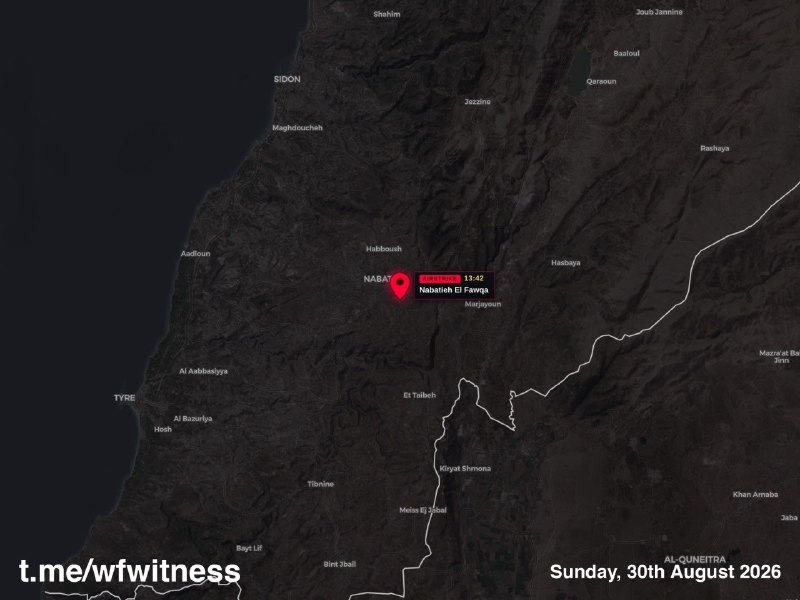
Israeli artillery and detonation strikes hit the towns of Houla and Al Mansouri in southern Lebanon, and an Israeli airstrike killed one Palestinian in Deir el-Balah in central Gaza, inside a four-hour window on the morning of 30 August 2026, according to posts from the witness channel wfwitness that aggregate wire and field reporting.
The cluster is small in evidentiary terms, a handful of Telegram posts aggregating wire and witness reporting, but the pattern is consistent with the daily tempo of cross-border operations that has defined the northern and Gaza theatres through the summer. What the morning's reporting adds is simultaneity: a populated target in central Gaza and two targets in southern Lebanon struck within the same operational day, in line with the Israeli military's stated posture of degrading militia infrastructure along the frontier while continuing its campaign inside Gaza.
Houla, then Al Mansouri, in sequence
The first item logged on the morning feed, at 09:02 UTC, was an Israeli detonation targeting the town of Houla in southern Lebanon. A follow-up post at 09:03 UTC carried the same Houla item, bundled in its visible excerpt with a separate reference to Israeli artillery fire on Al Mansouri. That bundled reference matters: it indicates the wfwitness channel was tracking both southern Lebanon towns in close succession, even if the dedicated artillery post for Al Mansouri did not appear until later in the feed. The Al Mansouri artillery item itself was logged at 10:39 UTC, with a duplicate at 10:45 UTC.
The cited posts do not specify which Lebanese districts the towns fall in, the weapon types beyond the labels "artillery" and "detonation," casualty counts, or whether the targets struck were residential structures or open ground. The reporting is operational in tone. The originating wfwitness account frames both strikes as Israeli-initiated; that framing is consistent with how Israeli security-force communications have described operations in the area but is not independently corroborated in the source items available to this article.
Central Gaza: Deir el-Balah
The Deir el-Balah strike, logged at 10:23 UTC, is the only item in the morning's cluster that names a casualty count. The wfwitness post attributes the figure, one Palestinian killed, a number wounded, to Al Jazeera. The cited post does not specify the target type, the militant affiliation of those struck, the building type, or the combatant-versus-civilian status of those killed and wounded. That distinction is one of the standard points of dispute between Israeli-military communiqués and Gaza-based health authorities, and the available source items do not resolve it here.
What the wire relay does and does not say
At the time of writing, the wfwitness feed does not include corresponding Israeli Defense Forces (IDF), Office for the Coordination of Humanitarian Affairs (OCHA), or UN Interim Force in Lebanon (UNIFIL) postings that would corroborate the Al Mansouri, Houla, or Deir el-Balah strikes. That is a feature of the feed, not a finding: the channel publishes witness and wire relays, not the spokesbodies of either side. A standard Monexus morning brief on these incidents would await the afternoon IDF readout and an OCHA or UNIFIL situation report before assigning target type, casualty breakdown, or attribution. The available source items do not specify any of those details.
The structural read
Monexus assessment: the simultaneity of the morning's strikes is the more telling fact than any one of them. When southern Lebanon and central Gaza are hit inside the same operational day, the implicit logic is that the northern and southern fronts are being treated as a single operational problem set by the Israeli high command, with Hezbollah-adjacent infrastructure in the south and the residual Hamas command structure in central Gaza degraded on parallel timelines rather than as competing priorities. A counter-reading is that these are unrelated daily tasking orders, the routine of an air force and artillery corps with a fixed tempo, and that no grand-coordination claim is warranted from a four-strike sample. Both readings fit the evidence; the first assumes command-level intent, the second assumes tactical routine. The available source items do not specify which is correct.
Stakes to watch
Three indicators will tell readers whether the morning's tempo is a one-day spike or a new baseline. First, the IDF evening readout for 30 August, which normally reconciles the day's strikes with named targets and affiliations. Second, the UNIFIL situation report, which logs the precise count of cross-border incidents and the side of origin. Third, the Gaza Ministry of Health casualty roll for 30 August, which converts the morning's "one killed, a number wounded" line into a defensible figure once names and ages are attached. None of those reconciliation steps appears in the morning feed yet. The honest position at 10:45 UTC on 30 August 2026 is that three witness-reported strikes, one relayed casualty count, and no first-party confirmation in hand is enough to log the day, and not enough to declare a shift.
Desk note: Monexus frames this as a tempo piece, not a war-of-the-week piece. The four-strike cluster is significant for its simultaneity across two fronts; it is not significant in absolute terms until IDF, OCHA, and UNIFIL reconciliation places it inside a weekly or monthly pattern. Where the witness channel attributes a casualty count to Al Jazeera, Monexus attributes the attribution, not the count itself, until a primary source carries it.
Wire provenance
This editorial synthesis draws on the following public wire/social posts:
- https://t.me/wfwitness/108772
- https://t.me/wfwitness/108773
- https://t.me/wfwitness/108790
- https://t.me/wfwitness/108796
- https://t.me/wfwitness/108797