Israeli artillery and airstrikes hammer southern Lebanon as Hadatha and Al Mansouri report fresh fire
War-monitoring channels report Israeli artillery in Hadatha and a wave of airstrikes across the south, including two drone hits on Al Mansouri, as the border tempo holds through the late August lull.
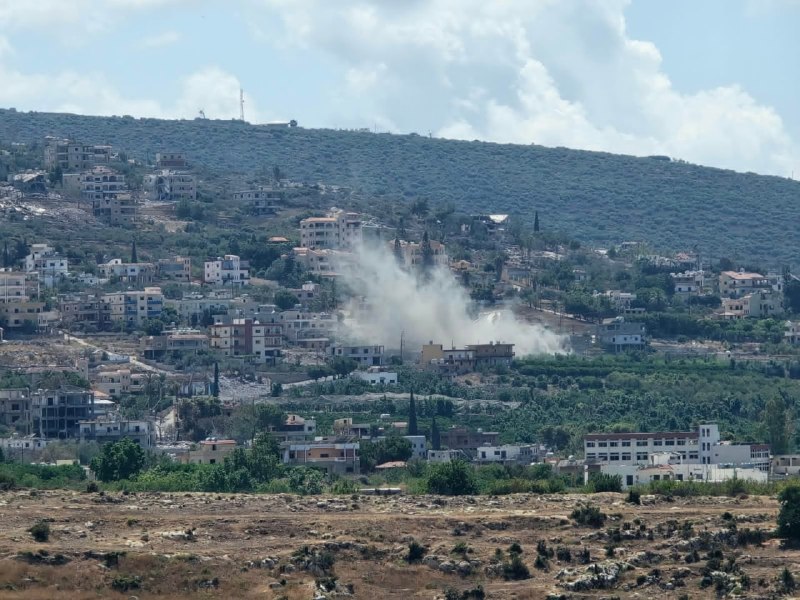
Israeli artillery opened up on the village of Hadatha in southern Lebanon on the evening of 29 August 2026, according to war-monitoring channel wfwitness, with the report timestamped at 21:14 UTC. The strike pattern was not isolated. Two earlier wfwitness posts in the same hour, at 20:42 UTC and 20:43 UTC, described a "wave of Israeli airstrike" across the south, with the 20:43 UTC message adding that two drone strikes targeted the town of Al Mansouri. The three messages, posted within roughly half an hour of one another, sketch the tempo of a border that has been running hot for months.
What the monitoring feeds describe is kinetic and specific: artillery at one named village, a drone pair at another, in a sequence rather than a single incident. That sequence matters, because each round of fire is its own decision under fire, even when the broader operation is a continuation. Israeli security planners frame the southern Lebanese frontier as the most active external front since the Gaza war began, and they argue that preemptive and retaliatory fire against Hezbollah-linked infrastructure is the principal lever the IDF has to keep rocket and anti-tank fire off its northern towns. Lebanese authorities and aid groups have documented cumulative civilian harm on the Lebanese side across the same period.
What the monitoring posts say
The three wfwitness dispatches are short and operational. The 21:14 UTC post reads, in full, that "Israeli artillery fire [is] reported in Hadatha, southern Lebanon." The 20:42 UTC and 20:43 UTC posts both lead with "A wave of Israeli airstrike on southern Lebanon." The 20:43 UTC message adds the most granular detail in the source set: two drone strikes targeted Al Mansouri. None of the posts carry casualty counts, damage assessments, or claims of responsibility. None attribute the reporting to the IDF, the Israeli Air Force, the Lebanese Armed Forces, or any named field commander. The naming is geographical, not institutional.
That gap is the central interpretive problem. Telegram-based war monitors have a record of running ahead of the wire on tactical detail and a record of being used as one-way megaphones by interested parties. A strike report from a southern Lebanon channel can be a faithful account, an exaggeration, or a planted item; readers cannot tell which from a single post. The 20:43 UTC message carries the watermark of a crypto-sportsbook advertiser, which is typical for this kind of channel and unrelated to the content but is a reminder that the platform itself is a commercial channel, not a press outlet.
What is missing from the public record inside this thread
The thread context for this article contains no Israeli military spokesperson statement confirming the specific strikes at Hadatha and Al Mansouri, no casualty figures from the Lebanese Ministry of Public Health for those villages, and no Hezbollah communique responding to those incidents. Monexus has not independently established, on the strength of the source set alone, whether any of the three strikes struck populated areas, hit military targets only, or produced injuries. The available source items do not specify which units fired, what platform delivered the munitions, or whether the artillery and drone strikes were coordinated or sequential. The absence inside this thread matters, because the same tactical pattern, on a different day, has been the subject of disputes about proportionality, civilian-protection obligations, and the legal characterisation of Hezbollah's southern presence.
Independent English-language reporting on Israeli strikes in southern Lebanon for 29 August 2026 exists outside this thread, including Asharq Al-Awsat's same-day piece on Israel's push for new rules of engagement with Hezbollah around the Ali al-Taher file and the Daily Asian Age's same-day wire noting continued Israeli airstrikes in southern Lebanon. The Telegram monitors were running the story first; the broader English-language coverage was following the same pattern. The thread evidence here is the three wfwitness dispatches and one unrelated WarMonitors post; any reader who needs a fuller institutional picture should treat those external items as a supplement, not a substitute for on-the-ground confirmation.
The structural frame
The southern Lebanon front has become the slow bleed of the Gaza era. Public statements from Israeli officials since late 2023 have framed the campaign as an effort to push Hezbollah north of the Litani River and to dismantle forward infrastructure. Hezbollah-aligned messaging has framed the same activity as a continuous resistance front and a guarantee that any Israeli escalation in Gaza or beyond will be paid for on the northern border. Both framings can be true at once, which is the structural problem: the tempo on the ground is set by unilateral decisions on each side, and the international mediation that ended the 2006 war, including UNIFIL's monitoring role and US-French pressure, has not produced a comparable architecture this time.
The arithmetic that drives the daily rhythm is plain. Artillery exchanges and drone strikes at the scale described by the wfwitness posts require logistics, ammunition expenditure, and command authorisation on the Israeli side, and rocket, drone, and anti-tank responses require the same on the Lebanese side. Each round of fire, even when framed as routine, raises the political cost of de-escalation and reduces the breathing room for a ceasefire negotiation. The 29 August incidents sit inside that arithmetic, and the search for new rules of engagement with Hezbollah that surfaced in same-day regional reporting is the diplomatic mirror of the tactical sequence the monitors are describing.
What to watch next
Three indicators will determine whether the 29 August reporting represents a continuation of the established tempo or a sharper escalation. First, an Israeli military spokesperson statement, normally issued within hours of a strike through the IDF Spokesperson's X account and Haaretz, Ynet, and Times of Israel wire pickups, will say whether the IDF confirms, denies, or characterises the strikes as retaliatory. Second, the Lebanese Ministry of Public Health daily cumulative tally, posted around midday UTC, will say whether any of the three incidents produced casualties. Third, Hezbollah-aligned outlets including Al-Manar and the party's media arm will issue or withhold a communique in the following twelve to twenty-four hours; the presence or absence of a response, and its scale, will tell readers whether the group treats the 29 August activity as absorbed into the baseline or as a threshold event. Until those three signals land, the picture inside this thread is one of kinetic activity without institutional confirmation inside the source set, a familiar shape for the southern Lebanon front and an unreliable one for any reader who needs to act on it.
Desk note: this piece was assembled from three short wfwitness Telegram dispatches timestamped 20:42 UTC, 20:43 UTC and 21:14 UTC on 29 August 2026, plus one unrelated WarMonitors post at 22:49 UTC. No Israeli military spokesperson statement, Lebanese casualty tally, or Hezbollah communique on the specific Hadatha and Al Mansouri incidents appears inside the source set; Monexus has not independently verified casualty figures, platform types, or the institutional chain of command behind the reported fire from the thread alone. The structural framing reflects the southern Lebanon front's documented operating pattern since late 2023 rather than a single day's events. Same-day regional and wire coverage exists outside this thread and supplements, but is not relied on as a primary source within it.
Wire provenance
This editorial synthesis draws on the following public wire/social posts:
- https://t.me/wfwitness/108740
- https://t.me/wfwitness/108737
- https://t.me/wfwitness/108736
- https://t.me/WarMonitors/45390