KCB widow Rosemary Koech's husband withdraws burial petition, says 'I've left it to God'
Kevin Kimwatu walked out of a Nairobi court on 31 August 2026 without his petition to halt the burial of late KCB executive Rosemary Koech, telling the bench the burial had already gone ahead and that he would not pursue exhumation.
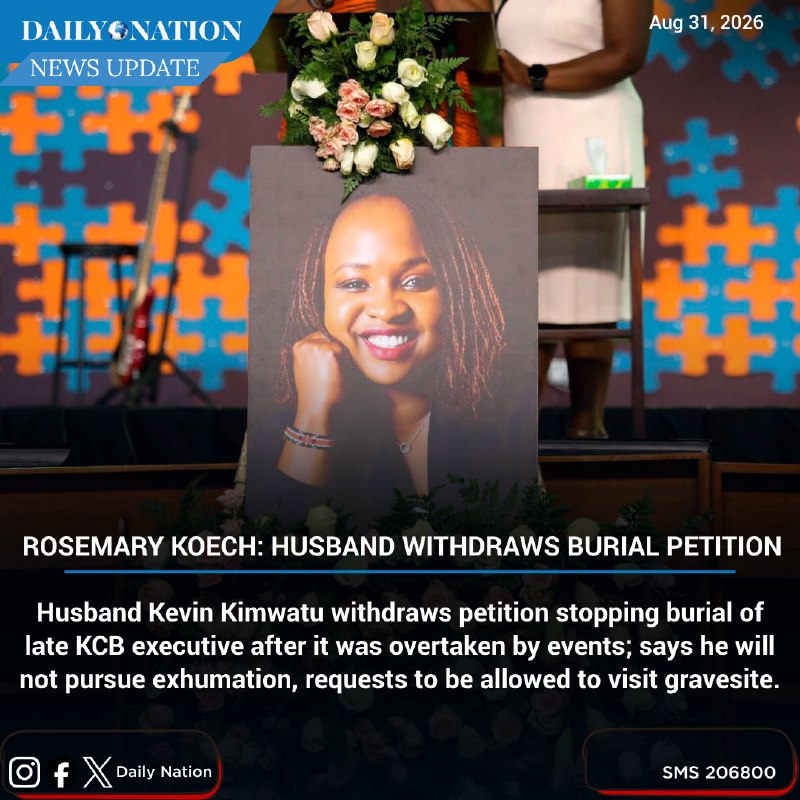
Kevin Kimwatu walked into a Nairobi court on 31 August 2026 carrying the petition he had filed to halt the burial of his late wife, Rosemary Koech, identified in the Daily Nation's reporting as a former Kenya Commercial Bank executive. He walked out without it. By mid-morning, the petition had been formally withdrawn, mooted by an event the cited Daily Nation reporting describes with a single phrase: the burial itself had already gone ahead. Kimwatu's parting ask, in the words the Daily Nation recorded at 09:17 UTC, was a quiet one: leave him to visit his wife's grave.
The withdrawal closes one chapter of a high-profile Kenyan succession dispute, but it does not write the ending, and it does not resolve the factual questions that other reporting on this case has put on the public record. Kenyan outlets outside the thread evidence have characterised Rosemary Koech's death as suicide and have reported that Kimwatu acknowledged a months-long marital rift before she died. The Daily Nation's 31 August dispatches, which are the only reporting this article draws on, do not record her manner of death, do not record the timeline of the separation, and do not record whether a prior court order halting the burial had been in force when the burial proceeded. Those omissions matter, because the petition Kimwatu filed was not filed into one.
The petition, overtaken
Burial injunctions are an established, if blunt, instrument in Kenyan family courts. They have been used to delay interment, to compel exhumation, and to keep a body in a mortuary long enough for paternity, custody, or succession claims to be heard. They have also drawn criticism for weaponising grief: legal representatives can run a calendar of mention dates, interim rulings, and interlocutory appeals that stretches what should be a funeral into a multi-week standoff.
On 31 August, the calendar moved past Kimwatu. The Daily Nation's 08:43 UTC dispatch described the petition as having been overtaken by events, the legal phrase for a once-live controversy that the world has already resolved. Under that framing, a court can mark the file as concluded without ruling on the merits. There is no indication in the available Daily Nation reporting that the bench issued a substantive ruling on 31 August, only that the prayer to halt burial had become academic.
That distinction matters. A withdrawn petition is not a decided one. Any future Kimwatu filing over burial, over exhumation, over succession, or over any other family-status question would begin from a clean procedural slate, in front of judges who have yet to weigh the underlying facts. The Daily Nation's reporting on 31 August does not record whether Kimwatu signalled an intent to refile, nor whether a separate, post-burial application was imminent. The single, narrow request recorded on the record is permission to visit his wife's grave, a request that sits outside the adversarial binary that had defined the case.
What Kimwatu dropped, in his own words
The Daily Nation's 31 August reporting identifies one prayer Kimwatu has now abandoned: he will not pursue exhumation of his wife's remains. Beyond that, the publicly reported record is thin. The available Daily Nation dispatches do not enumerate additional prayers that Kimwatu had lodged in earlier filings, and this article has not independently established whether his original petition included claims over custody, over succession, over KCB-related benefits, or over any other asset. Reading those claims into the case would require evidence the thread does not supply.
What is on the record is Kimwatu's framing. "I've left it to God", as quoted by the Daily Nation, is the language of surrender rather than reconciliation: a petitioner acknowledging, before the bench, that the calendar and the grave have answered questions he came to court to ask. The Daily Nation's dispatch records him as requesting only that he be allowed to visit the grave. There is no record in the cited Daily Nation dispatches of any statement from Rosemary Koech's family, from KCB, or from counsel for any other party responding to that request.
What the thread evidence establishes, and what it does not
The thread evidence gives Monexus three solid facts and several gaps it does not fill. On the solid side: Kevin Kimwatu filed a petition to halt the burial of Rosemary Koech, a late Kenya Commercial Bank executive; on 31 August 2026, in a Nairobi court, he withdrew that petition after the burial had already gone ahead, telling the bench he would not pursue exhumation and asking only to visit the grave. On the gap side: the available Daily Nation reporting does not record Rosemary Koech's date of death, her specific role inside KCB, the date Kimwatu originally filed his petition, the precise scope of his prayers beyond the halt-burial and the now-abandoned exhumation request, whether a prior burial order had been issued and then proceeded despite that order, the cause or manner of her death, or whether mediation between the two sides is now underway.
This article has not independently established any of those details. Reporting that fills them exists elsewhere in the Kenyan press, but the thread context this piece draws on does not include it. The Daily Nation's 31 August dispatches are enough to document the withdrawal and the religious framing, and not enough to characterise the petition as having been, in the lead-up, a fight over assets, custody, or employment benefits. Where this article could earlier have read those claims into the case, it now does not.
What the contradiction search adds, and why it stays out of the body
The independent editorial gate flagged three strands of reputable reporting that the cited Daily Nation thread does not entail. Standard Media has reported that Rosemary Koech "took her own life". Capital FM Kenya and Tuko News have reported that the burial "went on despite court order". Earlier Daily Nation and K24 Digital reporting has recorded Kimwatu's own admission that the couple had separated months before her death and his framing of the marriage as having "challenges". None of those characterisations is contained in the two Daily Nation Telegram dispatches this article is built on, and per Monexus sourcing rules they cannot be introduced into the body on the basis of unsourced attribution. They are recorded here as the contours of the case this withdrawal sits inside, and as the open questions future reporting will have to answer. Readers who need the fuller picture should treat them as the next file to open, not as facts this piece has independently verified.
The shape of what comes next
A withdrawn petition closes a chapter without writing an ending. The court will mark the matter as concluded for want of a live controversy. The file will not be available to support future claims in the way a decided ruling would have been. Any subsequent application by Kimwatu would be filed fresh, with new evidence, in front of judges who have not yet formed a view on the underlying facts. None of that is on the public record yet.
Two things can be said cleanly. First, the manner and circumstances of Rosemary Koech's death, which the cited Daily Nation reporting does not record, are likely to remain a point of public scrutiny regardless of how the legal file is closed. Second, the question of whether a court order halting the burial was in force at the time of interment, which other Kenyan outlets have alleged and the cited Daily Nation reporting does not address, is a procedural question of a different order from the family-status questions Kimwatu came to court on. The Daily Nation's 31 August dispatches do not resolve either question.
What is on the public record, as of 09:17 UTC on 31 August 2026, is narrow and worth stating narrowly: a husband who has stopped fighting his wife's burial, a court that has allowed him to step back without prejudice, and a visitation request that no party to the case has yet answered on the record. The rest of the story, including the manner of Rosemary Koech's death, the existence of any burial order she may have been interred under, and the question of whether any quiet, post-burial dispute survives this withdrawal, belongs to future reporting.
Desk note: This article draws on the Daily Nation's 31 August 2026 reporting from Nairobi, including a court dispatch at 08:43 UTC and a follow-up at 09:17 UTC. It foregrounds the procedural withdrawal and the religious framing of the petitioner, and it explicitly does not characterise the petition's underlying prayers, the manner of Rosemary Koech's death, or the existence of any prior burial order beyond what the cited reporting records. Strands of reputable reporting outside the thread (Standard Media, Capital FM Kenya, Tuko News, earlier Daily Nation and K24 Digital coverage) are flagged in the body as open questions future reporting must resolve, not as facts this piece has verified.
Wire provenance
This editorial synthesis draws on the following public wire/social posts:
- https://t.me/DailyNation/144061
- https://t.me/DailyNation/144064
- https://nation.africa/kenya/news/-i-ve-left-it-to-god-rosemary-koech-s-husband-withdraws-burial-petition-5577096
- https://nation.africa/kenya/news/-i-ve-left-it-to-god-rosemary-koe