US strikes Iranian launchers on Larak Island as Treasury opens the sanctions spigot
Hours after the US hit two Iranian launchers on Larak Island, Treasury Secretary Scott Bessent said new secondary sanctions on Iran will land weekly. Brent crude jumped more than 2%.
US forces struck two Iranian mine-laying rocket launchers on Larak Island in the Strait of Hormuz late on 30 August 2026, a US official told Reuters, in the first publicly confirmed American strike on Iranian territory in the latest flare-up. Within hours, Treasury Secretary Scott Bessent said new secondary sanctions on Iran would land on a weekly cadence, and Brent crude was trading more than 2% higher.
The kinetic action and the financial one are now running on the same clock. The pattern is the story: a calibrated military hit, paired with a Treasury escalation designed to deny Tehran the revenue that pays for the next round of launchers.
What hit, and where
Reuters reported on 30 August 2026 at 23:10 UTC that US forces struck two Iranian launchers on Larak Island, citing a US official, and identified the targets as mine-laying rocket launchers. Larak sits in the Strait of Hormuz, the chokepoint through which a large share of seaborne crude transits. Within roughly thirty-five minutes of that report, Reuters was carrying a market alert that oil prices had risen more than 2% on the strike. By 00:00 UTC on 31 August, Bessent was on the record saying he expects new US secondary sanctions on Iran to be issued weekly, with the explicit aim of intensifying economic pressure.
The strike's scope, as described in the public reporting, was narrow: two launchers, not an installation or a port facility. The framing in the Reuters dispatch treats the targets as mine-laying systems, a category that carries an obvious naval-interdiction reading in a corridor where Iran has historically threatened shipping. Monexus analysis: by selecting a weapon system rather than a base, Washington is signalling that the threshold for direct action on Iranian soil is now lower than it was a week ago, while still stopping short of the kind of strike that would foreclose diplomacy entirely.
The Iranian counter-frame
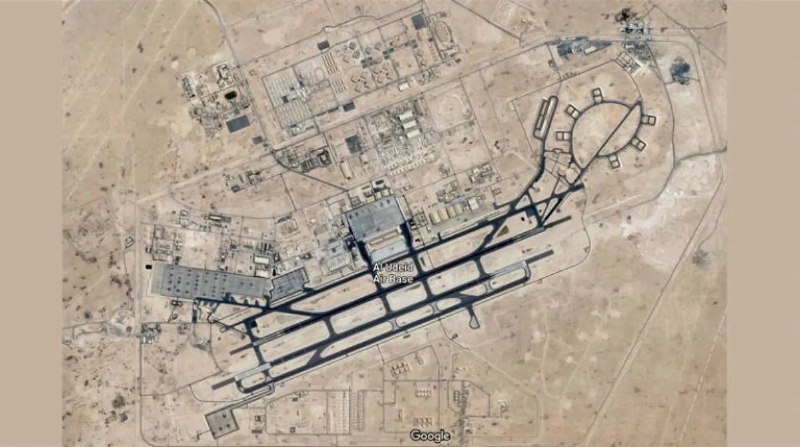
Iranian state media moved quickly. Press TV posted on its Telegram channel at 22:33 UTC on 30 August 2026 that the Al Udeid Air Base in Qatar had been struck by an Iranian missile. The OSINTdefender Telegram feed carried a related item at 22:59 UTC citing Iranian news outlets claiming Al Udeid was targeted in the night's attacks, following a US strike on the two mine-laying rocket launchers. These reports are unverified by independent sourcing in the available items. The Iranian side is treating the US strike as the opening move of an exchange, not a one-off, and is signalling reach against Gulf state hosts of US forces. Whether the Al Udeid claim holds is the single most consequential open question in the package.
Two cautions follow. First, the Iranian-channel sourcing here is the only sourcing for the Al Udeid claim in the materials available to this article; the original primary reporting has not been independently confirmed in the supplied thread. Second, the framing of Larak as Iranian territory in some commentary is contested in a wider sense: the island sits in a waterway whose sovereignty is rarely in dispute, but a strike inside it crosses a threshold that previous US administrations have approached only with great reluctance.
The financial lever, opened weekly
Bessent's weekly-cadence statement is the underappreciated half of the package. Secondary sanctions do not need a kinetic trigger. They reach foreign firms, banks, shippers and insurers that touch Iranian oil, and they convert a bilateral dispute into a global compliance problem. The wire reporting frames the objective straightforwardly: increase pressure on Iran. Read alongside the Larak strike, the timing is the point. Treasury is signalling that the cost of doing business with Tehran is going up on a predictable schedule, not in response to a provocation. That is a different instrument than a blockade, and a steadier one.
Monexus analysis: weekly designations are a campaign posture. They imply a Treasury pipeline of targets already vetted, queued and waiting for designation announcements. They also imply that the administration has decided the cumulative weight of sanctions designations, rather than any single tranche, is what bends behaviour.
Stakes over the next 72 hours
The Strait of Hormuz is the near-term fault line. A more than 2% move in crude on a single strike, against a backdrop of already-tight supply, shows how thin the margin is. The plausible readings split three ways. The first: Tehran de-escalates, the launchers are presented as a deterrent exceeded, and the sanctions cadence becomes the binding constraint. The second: Iran retaliates, the Al Udeid claim hardens into verified reporting, and the kinetic exchange widens. The third: a slow grind, with weekly designations, intermittent maritime incidents, and oil trading in a wider band than markets had priced a month ago.
What remains genuinely uncertain in the available reporting is the operational status of the two launchers after the strike (damaged, destroyed, or partially intact), whether any Iranian system actually struck Al Udeid, and the precise content of the next Treasury designation. Monexus's expectation, based on the cadence Bessent described, is that a new tranche will be public within seven days. That is a forecast, not a fact, and readers should treat it as the desk's reading of the rhythm Bessent set out, not as a calendar entry. The verifiable fact, on the record from Bessent via Reuters on 30 August 2026, is the weekly cadence. The next designation date is not yet specified in the materials available to this article.
Desk note: Monexus has reported this story at the level of what is publicly on the wire, separating the verified US strike on Larak (Reuters, US official, 30 August 23:10 UTC) from the unverified Al Udeid counter-claim (Press TV and Iranian outlets relayed via OSINTdefender, 30 August 22:33-22:59 UTC). Where analysis is offered, it is labelled in place. The Bessent weekly-cadence line is treated as the structural frame for the week ahead.
Wire provenance
This editorial synthesis draws on the following public wire/social posts:
- https://reut.rs/4cii3fQ
- https://x.com/Reuters/status/2094213820570890743
- https://reut.rs/4qOhwsf
- https://x.com/Reuters/status/2094209842772648129
- https://reut.rs/4zNYxSo
- https://x.com/Reuters/status/2094201031378776113
- https://t.me/osintlive/568325
- https://t.me/presstv/204798