Berlin blames Moscow for Leipzig airport drone plot, orders Bonn consulate closed
Germany has formally accused a Russian intelligence service of staging a drone attack on Leipzig/Halle Airport in early August 2026 and ordered the Russian Consulate General in Bonn shut. Moscow calls the allegations unsubstantiated.
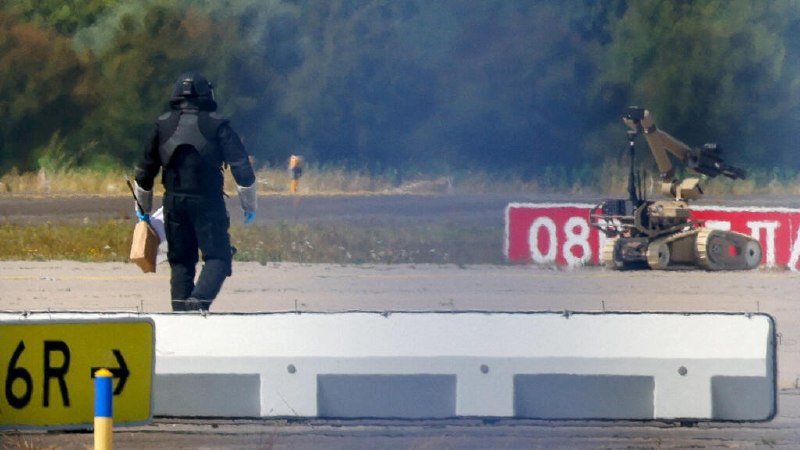
At a joint press conference in Berlin on 1 September 2026, German Interior Minister Alexander Dobrindt and Foreign Minister Johann Wadephul formally blamed a Russian intelligence service for the attempted drone attack on Leipzig/Halle Airport in early August 2026, and announced the closure of the Russian Consulate General in Bonn. The accusation, presented as a single coordinated package by two cabinet principals, frames the episode as a deliberate act of state-directed sabotage against critical German infrastructure.
Monexus analysis: by naming a service, shutting a Russian diplomatic mission on German soil, and coupling that with a public ministerial presentation, Berlin has chosen the loudest option available short of expelling the ambassador. Moscow's response, equally loud, is that no evidence has been produced at all. The next thirty to sixty days will be decided by whether Berlin publishes anything resembling an underlying case file, or whether the affair hardens into a he-said-she-said standoff.
What Berlin says it knows
German ministers described the incident as a "hybrid attack" organised by a Russian intelligence agency, using drones against Leipzig/Halle, one of Europe's largest cargo hubs, in early August 2026. The relaying OSINT channels' compilation of the briefing, drawn from the joint press appearance, names Dobrindt and Wadephul as the principals delivering the attribution. France 24's English wire summarised the German line as a single diplomatic package: attribution to a Russian intelligence service, paired with the closure of the Russian Consulate General in Bonn.
The available source items do not specify the technical contents of the German evidentiary file. The cited posts do not contain intercepted communications, flight-path reconstruction, or recovered airframe analysis, and this publication has not independently established those details from primary records. The briefing's specific claims about how the device or devices were guided, their payload composition, or the operational impact on airport traffic are not detailed in the materials cited here.
Moscow's counter-narrative
The Kremlin's first reaction, delivered by spokesman Dmitry Peskov and circulated through Brian McDonald's coverage of the wire, was categorical: Germany is escalating, and Berlin has presented no evidence. Peskov's framing, as relayed in the cited posts, accuses the German side of using the incident to poison the bilateral relationship, and signals that Moscow will treat further measures as provocative.
The counter-narrative has two working parts. The first is evidentiary: Berlin has named a service and a timeframe, but the materials cited here do not publish intercept transcripts or technical forensics in a form independent observers can scrutinise. The second is procedural: Russian-aligned commentary has long argued that "hybrid attack" labelling is a Western diplomatic convenience, used to attribute incidents on thin evidence and to justify pre-positioned sanctions packages. Both points are politically serious, and Berlin's credibility will rest on whether more of the underlying case file is made public in the coming weeks.
A pattern, not a one-off
Monexus assessment: the Leipzig episode sits inside a discernible European tempo of attributed sabotage. Over the past two years, governments from London to Warsaw to the Baltic states have named Russian military intelligence, or units affiliated with it, in operations targeting logistics nodes, undersea cables, ammunition depots, and border infrastructure. The throughline is operational: small payloads, deniable launch platforms, civilian infrastructure with strategic second-order effects. The Leipzig allegation is consistent with that profile, and the German government has plainly decided that the cost of staying quiet now exceeds the cost of a fight with Moscow.
The consulate decision is the politically heavy instrument. Closing a diplomatic mission is a rare step, normally reserved for espionage expulsions or serious treaty breaches. By tying it directly to the airport incident, Berlin has put the locus of the dispute inside Germany itself: the claim is not that Moscow is waging a distant campaign against European logistics, but that a Russian service acted against a German airport on German soil. The choice of Bonn, the historic diplomatic capital and seat of the Russian Consulate General, signals that Berlin is willing to absorb the reciprocal cost of forcing Moscow to draw down its German presence.
Stakes and what to watch next
The diplomatic reaction is already visible. The France 24 wire relay cites NATO Secretary-General Mark Rutte and European Commission President Ursula von der Leyen vowing solidarity with Berlin, framing the attribution inside the existing alliance architecture rather than as a purely bilateral German-Russian dispute. That alignment matters operationally: it makes the German move harder to isolate, and it converts the Leipzig file into a potential reference point for future allied attributions.
The immediate procedural consequence is reciprocal. Moscow will almost certainly draw down the German diplomatic presence in Russia and tighten visa issuance. European Union partners, already coordinating on sanctions packages targeting Russian intelligence services, will be pressed to align. The available source items do not specify whether NATO has issued a formal council statement on the Leipzig attribution beyond the solidarity rhetoric cited above; this publication has not independently established that detail.
The harder consequence is evidentiary. If Berlin publishes intercepts, flight-path forensics, or recovered airframe analysis that survives independent technical review, the Leipzig case becomes a precedent: a worked example of a Western government successfully attributing a hybrid operation to a named Russian service, with consequences that travel. If the evidentiary file stays classified, the affair risks hardening into a he-said-she-said standoff in which Russia's "no evidence" line gains traction with audiences already sceptical of Western attribution practice. Watch for any declassified technical briefing from the German interior ministry, any readouts from the EU Foreign Affairs Council, and any reciprocal expulsion order from Moscow. The consulate is closed; the information contest around it is just beginning.
Desk note: Monexus framed the German allegation as an official attribution requiring evidentiary support, and the Kremlin's denial as a serious diplomatic counter-position rather than as noise. The structural frame is the European tempo of attributed sabotage, not a re-litigation of the broader Ukraine conflict.
Wire provenance
This editorial synthesis draws on the following public wire/social posts:
- https://f24.my/C8Le.g
- https://t.me/france24_en/18446
- https://t.me/osintlive/568825
- https://t.me/osintlive/568818
- https://x.com/BrianMcDonaldIE/status/2094855829971165261
- http://nitter.perennialte.ch/BrianMcDonaldIE/status/2094831318462759184